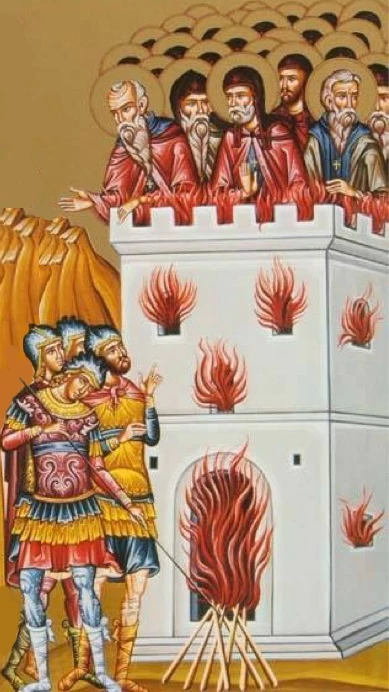
Athonite Monastic Martyrs
Twenty-Six Venerable Martyrs of Zographou
Abbot Thomas and twenty-five companions who remained faithful to Orthodoxy and died in their monastery tower.
Core account checked against Orthodox Church in America — Twenty-Six Monastic Martyrs of Zographou. Additional ecclesiastical references appear below.
Life and Witness
The Empire and the Union of Lyons
In 1204, the Fourth Crusade captured and devastated Constantinople. The Byzantine Empire was restored in the city in 1261 under Emperor Michael VIII Palaiologos, but restoration did not bring security.
The empire faced political and military threats from several directions. Among the most serious was the ambition of Charles of Anjou, whose power in southern Italy carried the possibility of a campaign against Byzantium.
Michael VIII had reason to seek allies. An agreement with Rome might weaken the danger from the West and give the restored empire room to breathe.
But a policy that looked like diplomacy at court could appear very different to Christians concerned with the Church’s teaching and authority.
The Second Council of Lyons met in 1274. Michael VIII supported a union between the Byzantine Church and the Church of Rome, hoping that reconciliation might also serve the empire’s political needs.
Patriarch John XI Bekkos supported the union. Yet many Orthodox Christians rejected its terms, fearing that agreement required acceptance of teachings and practices they believed contradicted the faith handed down to them.
The controversy involved papal primacy, the addition of the Filioque to the Creed, and other questions of ecclesiastical authority and worship.
For the Athonite monks, these were not simply matters of ceremony. They touched the Creed, the life of the Church, and fidelity to the Fathers.
Mount Athos became a center of resistance to the union policy. Its monasteries stood far from the imperial court, but the monks believed that distance did not release them from speaking about the faith.
A political agreement could promise safety. It could not, in their view, decide what the Church was permitted to confess.
Athonite monks addressed Michael VIII and urged him to abandon the policy. Their appeal challenged the commemoration of the Pope, papal claims, the Filioque, and Latin Eucharistic practices.
They begged the emperor to remain within the teaching received from the Fathers. Their concern was not hatred of another people, but fear that political necessity was being made a measure of doctrine.
Zographou and Abbot Thomas
The story narrows from an empire to Zographou Monastery, a Bulgarian and Slavic monastic community on Mount Athos.
Like other Athonite houses, Zographou’s life was shaped by prayer, fasting, the Divine Liturgy, obedience, and work. Manuscripts were copied; food was prepared; paths and buildings were maintained.
The surviving accounts preserve names, but offer little about the individual lives behind them. We do not know their childhoods, their private thoughts, or what each man said in his final hours.
That silence matters. Their story does not need invented biographies to make their choice human.
The leading named figure is Abbot Thomas. He is remembered as the head of the community who remained with the martyrs.
The sources give us no reliable portrait of his private character. What they preserve is his place in this crisis: the abbot standing among the brethren when the community faced a choice.
A later Athonite tradition connects the approaching danger with the Akathist Icon of the Mother of God.
The tradition tells of an elderly monk praying the Akathist before the icon at a vineyard or isolated monastic dependency. There, he received a warning that danger was coming to Zographou.
In this account, the monk was instructed to warn the brethren. He hurried toward the monastery, carrying the urgency of what he had heard.
When he arrived, the icon was already there. The story is preserved as monastic tradition, not as an independently established detail of secular history.
The scene needs no spectacle. Its force lies in the contrast: a community at prayer, an unexpected warning, and the knowledge that events outside the monastery are closing in.
The Twenty-Six Who Remained
The brethren learned that danger was approaching. According to the hagiographical tradition, they were not all compelled to stay. Those who wished to leave could do so.
The majority departed. Their departure is not remembered here as cowardice. The tradition does not ask us to condemn those who chose to withdraw from a danger they could not overcome.
Then came the decision that gives the story its name. Twenty-six remained, led by Abbot Thomas.
They were not soldiers preparing to defend a fortress. They were monks and companions who chose not to abandon what they understood as the Orthodox faith.
Orthodox accounts preserve twenty-two names and record four additional companions whose names are not known. Some accounts describe those unnamed companions as laymen or monastery workers.
The names remembered include Abbot Thomas, Barsanuphius, Cyril, Micah, Simon, Hilarion, and two men named James.
The list continues with Job, Cyprian, Sabbas, Martinian, Cosmas, Sergius, Menas, Joasaph, Joannicius, Paul, Anthony, Euthymius, and Dometius.
Parthenius is also named. Four companions remain unnamed in the record; their identities should not be supplied by guesswork.
The Date and the Demand
The precise year of the martyrdom is not settled. Orthodox sources preserve different dates for the event, placing it in the closing years of the thirteenth-century conflict; the Church commemorates the martyrs on October 10.
The uncertainty does not erase the central account: the monastery was threatened, and twenty-six people remained.
According to Orthodox accounts, armed men associated with the enforcement of the Union policy approached Zographou. The surviving tradition does not establish every detail of their force or identify a commander.
The attackers reached the monastery and demanded that the brethren accept the Union. The exact words are preserved through tradition, not a verifiable transcript.
The answer attributed to the martyrs is simple: they would remain faithful to the teaching they had received.
The historical stakes had already been made clear by years of dispute.
The men in the monastery had heard the demand. They understood what refusal could bring. They did not accept the terms.
Prayer in the Burning Tower
Then the attackers set the tower on fire, according to the Orthodox tradition. Smoke rose around the stone structure as flames caught in its wooden parts.
The scene is not one of combat. The men inside had no weapons, and the account does not make them warriors.
According to the tradition, they continued praying and singing hymns to the Mother of God. Their final resistance was not a weapon or a curse. It was prayer.
The flames consumed the tower. The twenty-six who had remained died there.
The Church remembers them not as soldiers defeated in a siege, but as martyrs who refused to surrender the faith they believed they had received from the Fathers.
Their martyrdom belongs to a wider conflict between imperial policy and religious conviction. Yet the story’s meaning does not depend on claiming that they changed the course of an empire.
It rests first on what they chose when the demand reached their monastery.
The Icon and the Monastery’s Memory
The Union of Lyons did not achieve lasting acceptance within Byzantium. Michael VIII died in 1282, and the union policy collapsed soon afterward under his successor.
The martyrs did not alone bring about that political change. Their story belongs to the resistance of many Orthodox Christians, among them the communities of Mount Athos.
For Zographou, memory also turned toward the Akathist Icon of the Mother of God. Monastic tradition relates that the icon was preserved and became one of the sacred treasures associated with the martyrs.
The icon’s connection to the warning and to the martyrs has remained part of Zographou’s spiritual memory. It is presented as a tradition of the monastery, not as proof offered by modern historical investigation.
A later monastery tradition records that, during an all-night vigil in 1873, witnesses saw a brilliant fiery pillar above the church.
That account belongs to the later devotional memory of the community. It should not overshadow the central event, or be mistaken for a scientifically verified occurrence.
The tower, the fire, and the choice of the twenty-six remain the heart of the commemoration.
Feast and Orthodox Witness
The martyrs’ story is not a judgment on Christians today. It belongs to a specific thirteenth-century controversy, when questions of authority, the Creed, and the limits of political compromise divided the Church.
Many Orthodox Christians believed the terms of union compromised essential parts of the faith they had received. The Zographou martyrs are remembered within that conviction.
An emperor had hoped union could protect an empire. The monks believed no political calculation could justify surrendering the faith entrusted to them.
Most of the community left. Twenty-six remained. The tower became their place of martyrdom.
Commemoration and Sources
The Church commemorates the Twenty-Six Venerable Martyrs of Zographou on October 10. The OCA account also records a September 22 commemoration. Its October account gives 1284 and notes 1276 as another transmitted year; the date of the event should therefore not be treated as settled. The monastery’s liturgical remembrance preserves the names and witness of the martyrs despite this chronological uncertainty.
Biographical information on this page is based exclusively on the Orthodox ecclesiastical sources listed below.
Orthodox Church in America — Twenty-Six Monastic Martyrs of Zographou