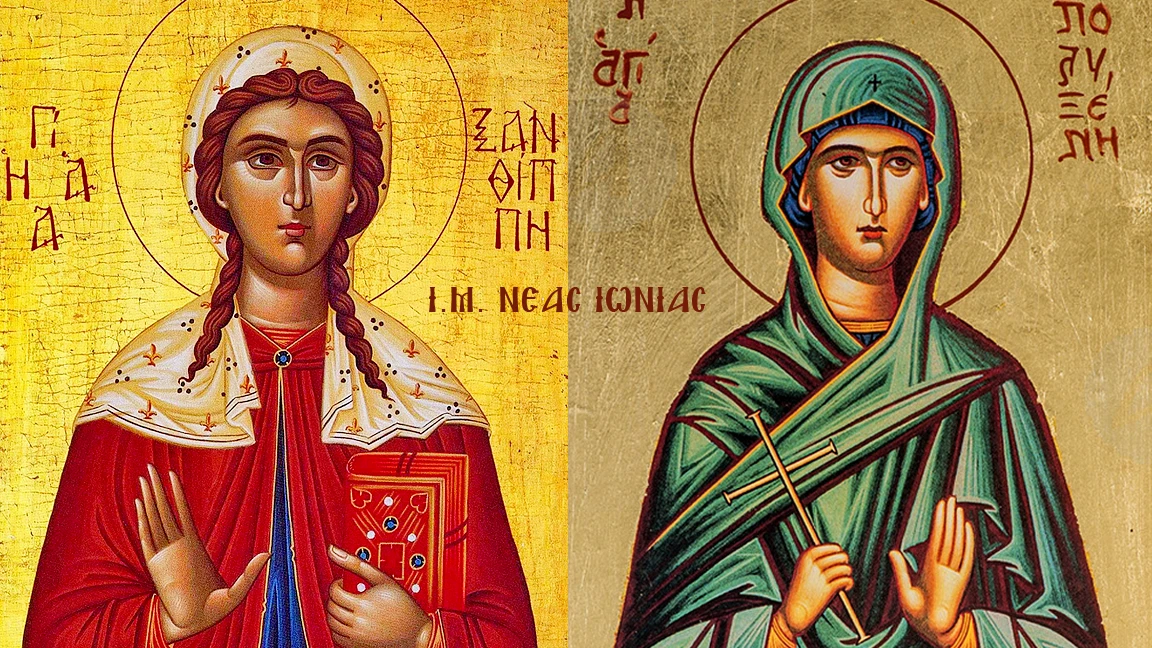
Righteous Women of the Apostolic Age
Saints Xanthippe and Polyxene of Spain
✓ Comprehensive Orthodox source review completed
Sisters and disciples of the Apostles who carried the Gospel through suffering, Baptism and decades of missionary service.
Core account checked against Orthodox Church in America — Saints Xanthippe and Polyxene of Spain, Orthodox Church in America — Troparion and Kontakion, Mystagogy Resource Center — Saints Xanthippe and Polyxene as Models for Our Lives. Additional ecclesiastical references appear below.
Life and Witness
Sisters in Apostolic Spain
Saints Xanthippe and Polyxene were sisters from Spain who lived in the apostolic age. The received Orthodox life says that they heard the preaching of the Apostle Paul when the Gospel first reached their land. Xanthippe and her husband Probus accepted the Christian faith, while Polyxene's path to Baptism began through a violent separation from her home.
Romans 15 records Saint Paul's intention to travel to Spain, but the New Testament does not narrate the sisters' lives. Their story belongs to the Church's later hagiographical tradition and must therefore be presented as such rather than inserted into Acts as an unrecorded biblical episode.
Polyxene's Abduction and Divine Protection
Before she had received Baptism, Polyxene was abducted by a man who carried her away by ship toward the eastern Mediterranean. The ecclesiastical tradition emphasizes that God's grace preserved her from violation during the journey. Her suffering is not romanticized: abduction and coercion remain grave evils, while the saint's dignity is never defined by the violence attempted against her.
Expanded forms of the narrative contain a long sequence of journeys, dangers and rescues. The principal Orthodox calendars preserve the stable outline without requiring every episode to be treated as equally early or historically documented.
The Apostles Philip and Andrew
In Greece, Polyxene heard the preaching of the Apostle Philip and sought protection among Christians. She was hidden at Patras in Achaia, where she encountered the Apostle Andrew the First-Called. Andrew baptized Polyxene together with Rebecca, a Jewish servant who became her faithful companion.
Polyxene witnessed Saint Andrew's apostolic work, miracles and final martyrdom at Patras. The tradition places her near his cross, learning from his patience and confession. Her life is thus remembered not only as escape from danger but as formation in the faith through the apostolic Church.
Return to Spain and Mission
After Saint Andrew's martyrdom, Polyxene returned to Spain with Rebecca and the Apostle Onesimus. Reunited with Xanthippe, she devoted herself to the proclamation of Christ. The sisters instructed women and families, strengthened new believers and helped many pagans enter the Church.
The Orthodox account says that Polyxene labored for approximately forty years and that Xanthippe preached especially in Toledo. Their mission demonstrates that women were active witnesses to the Gospel from the apostolic age, serving through teaching, hospitality, courage and holy example.
Repose, Feast and Hymnography
Saint Polyxene is traditionally said to have reposed around the year 109 after preserving her virginity and completing decades of missionary labor. The Orthodox Church commemorates Xanthippe and Polyxene on September 23; in some Slavic calendars their commemoration occurs on September 24.
The troparion praises Polyxene for receiving the light of faith and glorifying Christ through a blameless life. The kontakion honors both sisters for passing through many lands and receiving unfading crowns from the Savior. Their title is that of righteous or venerable women, not martyrs.
Source-Critical Summary
The common Orthodox core is that Xanthippe and Polyxene were sisters from Spain in the apostolic age; Xanthippe and Probus accepted the faith; Polyxene was abducted but preserved, heard apostolic preaching, was baptized by Saint Andrew with Rebecca, returned to Spain and joined her sister in missionary work.
The detailed itinerary, dialogues, repeated abductions, miraculous animals and some named companions derive from expanded hagiographical forms often known as the Acts of Xanthippe, Polyxene and Rebecca. The article retains the Church's received life while distinguishing its stable liturgical summary from the most elaborate narrative variants.
Historical Record and Ecclesiastical Tradition
The sisters' apostolic-age mission is received from the Orthodox Synaxarion rather than the canonical Acts of the Apostles. The stable liturgical account is distinguished from expanded episodes in the Acts of Xanthippe, Polyxene and Rebecca, and the differing September 23/24 usages are stated explicitly.
Biographical information on this page is based exclusively on the Orthodox ecclesiastical sources listed below.
Orthodox Church in America — Saints Xanthippe and Polyxene of SpainOrthodox Church in America — Troparion and KontakionMystagogy Resource Center — Saints Xanthippe and Polyxene as Models for Our LivesMonastic Republic — Orthodox SynaxarionOrthodox Christianity — Saints Xanthippe and Polyxene