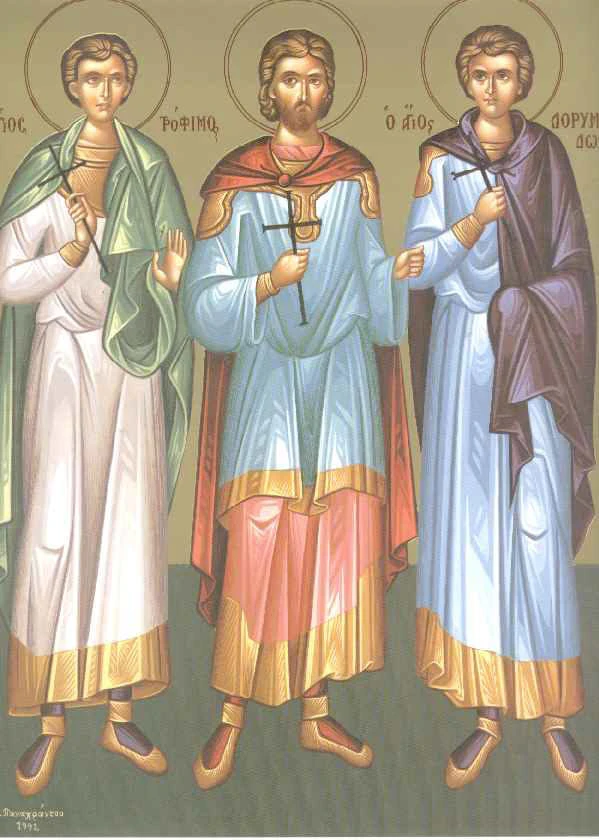
Martyrs of Antioch and Synnada
Holy Martyrs Trophimus, Sabbatius and Dorymedon
✓ Comprehensive Orthodox source review completed
Three confessors whose steadfast witness joined Antioch and Synnada, where the wild beasts would not harm them.
Core account checked against Orthodox Church in America — Martyrs Trophimus, Sabbatius and Dorymedon of Synnada, Orthodox Church in America — Troparion and Kontakion, Monastic Republic — Orthodox Synaxarion. Additional ecclesiastical references appear below.
Life and Witness
Antioch under Emperor Probus
The Holy Martyrs Trophimus, Sabbatius and Dorymedon are commemorated together by the Orthodox Church on September 19. The received ecclesiastical account places their contest during the reign of the Roman emperor Probus, between 276 and 282. Trophimus and Sabbatius came to Antioch while a public festival was being celebrated with sacrifices, wine and conduct that the Synaxarion describes as disorderly and impious.
The two Christians grieved over the idolatry and prayed that those who had gone astray might be led to salvation. They did not join the sacrifice. Their refusal drew attention, and they were arrested and brought before the governor. The principal Orthodox sources do not preserve reliable information about their birthplaces, families or earlier occupations; those gaps are left open rather than filled with conjecture.
The Confession of Trophimus and Sabbatius
Before the authorities, Trophimus and Sabbatius openly confessed Christ and refused to renounce Him. Their witness belongs to the Church's martyrological tradition, not to a surviving Roman court transcript. The accounts agree that the two were subjected to severe torture and that Sabbatius died from his wounds in Antioch.
Trophimus survived this first stage of the persecution and was sent under guard to Synnada in Phrygia. The OCA and related Synaxaria say that he was forced to walk for three days wearing iron sandals driven through with sharp nails. During his suffering he repeated the words of Psalm 33/34: many are the afflictions of the righteous, but the Lord delivers them from them all.
Dorymedon, the Secret Christian
At Synnada, Trophimus was imprisoned and subjected to further torments by the governor Dionysius. Dorymedon, a senator or councilor and a Christian who had not yet confessed publicly, came to the prison. He washed and bound the martyr's wounds and served him with compassion.
Dorymedon's faith was revealed when he refused to participate in a festival honoring Castor and Pollux. Asked to explain his absence, he declared that he was a Christian and would not worship what the Church regarded as demons. His act joins mercy toward an imprisoned brother with public confession: service prepared the way for his own martyrdom.
The Arena and the Wild Beasts
Trophimus and Dorymedon were condemned to be devoured by wild beasts. The common Orthodox account says that the animals did not harm them. Expanded retellings describe a bear, leopard or lioness approaching the martyrs without attacking; because the lists are not identical in every witness, the article retains the shared fact of their deliverance without insisting on one zoological sequence.
The title of the accompanying video speaks of a miracle that terrified Rome. The ecclesiastical sources locate the arena episode at Synnada rather than in the city of Rome. 'Rome' in such a title can only mean the Roman imperial world; it must not be read as a geographical claim that their contest occurred in Rome.
Martyrdom by the Sword
When the beasts would not kill the saints, Trophimus and Dorymedon were sentenced to death by the sword. They were beheaded and completed their witness to Christ. Sabbatius had already died under torture in Antioch, yet the Church unites the three men in one commemoration because their confession and suffering belong to the same sacred narrative.
Orthodox worship calls their death a victory, not because suffering is good in itself, but because coercion failed to separate them from Christ. Their feast condemns idolatrous compulsion and cruelty while proclaiming courage, mercy and fidelity.
Hymnography and Iconography
The troparion calls the three saints a trinity of martyrs glorified by the God praised in Trinity. The kontakion honors Trophimus and his fellow sufferers as steadfast spiritual athletes and asks their intercession. These hymns are part of the Church's liturgical reception and provide the proper theological interpretation of the narrative.
Orthodox icons usually portray the three together as martyrs holding crosses. Historical iconographic witnesses include their representation in the Menologion of Basil II. The cross in their hands signifies confession of the crucified and risen Christ; it is not a decoration celebrating violence.
Source-Critical Summary
The convergent Orthodox core is clear: Trophimus and Sabbatius encountered a pagan festival at Antioch, refused sacrifice, confessed Christ and were tortured; Sabbatius died there; Trophimus was transferred to Synnada; Dorymedon ministered to him and publicly confessed the faith; Trophimus and Dorymedon were preserved from wild beasts and finally beheaded; the three are commemorated on September 19.
The precise wording of the interrogations, the full sequence of torments, the species and number of beasts, and some official titles vary among retellings. No dependable account of their childhoods, family lives, later relic translations or a catalogue of posthumous miracles is shared by the principal sources. Those details are therefore neither invented nor presented as settled history.
Historical Record and Ecclesiastical Tradition
The common Orthodox witness places Sabbatius's death at Antioch and the later contest of Trophimus and Dorymedon at Synnada. Preservation from the wild beasts and martyrdom by the sword are received Synaxarion testimony; variant lists of animals and expanded torments are not forced into false precision, and the video's reference to Rome means the Roman imperial world rather than the city of Rome.
Biographical information on this page is based exclusively on the Orthodox ecclesiastical sources listed below.
Orthodox Church in America — Martyrs Trophimus, Sabbatius and Dorymedon of SynnadaOrthodox Church in America — Troparion and KontakionMonastic Republic — Orthodox SynaxarionMystagogy Resource Center — Holy Martyrs Trophimos, Sabbatios and DorymedonThe Prologue from Ohrid — September 19St John the Forerunner Orthodox Church — Synaxarion for September 19