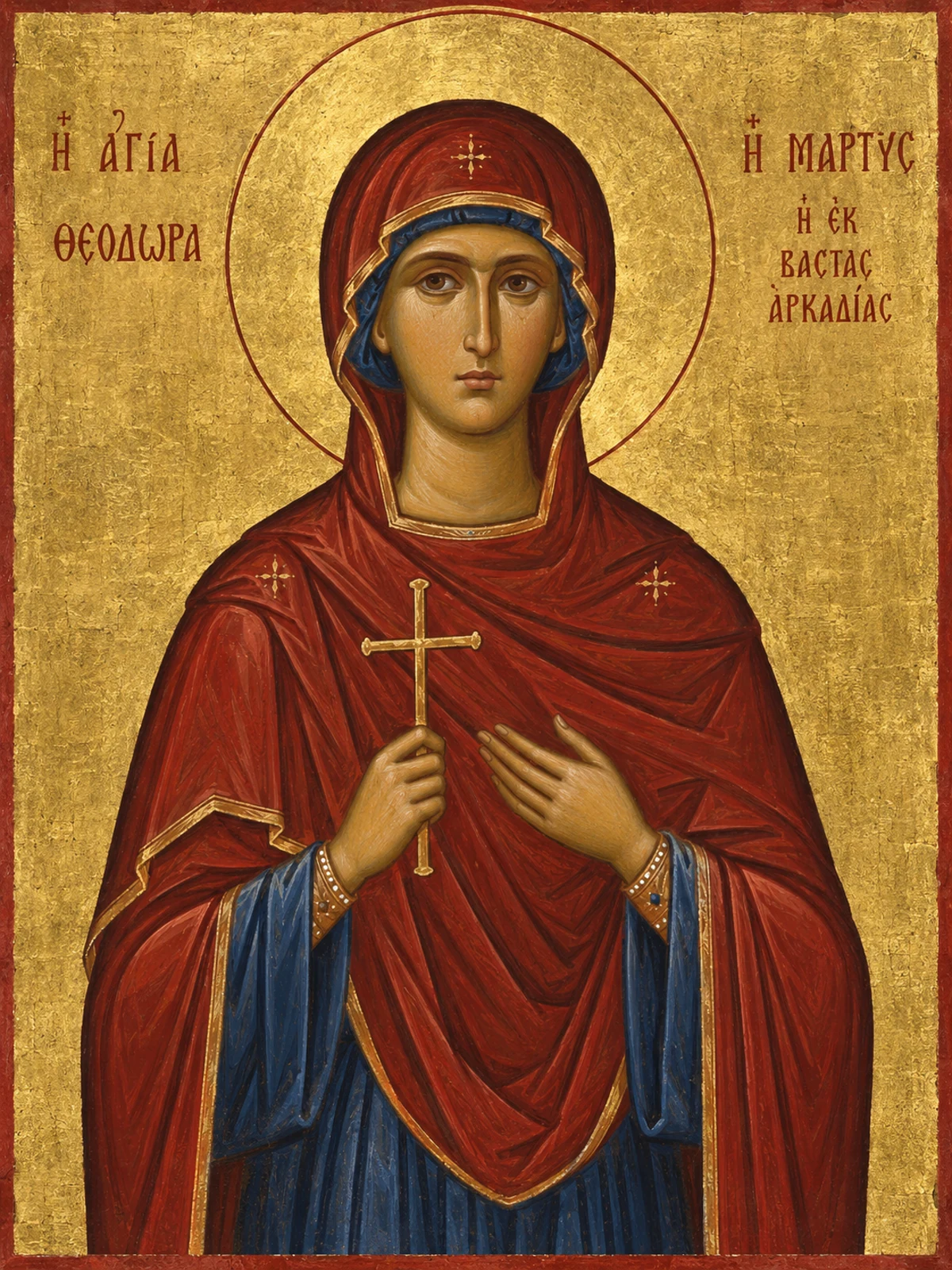
Virgin Martyr
Holy Martyr Theodora of Vasta
✓ Comprehensive Orthodox source review completed
The young woman of Arcadia who preserved her faith in Christ and whose shrine at Vasta remains one of Greece’s best-known Orthodox pilgrimage places.
Core account checked against Greek Orthodox Archdiocese of America — Saint Theodora of Vasta (September 11), OrthodoxWiki — Theodora of Vasta, Orthodox Christianity Then and Now — The Life of Saint Theodora of Vasta. Additional ecclesiastical references appear below.
Life and Witness
A Daughter of Arcadia
Holy Martyr Theodora is venerated in the Orthodox Church as a native of the region of Arcadia in the Peloponnese. The received local tradition places her earthly life during the Byzantine period, commonly in the tenth century. Because the surviving ecclesiastical accounts preserve different details concerning her family and the circumstances that led her from home, this life follows their shared witness and does not present uncertain additions as established history.
Theodora desired to remain faithful to Christ and to preserve a life of purity. According to the tradition, circumstances led her to conceal her identity beneath a soldier’s clothing and to serve under the name Theodore. Her hidden life required courage and vigilance, yet the Church remembers above all the faith that directed her choices.
Hidden Service and Christian Courage
The local account relates that every household was required either to provide a man for military service or to pay for a replacement. Because her poor Christian family had no son and could not bear the expense, Theodora cut her hair, put on a soldier’s clothing and entered service without revealing that she was a woman.
A shorter form of the tradition says that she joined the defense of her region when it was threatened. The surviving narratives do not agree in every historical detail. They agree, however, in remembering her courage, her concealed identity and the Christian faith with which she accepted danger for the sake of others.
Martyrdom and Final Prayer
The circumstances of Saint Theodora’s death are preserved in more than one local form. The common ecclesiastical memory is that she was killed while still dressed as a soldier and that only afterward was her identity revealed. Near Vasta she received the martyr’s crown.
Orthodox local tradition preserves her final prayer: that her body might become a church, her hair a forest of trees and her blood a spring to water them. The account interprets the wonders at her shrine as God’s answer to this prayer.
These wonders do not replace the central meaning of her commemoration: a Christian life completed in faith, courage and self-offering.
The Church of Saint Theodora at Vasta
A small Byzantine church dedicated to Saint Theodora stands near the village of Vasta in Arcadia. Large trees rise from its roof while their roots are not visibly exposed inside the chapel, and a stream flows beneath the building. The shrine has therefore become one of the most widely known Orthodox pilgrimage places in the Peloponnese.
Pilgrims come to venerate the saint, participate in prayer and give thanks to God. The unusual natural features of the chapel are received by the local Church in connection with Saint Theodora’s final prayer; the website presents that interpretation as ecclesiastical tradition, without inventing additional miracle stories or unverified modern testimonies.
Orthodox Veneration and Feast Day
The icon of Saint Theodora normally depicts her as a young female martyr holding the Cross of witness. Her life calls the faithful to steadfastness, repentance, purity of heart and trust in God when human judgment is unjust.
September 11 — Holy Martyr Theodora of Vasta. She must be distinguished from Venerable Theodora of Alexandria, another Orthodox saint commemorated on the same date whose life belongs to a different place and tradition.
Historical Record and Ecclesiastical Tradition
The local Church firmly venerates the martyr and her shrine at Vasta, but surviving accounts differ about her century, military disguise and exact manner of death. The page preserves the shared tradition, labels variants and does not convert the remarkable trees and spring into unsupported scientific claims.
Biographical information on this page is based exclusively on the Orthodox ecclesiastical sources listed below.
Greek Orthodox Archdiocese of America — Saint Theodora of Vasta (September 11)OrthodoxWiki — Theodora of VastaOrthodox Christianity Then and Now — The Life of Saint Theodora of Vasta