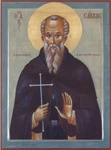
Athonite Ascetic & Wonderworker
Venerable Savvas of Vatopedi, Fool for Christ
The silent monk who hid his holiness, fled public honors and refused the patriarchal throne.
Core account checked against Holy Great Monastery of Vatopedi — Saint Savvas of Vatopedi, Fool for Christ. Additional ecclesiastical references appear below.
Life and Witness
From Thessaloniki to Mount Athos
The Life written by Saint Philotheos Kokkinos describes Stephen’s parents as devout Christians. In time, both would enter monastic life.
Stephen received a basic education and grew up with a reputation for self-control, humility, and seriousness about spiritual things.
Around the age of eighteen, Stephen left his family and the familiar life of Thessaloniki. He traveled toward Mount Athos.
The decision meant leaving security and social standing for an unfamiliar landscape of rugged coast, forest, and monastic solitude.
Stephen entered a cell belonging to Vatopedi, near Karyes, and placed himself under the guidance of an experienced Elder.
At his monastic tonsure, Stephen received a new name: Savvas. The young man from Thessaloniki began a life shaped by obedience.
Obedience and the Refusal of Ordination
His Elder was exceptionally strict. Savvas endured hunger, thirst, fasting, night vigils, and long periods standing in prayer.
The Life presents this severity not as cruelty, but as discipline accepted by a disciple who trusted his spiritual guide.
Obedience formed the monk who would later refuse emperors. Yet even among his fellow monks, Savvas’s humility soon became impossible to overlook.
They admired his life and wanted him to accept priesthood. Savvas considered himself unworthy and resisted their plans.
When the day of ordination arrived, the Life says, Savvas hid where those seeking him could not find him.
Long before he fled imperial honor, Savvas was already running from ecclesiastical honor. He would not be persuaded to step forward.
Exile, Wandering and Cyprus
Around 1308, Catalan raids brought insecurity to parts of Macedonia and the Athonite region. Savvas’s Elder and other monks moved toward Thessaloniki.
Savvas faced a choice: return to the city, where relatives and acquaintances might recognize him, or continue into uncertainty.
He feared the attention, comfort, and praise that might come from going home. Instead, he began years of wandering.
The journey carried him through Lemnos, Lesbos, Chios, Ephesus, Patmos, and other places, eventually bringing him to Cyprus.
In Cyprus, after intense prayer and tears, Savvas adopted what the Orthodox tradition calls foolishness for Christ.
This did not mean theatrical performances or comic tricks. Saint Philotheos portrays Savvas’s path as unusually quiet and restrained.
A Fool for Christ accepts misunderstanding and humiliation rather than chase reputation or human approval. Savvas’s central practice was silence.
He appeared simple and insignificant, keeping his inner life hidden. Some people pitied him; others dismissed or despised him.
The Life describes Savvas living without ordinary shelter, enduring heat and cold, fasting severely, and eating very little.
These are ascetic feats preserved in hagiography, not an invitation to imitate physical deprivation. Their meaning lies in his pursuit of prayer and humility.
Many who encountered him believed he was insane. The account says he was insulted, cursed, rejected, and sometimes physically beaten.
One episode describes Savvas entering a Latin monastery during a meal and being beaten after he was mistaken for an impostor.
Hidden Holiness and the Flight from Praise
Gradually, people began to notice his peace, endurance, and humility. The man they had treated as foolish started to inspire respect.
In Cyprus, some came to believe that this silent wanderer was a holy ascetic. The attention he feared was gathering around him.
Savvas had endured hunger, cold, mockery, and violence. What finally drove him away was praise.
When people began honoring him, he left Cyprus. For Savvas, recognition could become a greater spiritual danger than insult.
The Holy Land and Hesychast Prayer
His route led to Jerusalem and the Holy Sepulchre, then onward to Mount Sinai. Pilgrimage brought him to sacred places, but not toward public life.
The journey continued into the region beyond the Jordan, where solitude and wilderness offered another refuge from attention.
The Life describes Savvas withdrawing into deeper solitude beyond the Jordan. It speaks of bodily weakness, prolonged prayer, and spiritual struggle.
Saint Philotheos also relates that Savvas endured attacks by demons. The account presents these as trials within an ascetic life.
The same Life records encounters with Christ in divine light. It does not require a spectacular display to communicate their significance.
Saint Philotheos interprets Savvas’s experiences within the Orthodox understanding of divine illumination associated with hesychast prayer.
Hesychasm is a life of stillness and inner prayer, joined to ascetic discipline and the search for communion with God.
For Savvas, this was not an abstract idea. The Life connects his prayer, silence, and desert solitude with experiences of divine light.
Savvas entered the monastery associated with Saint Savvas the Sanctified, a different saint whose name he shared.
There, his discipline became more widely known. Monks and laypeople began seeking him, and the fame he had fled found him again.
Miracles in the Received Life
His Life even preserves accounts of wild animals becoming peaceful in his presence, including lions.
The stories are offered as signs of spiritual harmony, not as a spectacle. The narrative keeps its attention on Savvas’s quiet way of life.
Saint Philotheos records an extraordinary account from Savvas’s travels toward Damascus and Antioch. A grieving woman carried her dead child.
According to the hagiographical Life, the child was restored to life through Savvas. The account also preserves a similar miracle.
The miracle brought the possibility of recognition once more. Savvas’s pattern remained: when people began to honor him, he moved away.
His Life records no desire to build a following. The wonder was never an excuse to claim status or attention.
Crete and Constantinople
Savvas reached Crete and, according to the Life, spent about two years in remote mountain asceticism.
The account describes prayer, little sleep, illness, and isolation. These details are conveyed soberly, not as a contest of physical endurance.
His wanderings continued through Euboea, the Peloponnese, Athens, Macedonia, Thrace, and Heraclea, before he reached Constantinople.
For decades, Savvas repeatedly escaped recognition. Yet wherever he went, stories of his holiness seemed to travel ahead of him.
In Constantinople, Savvas stayed quietly at the Monastery of Saint Diomedes. His obscurity did not last.
According to the traditional Life, Patriarch Isaiah and Emperor Andronikos II Palaiologos sought him out and examined his faith.
Savvas gave a confession of Orthodox faith. Instead of bringing him lasting privacy, the encounter made his reputation stronger.
Once again, the monk faced the attention he had spent years avoiding. And once again, he left.
Return to Vatopedi
Eventually, Savvas returned to Mount Athos and to Vatopedi. His Elder had reposed, and the years of wandering had changed him.
He re-entered the life of a monastic community, not as a celebrated wonderworker, but as a brother ready to serve.
Vatopedi tradition remembers him carrying out ordinary obediences: serving in church, chanting, reading, working in the refectory, and caring for the sick.
The man whose Life recounts visions and miracles did not demand leadership. He returned to the daily work of a monk.
This return to ordinary service reveals the heart of Savvas’s humility. He did not use spiritual experiences to claim authority or escape obedience.
After years of solitude, he accepted the unremarkable tasks that held a community together. The hidden ascetic chose service again.
Peace, Hesychasm and the Patriarchal Proposal
Then the Byzantine civil war of 1341 to 1347 divided the empire and strained the Church, Constantinople, Thessaloniki, and Mount Athos.
In 1342, Athonite fathers asked Savvas to join a mission seeking peace. He did not want public involvement, but obeyed.
The Life says Savvas foresaw that the mission would not bring an immediate end to conflict. He went nonetheless.
In Constantinople, he prayed for peace and counseled reconciliation, acting as a monk and spiritual adviser, not a political strategist.
The same century saw a major controversy over hesychasm: prayer, divine grace, and the experience of uncreated light.
Savvas belonged to the spiritual world associated with Saint Gregory Palamas and the defense of hesychast life.
The Life presents Savvas as opposing anti-hesychast positions. For him, the dispute was more than a matter of argument.
His decades of silence, inner prayer, and desert solitude formed the experience his biographer understood through hesychast theology.
Emperor John VI Kantakouzenos came to value Savvas’s counsel and prayers. The monk had become respected in the highest circles of the empire.
Yet there is no need to imagine Savvas controlling policy. His influence rested in spiritual counsel, prayer, and the authority of his life.
According to the Life, the emperor put Savvas forward for election as Patriarch.
The proposal found broad support. The monk who once hid from ordination was now considered for one of the Church’s highest offices.
The Life says Savvas persistently refused. The emperor himself reportedly came with his entourage to persuade him, and preparations had advanced.
Decades earlier, Savvas had hidden to avoid becoming a priest. Now an emperor asked him to become Patriarch. His answer remained no.
Repose and the Life by Saint Philotheos
In his final years, tradition places Savvas in relative seclusion at the Monastery of Chora in Constantinople.
He continued in prayer and humility. The Life says he foresaw his approaching death and spoke with a disciple about humility.
Savvas reposed peacefully around 1349.
The man who crossed seas, deserts, monasteries, and imperial courts ended his life away from power and turned toward God.
Saint Philotheos Kokkinos, who knew Savvas, later composed a substantial account of his Life. He also gathered testimony from people who had known the monk.
The account drew on information from ascetics and a close disciple of Savvas, and survives in multiple medieval manuscripts.
This makes the Life unusually substantial for a medieval saint. It gives us a detailed portrait from a near-contemporary who admired Savvas.
That closeness helps explain the richness of the tradition, while extraordinary events remain accounts recorded by the hagiographer.
The Question of Saint Eudokimos
In October 1840, work in the old cemetery or ossuary at Vatopedi uncovered fragrant monastic remains. The monk’s original identity was unknown.
The relics came to be associated with the name Eudokimos, remembered as Saint Eudokimos the Newly-Revealed of Vatopedi.
A later Athonite tradition raised a remarkable possibility: could the unknown relics venerated as Saint Eudokimos have belonged to Savvas?
The Orthodox Synaxarion preserves traditions behind this suggestion, including an identification attributed to the ascetic Iakovos.
Elder Daniel of Katounakia later preserved a tradition involving an appearance attributed to Savvas. But the identification remains a tradition, not established historical certainty.
The possibility is powerful precisely because Savvas spent his life trying to hide his identity.
Feast Days and Veneration
Saint Savvas is commemorated on October 11, and Vatopedi also honors him on June 15. The monastery’s published Synaxarion records his remembrance among the Vatopedi saints on July 10. These observances belong to his ecclesiastical veneration and should not be confused with the October 5 commemoration of Saint Eudokimos.
The account of his miracles and divine illumination is transmitted through Orthodox hagiography, above all the Life associated with Saint Philotheos Kokkinos. The saint’s enduring witness is humility expressed through prayer, obedience and service. He never became Patriarch; the proposed identification with the relics of Saint Eudokimos remains unproven.
Biographical information on this page is based exclusively on the Orthodox ecclesiastical sources listed below.
Holy Great Monastery of Vatopedi — Saint Savvas of Vatopedi, Fool for Christ