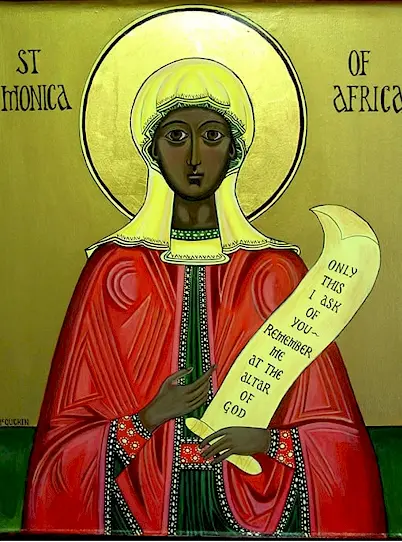
Righteous Mother
Saint Monica
✓ Comprehensive Orthodox source review completed
A mother whose patient prayer and tears accompanied Saint Augustine's return to faith.
Core account checked against Greek Orthodox Archdiocese of America — Online Chapel: Saints and Feasts. Additional ecclesiastical references appear below.
Life and Witness
Life and Historical Setting
Monica lived with patient faith through deep family trials. Her persistent prayers accompanied the long conversion of her son Augustine, who later became a bishop and one of the great teachers of the Church.
Miracles, Relics and Places of Veneration
Ostia is the place of her repose according to Saint Augustine's Confessions. Later translations of her relics belong chiefly to Western history; Orthodox veneration centers on her patient prayer, Christian motherhood and the conversion of her household.
Iconography and Spiritual Meaning
The saint's icon presents a transfigured human person whose holiness is the gift of God. The spiritual lesson is drawn from the received life and worship of the Church, not from invented moral anecdotes.
Feast Day
May 4 — Saint Monica.
From the Orthodox Synaxarion
The Orthodox commemoration of Saint Monica honors perseverance in prayer rather than a single dramatic act. Her patient faith through family sorrow and her tears for Augustine became a lasting witness to maternal intercession and hope in God.
Historical Record and Ecclesiastical Tradition
Saint Augustine's Confessions, especially Book IX, is the principal near-contemporary witness to Monica's prayer, perseverance, character, final conversations and death at Ostia. Later devotional summaries are measured against Augustine's testimony, and her veneration in the Orthodox Church is presented without importing unsupported sayings or treating parental prayer as a mechanism that overrides another person's freedom.
Biographical information on this page is based exclusively on the Orthodox ecclesiastical sources listed below.
Greek Orthodox Archdiocese of America — Online Chapel: Saints and Feasts