New Martyr
Holy New Martyr Lygeri of Chios
✓ Comprehensive Orthodox source review completed
The young woman of Chios who refused wealth and power, remained faithful to Christ and received the crown of martyrdom in 1822.
Core account checked against Holy Metropolis of Nea Ionia and Philadelphia — Holy New Martyr Lygeri of Chios, Pemptousia — Saint Lygeri, the New Martyr from Anavatos of Chios, VEMA — Holy New Martyr Lygeri of Chios. Additional ecclesiastical references appear below.
Life and Witness
Child of Anavatos
Holy New Martyr Lygeri was born at the beginning of the nineteenth century, traditionally about 1804, in Anavatos on the island of Chios. Her village was a fortified settlement built upon a steep rock in the interior of the island. Her parents were ordinary islanders, but the ecclesiastical accounts emphasize their firm faith in God and the Orthodox formation they gave their daughter.
Lygeri grew up within the worship and customs of the Church. The sources remember her for both outward beauty and inward modesty. These details are not preserved to turn her life into a romantic legend: in the synaxarial narrative, her beauty becomes the occasion of a trial in which her freedom, chastity and confession of Christ are placed under violent pressure.
Chios under Ottoman Rule
The saint lived when Chios remained under Ottoman rule and Christians could be exposed to severe inequality and arbitrary power. Her martyrdom is usually dated to 1822, the year of the catastrophic Massacre of Chios, although some modern local researchers have questioned the exact year because the surviving tradition connects her death with a peaceful September feast gathering at Anavatos. The Church securely commemorates the event on September 6; the precise civil year should therefore be presented with appropriate historical caution.
This wider setting helps explain the unequal encounter preserved in her life. The man who desired Lygeri possessed political and military power, while she was a young Christian woman from a village family. Her refusal was consequently more than the rejection of an unwanted proposal: it exposed her to the force of an authority that expected obedience.
The Demand of the Pasha
According to the Orthodox accounts, an Ottoman pasha or local ruler saw Lygeri and ordered that she be brought to him. He offered wealth, honor and an elevated position if she would consent to belong to him. Some Greek accounts describe the demand as marriage to a Muslim ruler; the English tradition also speaks of an attempt to take her as his lover. Both forms of the narrative agree on the essential point: acceptance would have violated her Christian conscience and personal chastity.
Lygeri rejected the promises. The ruler did not treat her answer as the free decision of another person, and his men returned with pressure and threats. She remained steadfast. The Church honors her refusal not as hostility toward another people, but as fidelity to Christ in the face of coercion and as a defense of the God-given dignity of the human person.
The Feast at Anavatos
The received tradition places the final event on September 6, when the Christians of Anavatos were keeping the feast of the Miracle of the Archangel Michael at Chonae. The ruler’s attendants entered the village amid the gathering and seized Lygeri by force. They intended to carry her to the ruler, who was said to be waiting in the direction of the western coast near Elinda.
The coincidence with the feast is important in the local memory. While the faithful celebrated the Archangel’s protection and the preservation of the holy shrine at Chonae, a young Christian of Anavatos was called to preserve the living temple of her own body and soul from forced surrender.
Her Final Confession and Martyrdom
As the armed men dragged her away, Lygeri resisted and wrapped her arms firmly around a tree. The ecclesiastical narrative preserves the meaning of her last confession: she had been born a Christian and would die a Christian; she would not deny Christ. Unable to make her release the tree or continue with them, one of the attendants beheaded her.
The martyr was still a young woman, traditionally eighteen years old if the date 1804 is accepted. Her execution transformed what the powerful intended as an act of domination into a public confession of freedom in Christ. Orthodox veneration does not glorify violence or the destruction of life. It glorifies God, whose grace enables a vulnerable person to remain faithful when every earthly advantage and even survival are placed against the truth of conscience.
Some versions add that the executioner carried her head toward Elinda as proof that the order had been fulfilled. The precise later history of her body and relics is not securely documented in the principal ecclesiastical sources consulted for this page, so no present location of relics is asserted here.
Recognition and Veneration in Chios
Saint Lygeri belongs to the company of the New Martyrs—Orthodox Christians who confessed Christ and suffered death under Ottoman rule. Her memory was preserved especially by the faithful of Chios and her native Anavatos. She has also been included among the saints of Chios and depicted in their official collective icon, which is kept in the Church of Saint George at the Castle of Chios.
On July 18, 2021, Metropolitan Markos of Chios, Psara and Oinousses consecrated a sacred side chapel in her honor within the Church of the Holy Archangels at Anavatos. This documented act of ecclesiastical veneration gives pilgrims a concrete place in her native village where her confession can be remembered liturgically.
Miracles and Intercession
The Orthodox sources used for this article center on Lygeri’s martyrdom, her unwavering confession and her local veneration. They do not provide a responsibly documented catalogue of individual posthumous miracles with names, dates and ecclesiastical investigation. For that reason, this page does not invent miracle stories or present unverified reports as established fact.
The Church nevertheless understands every saint’s intercession within the one saving work of Christ. The faithful may ask Saint Lygeri to pray for those facing coercion, abuse, threats against their faith or violations of their freedom and dignity. Any grace or healing is attributed to God; the martyr is honored as His servant and intercessor.
Iconography and Spiritual Meaning
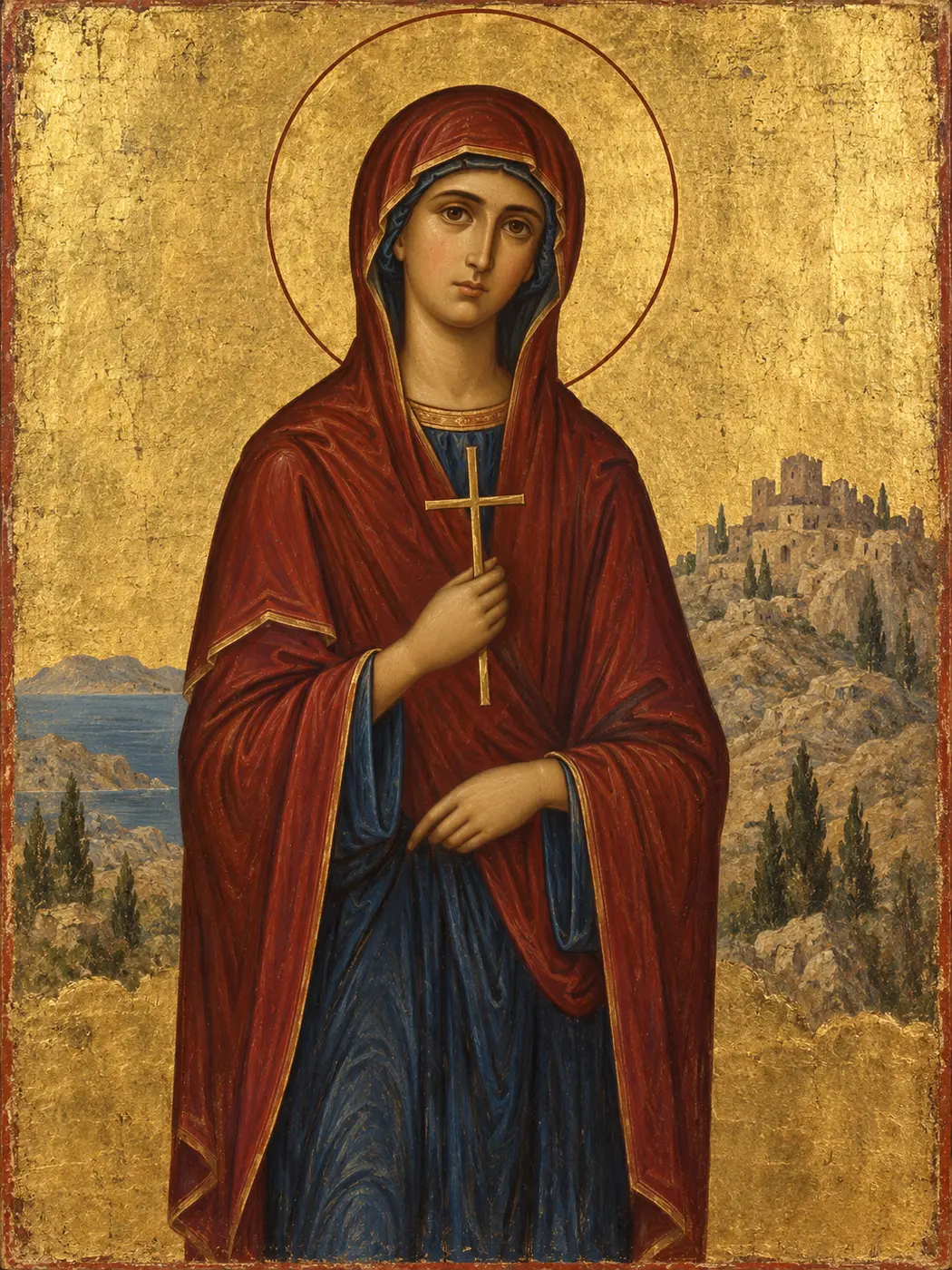
In Orthodox iconography Saint Lygeri is shown as a youthful woman bearing the cross of martyrdom. The cross identifies both her manner of witness and the victory of Christ in which the martyrs share. Her icon is not intended as a photographic reconstruction. It is an ecclesiastical confession that the young woman who was condemned on earth lives in the communion of the saints.
Her life speaks with particular force about Christian freedom. Wealth, position and fear could not purchase her conscience. Her courage also teaches that chastity is inseparable from freedom and love: it cannot be imposed by an aggressor or exchanged for worldly advantage. The Church remembers Lygeri because she entrusted her whole person to Christ and refused to let violence define the final meaning of her life.
Feast Day
September 6 — Holy New Martyr Lygeri of Chios.
From the Orthodox Synaxarion
The ecclesiastical testimony concerning the New Martyr Lygeri preserves her final confession that she had been born a Christian and would die a Christian. The Church therefore honors her steadfastness as a youthful but complete offering of fidelity to Christ.
Historical Record and Ecclesiastical Tradition
The New Martyr's identity, origin at Anavatos and nineteenth-century confession are drawn primarily from Chian and metropolitan ecclesiastical testimony. Because sources vary and are limited, uncertain family details and later miracle stories are omitted unless the responsible local Church records them.
Biographical information on this page is based exclusively on the Orthodox ecclesiastical sources listed below.
Holy Metropolis of Nea Ionia and Philadelphia — Holy New Martyr Lygeri of ChiosPemptousia — Saint Lygeri, the New Martyr from Anavatos of ChiosVEMA — Holy New Martyr Lygeri of ChiosOrthodox Synaxarion (Saint.gr) — Saint Lygeri the New Martyr of ChiosHoly Monastery of Pantokrator — Saint Lygeri the New Martyr of Chios