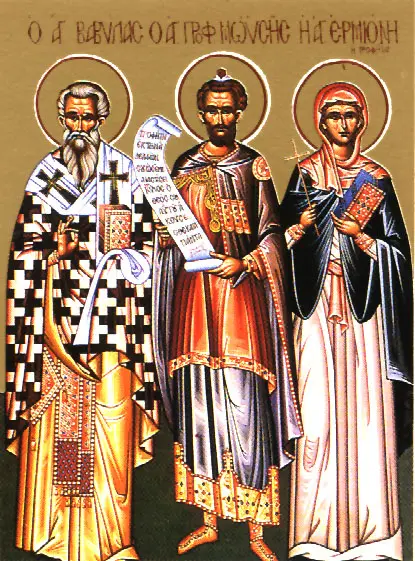
Virgin Martyr & Unmercenary Healer
Saint Hermione
✓ Comprehensive Orthodox source review completed
Daughter of Saint Philip the Deacon, prophetess and healer who confessed Christ with courage before the Roman emperors.
Core account checked against The Acts of the Apostles 21:8–9 — Philip the Evangelist and his four prophetic daughters, Orthodox Church in America — Martyr Hermione, Daughter of Saint Philip the Deacon, Mystagogy — Synaxarion of Saint Hermione, Daughter of the Apostle Philip. Additional ecclesiastical references appear below.
Life and Witness
A Daughter of the Apostolic Church
Saint Hermione belonged to the first generation of Christians after the holy Apostles. She was one of the four unmarried daughters of Saint Philip the Evangelist and Deacon, one of the Seven chosen by the Church in Jerusalem for the ministry of charity. The Acts of the Apostles records that Philip lived at Caesarea and that all four of his daughters prophesied.
Holy Scripture does not provide their individual names, but Orthodox ecclesiastical tradition identifies Hermione among them. Her prophetic gift was not fortune-telling or private speculation. In the life of the early Church, prophecy meant a grace of the Holy Spirit through which the truth of God was proclaimed for repentance, consolation and the building up of the faithful.
The Journey to Ephesus
Desiring the blessing and instruction of Saint John the Theologian, Hermione and her sister Eutychis travelled toward Ephesus. They learned that the Apostle had already reposed. Rather than abandon their purpose, they continued their spiritual search and met the holy Petronius, remembered in the sources as a disciple within the apostolic tradition. The sisters placed themselves under his guidance and imitated his life of prayer and service.
Ephesus was one of the most important centers of early Christianity, sanctified by the preaching of the Apostles and especially associated with Saint John. Within this environment Hermione united the gift of prophecy with practical care for people who suffered in soul and body.
Physician and Holy Unmercenary Healer
The Orthodox accounts say that Hermione learned the healing arts and used this knowledge diligently. She treated the sick without discrimination and without seeking payment. When ordinary medical help was insufficient, she invoked the name of Christ and healings took place through her prayer. For this reason, the Church numbers her among the holy Unmercenary Physicians.
Her ministry did not set medicine against faith. She cared for physical illness through the knowledge available to her and for spiritual illness through proclamation, repentance and prayer. Orthodox teaching attributes every true healing to Christ, the Physician of souls and bodies; the saint is His servant, never an independent source of supernatural power.
After her first trial, Hermione established a hospice or house of hospitality at Ephesus. There strangers, the poor and the sick could receive care. This ministry is sometimes described today as an early Christian hospital, but the ancient term is better understood as a combined place of hospitality, nursing, prayer and spiritual refuge rather than a modern medical institution.
Before Emperor Trajan
Hermione’s reputation spread through Ephesus and the surrounding region. When Emperor Trajan was travelling east for his campaign against the Parthians, he heard of her prophetic gift and summoned her. He wanted her to disclose the outcome of his expedition. The saint foretold that he would prevail in the war and that Hadrian would succeed him.
When Trajan learned that she was a Christian, he attempted to persuade her to deny Christ. Hermione confessed her faith openly. The emperor then ordered her to be struck repeatedly in the face for several hours. During the suffering, the Lord comforted her in a vision, appearing in the form of her spiritual guide Petronius and presiding over the judgment. Seeing that torture could not break her confession, Trajan released her.
Hermione returned to her ministry. She continued proclaiming the Gospel, healing the sick and caring for those who came to the hospice. Her release was not an escape from Christian witness but an opportunity to extend it through works of mercy.
The Trial under Hadrian
After Hadrian became emperor, Hermione was arrested again because she would not abandon the Christian faith. She was beaten severely, and the soles of her feet were pierced with nails. The authorities then cast her into a cauldron containing boiling pitch, lead and sulphur. She gave thanks to God amid the torment, and the fire was extinguished while the molten material poured away without harming her.
Hadrian approached and touched the vessel to test it, burning his own hand. Yet he remained unwilling to acknowledge the sign. The martyr was next placed naked inside a great copper vessel heated by fire. Her guardian angel extinguished the flames around her, while those standing nearby were burned. Hermione remained within as though standing upon cool, dew-covered grass, singing praise to God.
The Shattering of the Idols
The saint then allowed the emperor to believe that she was ready to sacrifice to the pagan god Heracles. She was taken into the temple, not to worship the idol, but to expose its powerlessness. Hermione prayed to the one true God. A great sound like thunder was heard, and the idols fell and shattered.
This episode is preserved in the synaxarial tradition as a confession that created objects cannot receive the worship belonging to God alone. Hermione’s action was not the use of magic against rival magic. It was prayer to Christ, whose power freed people from fear of the idols and the political authority attached to them.
The Conversion of Theodoulos and Theotimos
Two servants or executioners named Theodoulos and Theotimos were ordered to put the saint to death. In their haste they refused to allow her time to pray. Their hands immediately withered or became paralyzed. Terrified by what had happened, they fell before Hermione, confessed Christ and begged her to pray for their healing and salvation.
The saint did not seek revenge against the men sent to kill her. She prayed, and their hands were restored. The two men believed in Christ and asked that God receive them before her own departure. The Orthodox account says that their request was granted and that they completed their confession as martyrs.
Her Departure and Burial
The surviving Orthodox versions differ in the final detail of Hermione’s earthly end. The account published by the Orthodox Church in America says that she was beheaded after the conversion of the executioners. Another Greek ecclesiastical presentation says that Christ received her soul before replacement executioners arrived. Both traditions agree that she remained faithful to the end and that Christians reverently buried her body at Ephesus.
Rather than conceal this difference, the page records it openly. The Church’s veneration rests on the shared substance of the tradition: Hermione confessed Christ under two emperors, endured torture, brought her intended executioners to faith and completed her holy life in Ephesus.
Miracles and Intercession
The ancient life records healings during Hermione’s ministry, deliverance from the boiling cauldron and fiery vessel, the fall of the idols, the paralysis and restoration of the executioners’ hands, and their conversion through her prayer. These signs always direct attention to Christ and are never presented as powers belonging to Hermione apart from God.
The main ecclesiastical sources consulted do not provide a verifiable modern catalogue of named healings at a surviving shrine. Therefore, this article does not add later miracle stories without documentation. The faithful invoke Saint Hermione especially in illness, in the work of physicians and nurses, in charitable service and when courage is needed to confess the faith with mercy.
Relics, Churches and Veneration
The synaxarial tradition places her burial at Ephesus. The ancient city later suffered destruction, population movement and centuries of religious change. The sources used here do not securely identify an intact modern tomb or the present location of her complete relics, so the site makes no unsupported claim about them.
Saint Hermione is venerated throughout the Orthodox Church through the liturgical calendar, sacred hymns and icons. Although hospitals, chapels or charitable ministries may bear her name, no single universally recognized international sanctuary dedicated exclusively to her was established by the sources consulted for this article.
Iconography and Spiritual Teaching
Orthodox icons portray Hermione as a youthful virgin martyr, usually carrying the cross of witness. Medical imagery may also recall her healing ministry. Her halo confesses the grace of God manifested in her life, while the cross proclaims that mercy and martyrdom formed one undivided offering to Christ.
Her life joins gifts that are sometimes wrongly separated: knowledge and prayer, physical care and spiritual healing, prophecy and humble service, courage and forgiveness. She healed those who came to her and then healed even the men assigned to execute her. In this, Saint Hermione reveals the character of Christian witness: truth without compromise and love without retaliation.
Feast Day
September 4 — Saint Hermione, daughter of the Apostle Philip, Virgin Martyr and Unmercenary Healer.
From the Orthodox Synaxarion
The Orthodox account remembers Saint Hermione as one of the prophetic daughters of Saint Philip the Deacon. Her house of hospitality and healing expressed the apostolic union of proclamation, mercy and service freely offered in the name of Christ.
Historical Record and Ecclesiastical Tradition
Acts 21:8–9 establishes that Philip the Evangelist had four prophetic daughters but does not name them. Hermione's name, medical service, unmercenary healings and martyrdom under Trajan or Hadrian come from the Orthodox Synaxarion and are therefore distinguished from the explicit Biblical record.
Biographical information on this page is based exclusively on the Orthodox ecclesiastical sources listed below.
The Acts of the Apostles 21:8–9 — Philip the Evangelist and his four prophetic daughtersOrthodox Church in America — Martyr Hermione, Daughter of Saint Philip the DeaconMystagogy — Synaxarion of Saint Hermione, Daughter of the Apostle PhilipProtopresbyter George Papavarnavas — Saint Hermione the Prophetess as a Model for Our Lives