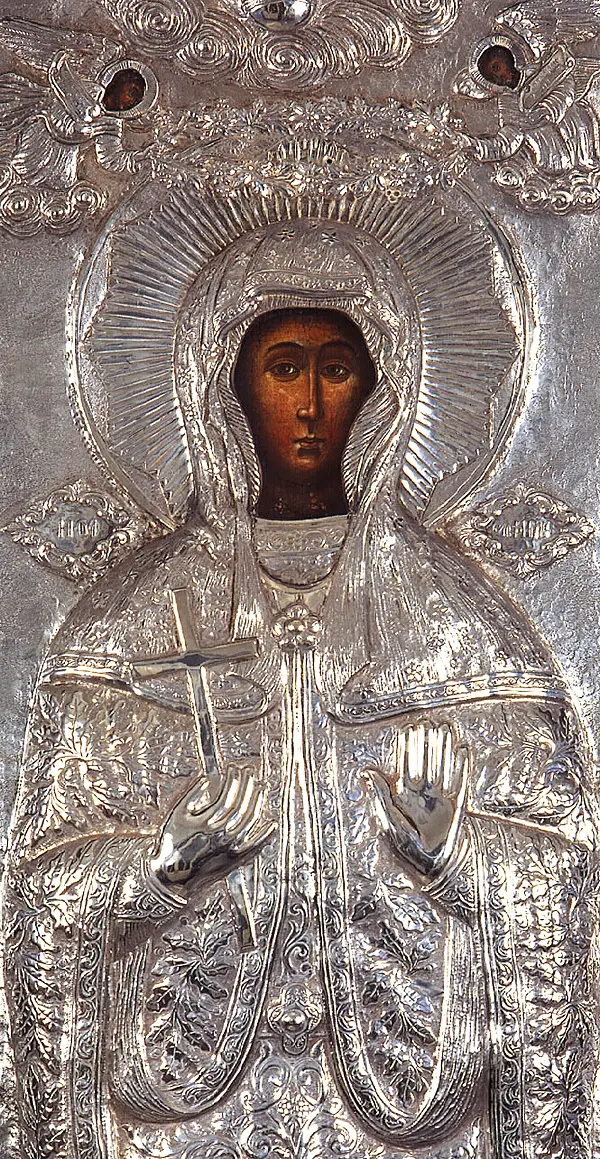
Great Martyr & Defender of Orthodoxy
Holy Great Martyr Euphemia the All-Praised
✓ Comprehensive Orthodox source review completed
The virgin martyr of Chalcedon whose steadfast confession and holy relics are bound to the memory of the Fourth Ecumenical Council.
Core account checked against Orthodox Church in America — Great Martyr Euphemia the All-Praised (September 16), Orthodox Church in America — Miracle of Saint Euphemia (July 11), Ecumenical Patriarchate — Patriarchal address for Saint Euphemia and her relics. Additional ecclesiastical references appear below.
Life and Witness
Chalcedon, Family and Christian Formation
The Holy Great Martyr Euphemia the All-Praised was born in Chalcedon, the city on the Asian shore of the Bosphorus opposite Constantinople. The Orthodox synaxarial tradition names her parents as Philophronos, a senator, and Theodosia, both Christians who formed their daughter in faith, chastity and prayer. Her martyrdom belongs to the persecution under Diocletian and is traditionally dated to the year 304.
The Church knows Euphemia principally through its received martyrological and liturgical memory. Details repeated across the Menaion, Synaxarion, the collection of Saint Dimitry of Rostov, the Prologue from Ohrid and modern official Orthodox calendars are presented here as ecclesiastical tradition; later local narratives are not treated as equal to those common witnesses.
The Forty-Nine Christians and the Festival of Ares
Priscus, the proconsul of Chalcedon, ordered the inhabitants to attend a public festival and sacrifice to Ares. Forty-nine Christians withdrew into a house and continued to worship the true God in secret. The young virgin Euphemia was among them. Their absence was discovered, and all were brought before the governor.
The group endured repeated interrogation and torments without offering sacrifice. Priscus eventually sent the other Christians to Emperor Diocletian for judgment but retained Euphemia, believing that isolation, her youth and promises of reward would break her resolve. She answered flattery and threats with the same confession of Christ.
The Wheel, the Furnace and the Confessing Soldiers
Euphemia was bound to a wheel fitted with sharp blades. As she prayed, the instrument stopped and she was released and healed by divine help. Priscus then commanded the soldiers Victor and Sosthenes to cast her into a blazing furnace. They saw angels in the fire, refused the order and confessed themselves Christians.
Victor and Sosthenes were condemned to the beasts. Before entering the arena they asked God to forgive the sins of their former pagan life. The ecclesiastical account says that a heavenly voice received them and that the beasts did not damage their bodies. Other soldiers threw Euphemia into the furnace, but she emerged unharmed.
Further Torments and Martyrdom in the Arena
The Synaxarion continues with further attempts to kill the martyr, including a concealed pit filled with blades. Euphemia passed safely over the trap. These wonders are not presented by the Church as entertainment: they show that the martyr's life remained in God's hands until her witness was complete.
Finally she was exposed to wild animals. The beasts would not attack her and instead licked her feet. After Euphemia prayed that she might complete her martyrdom, one she-bear inflicted a small wound and the saint surrendered her soul to God. An earthquake followed. Her parents recovered her body and buried it with honor near Chalcedon.
Her Basilica and the Fourth Ecumenical Council
A great basilica was built over Saint Euphemia's tomb. In 451 it became the meeting place of the Fourth Ecumenical Council of Chalcedon. The Council confessed one and the same Lord Jesus Christ, perfect in divinity and perfect in humanity, acknowledged in two natures without confusion, change, division or separation.
The fact that the Council met in her basilica belongs to the historical record. The further account of the two doctrinal texts placed in her reliquary belongs to the Church's received synaxarial and liturgical tradition. Keeping that distinction clear allows historical testimony and ecclesiastical tradition to be honored without being carelessly blended.
The Miracle of the Two Confessions
According to Orthodox tradition, the competing confessions of faith were placed upon the martyr's breast inside her sealed reliquary while the bishops prayed and fasted. When it was opened, the Orthodox definition was found in Saint Euphemia's right hand, while the opposing text lay rejected at her feet.
The Church commemorates this sign on July 11 and calls the martyr a protectress of the patristic dogmas. The miracle does not create the doctrine of Chalcedon or replace Scripture, apostolic Tradition and the conciliar judgment of the bishops. It is venerated as a sign confirming the Church's confession of the one Christ in two natures.
Translation and Preservation of the Holy Relics
When Persian forces captured Chalcedon in 617, the relics were transferred to Constantinople, approximately in 620. During the iconoclast period the reliquary was cast into the sea according to the received account, recovered by pious sailors and taken to Lemnos. It was returned to Constantinople in 796 after the restoration associated with the empress Saint Irene.
The incorrupt relics are now venerated in the Patriarchal Church of Saint George at the Phanar. The Ecumenical Patriarchate places them in the nave for the faithful on July 11 and September 16. Orthodox sources also record portions at Kykkos Monastery in Cyprus and at the Saint Alexander Nevsky Lavra in Saint Petersburg; the principal living shrine remains the Patriarchal Church.
Saint Paisios and Modern Orthodox Memory
Saint Paisios the Athonite spoke of an appearance of Saint Euphemia in his cell in 1974, after he had been praying about a grave ecclesiastical question. His account emphasizes her simplicity, radiance and the incomprehensible joy of martyrdom for Christ. This is a modern spiritual testimony transmitted through the tradition surrounding Saint Paisios, distinct from the ancient martyrdom narrative.
The account has deepened contemporary devotion to Saint Euphemia, especially among Orthodox Christians connected with Mount Athos. It is included here with its proper attribution, not as an episode found in the ancient Synaxarion.
Iconography, Worship and Feast Days
Orthodox icons depict Saint Euphemia as a young virgin martyr holding the Cross of confession. Some representations include the wheel, the furnace, wild beasts or the sealed confession of Chalcedon. Her hymns praise both her contest for Christ and her service to the Church's confession of the Incarnation.
September 16 — martyrdom of the Holy Great Martyr Euphemia the All-Praised. July 11 — her miracle at the Fourth Ecumenical Council. The two commemorations belong to one saint but preserve different events and must not be conflated.
Source-Critical Summary
The common core of the Orthodox sources comprises her Christian family in Chalcedon, the company of forty-nine believers, refusal of sacrifice, repeated torments, martyrdom through the beasts, burial and later translation of her relics. Minor numerical and narrative differences occur among retellings; where they do, this page follows the convergent ecclesiastical witness rather than forcing artificial precision.
The Council of Chalcedon in her basilica is historically documented. The ordeal of the two confessions is identified explicitly as received Orthodox synaxarial tradition. Locations of relics are stated only where an official Church source or a major Orthodox hagiographical witness supports them.
Historical Record and Ecclesiastical Tradition
Her martyrdom at Chalcedon and the Fourth Ecumenical Council's meeting in her basilica are distinguished from the later liturgical account of the two confessions placed in her reliquary. The encounter reported by Saint Paisios is separately identified as modern Orthodox testimony and not inserted into the ancient martyrdom narrative.
Biographical information on this page is based exclusively on the Orthodox ecclesiastical sources listed below.
Orthodox Church in America — Great Martyr Euphemia the All-Praised (September 16)Orthodox Church in America — Miracle of Saint Euphemia (July 11)Ecumenical Patriarchate — Patriarchal address for Saint Euphemia and her relicsOrthodox Synaxarion — September 16 commemorations and liturgical textsThe Prologue from Ohrid — September 16The Prologue from Ohrid — July 11Greek Orthodox Archdiocese Digital Chant Stand — September 16 Menaion serviceGreek Orthodox Metropolis of San Francisco — Reflection on Saint EuphemiaSaint Herman of Alaska Monastery — Saint Dimitry of Rostov, Lives of the Saints: September (bibliographical edition)Saint Paisios testimony — The Encounter with Saint Euphemia