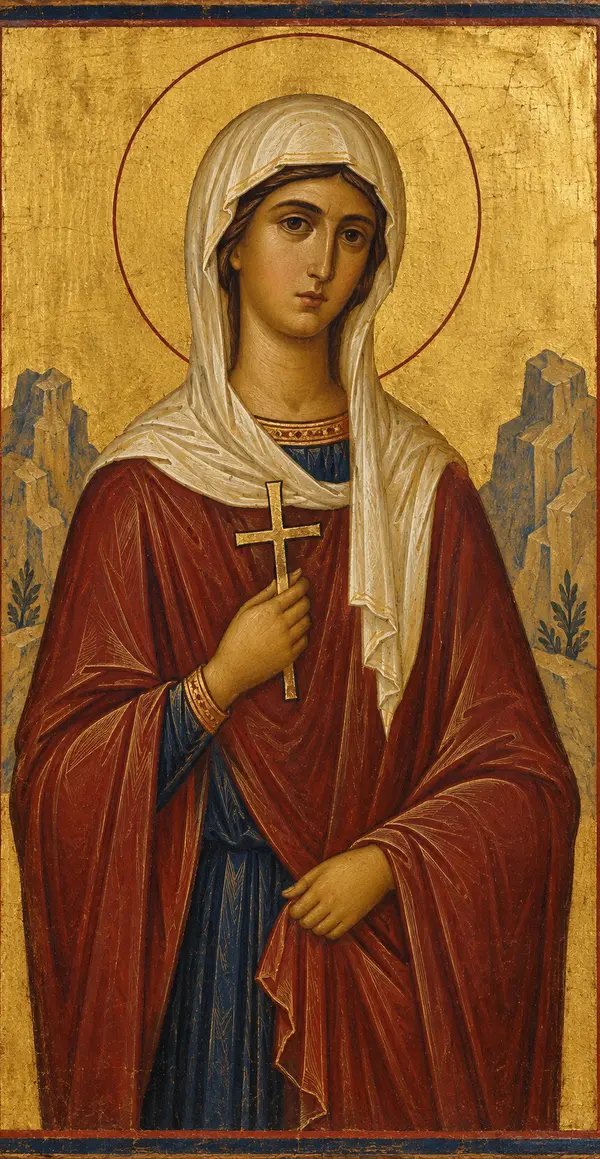
Virgin Martyr
Holy Martyr Ariadne of Phrygia
✓ Comprehensive Orthodox source review completed
The Christian servant who refused an idolatrous sacrifice and found refuge in the rock opened by God during her flight from persecution.
Core account checked against Orthodox Church in America — Martyr Ariadne of Phrygia, Orthodox Synaxarion — Saint Ariadne, Orthodox Synaxarion — September 18 calendar and hymn. Additional ecclesiastical references appear below.
Life and Witness
A Christian Servant in Phrygia
The Holy Martyr Ariadne lived in the second century, during the reign of Emperor Hadrian, and served in the household of Tertullus, a prominent official of Promissia in Phrygia. Although Roman society regarded her as a slave, the Orthodox Synaxarion praises the freedom of her soul: she belonged first to Christ and would not allow another person to command her conscience.
The place-name appears in English sources as Promissia or Promyssia and in Greek as the city of the Promisseans. Modern geography cannot be stated with complete precision from the hagiographical notice, so this page retains the traditional Phrygian setting without inventing a present-day identification.
The Pagan Celebration
When a son was born to Tertullus, the household held a celebration that included sacrifice to pagan gods. Ariadne refused to take part in the offering or to eat food associated with the sacrifice. Her refusal was neither contempt for the child nor social rebellion for its own sake; it was the necessary consequence of her Baptism and her confession that worship belongs to God alone.
Tertullus reacted with anger because her Christian freedom contradicted the religious authority he believed he possessed over his household. The account exposes the conflict between outward bondage and inward freedom that the Church also expresses in the saint's hymns.
Imprisonment and Torture
The Orthodox accounts say that Ariadne was beaten and that her flesh was torn with sharp iron hooks. She was then cast into prison, where hunger and further pressure were used in an attempt to make her sacrifice. None of these measures broke her fidelity to Christ.
These details come from the received martyr tradition rather than from a surviving Roman judicial transcript. They are included as the Church transmits them, while sensational embellishment is avoided. Ariadne's suffering condemns the abuse of power; it must never be used to romanticize slavery or teach that a victim is forbidden to flee danger.
Flight and the Opening of the Rock
After her release, Ariadne left her master's house. Tertullus regretted allowing her to escape and sent armed men to capture her. Seeing the pursuers approach and finding no human refuge, the martyr prayed that God would protect her.
According to the principal Orthodox account preserved by the OCA and other Synaxaria, a great rock opened and received Ariadne; it then closed, hiding her from the pursuers. The Church interprets the rock as a sign of Christ, the true refuge of those who trust in Him. Some Greek retellings instead say that she fell from a cliff while being pursued. Because the sources differ, the two forms are not blended into a single artificial narrative.
The Fate of the Pursuers
The expanded Synaxarion relates that the pursuers became disoriented and fought among themselves, while another version says that heavenly riders struck them with spears. These elements belong to variant hagiographical conclusions and are not present with identical detail in every Orthodox calendar.
The theological center is not vengeance against particular people but God's preservation of the martyr's confession. Ariadne's sanctity rests in her fidelity to Christ, not in the destruction of her enemies, and the Church's moral reading remains governed by repentance, mercy and the command to love one's enemies.
Feast, Hymnography and Iconography
The Orthodox Church commemorates the Holy Martyr Ariadne on September 18. Her appointed hymn praises the freedom of her will: though outwardly enslaved, she did not enslave her soul. The feast is preserved in Greek, Slavic, Romanian, Antiochian and OCA calendars, demonstrating the broad reception of her memory in the Orthodox Church.
Orthodox icons portray Ariadne as a young virgin martyr holding the Cross of confession. The Cross is the essential attribute; the cleft rock may appear as a narrative background. An icon proclaims communion with the crucified and risen Christ and does not function as an attempt to reconstruct her physical appearance.
Source-Critical Summary
The common ecclesiastical core comprises Ariadne's service to Tertullus in Phrygia, refusal of an idolatrous celebration, torture and imprisonment, flight from renewed persecution, divine refuge and commemoration on September 18. The reign of Hadrian supplies the traditional second-century setting.
The spelling of the city, the precise imperial dating, the manner in which the rock received her, and the fate of the pursuers vary among retellings. No independent birth date, family history, physical description, relic location or later miracle catalogue is securely preserved. This article therefore gives the fullest responsible synthesis without presenting later variants as equally documented historical facts.
Historical Record and Ecclesiastical Tradition
Ariadne's service to Tertullus in Phrygia, refusal of pagan sacrifice, torture, imprisonment and flight form the stable Orthodox account. The miraculous opening of the rock is the principal Synaxarion conclusion, while some Greek retellings mention a fatal fall from a cliff and the pursuers' fate varies; every variant is identified rather than combined into false historical precision.
Biographical information on this page is based exclusively on the Orthodox ecclesiastical sources listed below.
Orthodox Church in America — Martyr Ariadne of PhrygiaOrthodox Synaxarion — Saint AriadneOrthodox Synaxarion — September 18 calendar and hymnGreek Synaxarion — September 18Orthodox Christianity — Martyr Ariadne of PhrygiaPemptousia — Saint Ariadne, the Free Servant