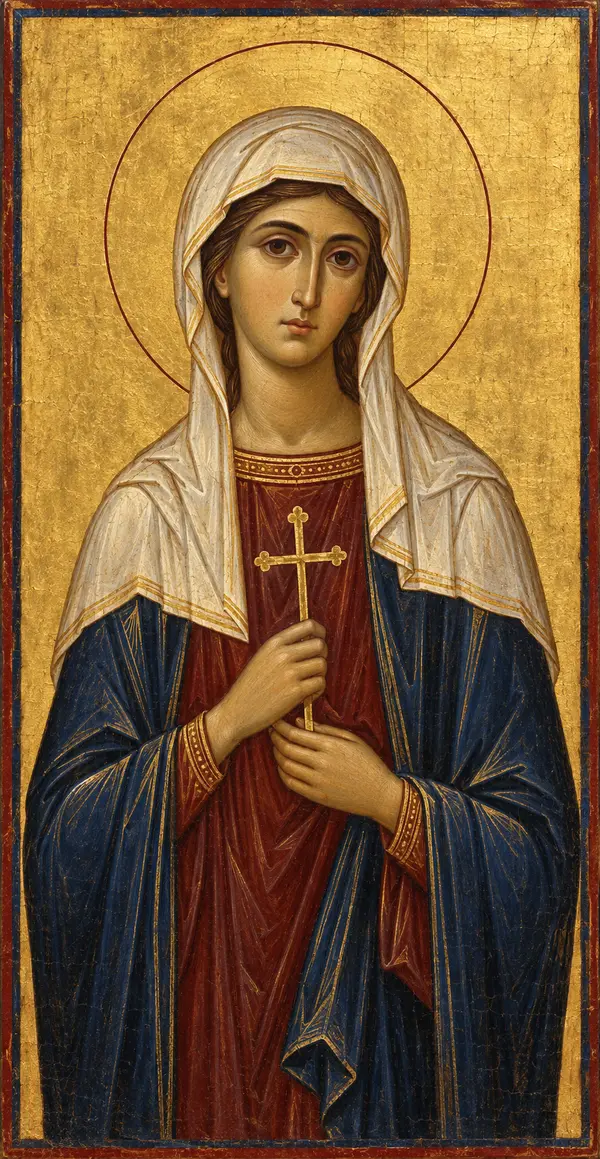
Virgin Martyr
Holy Martyr Agathocleia
✓ Comprehensive Orthodox source review completed
The Christian servant who endured eight years of persecution without abandoning Christ and received the martyr's crown through fire.
Core account checked against Orthodox Church in America — Martyr Agathocleia (September 17), Orthodox Synaxarion — Saint Agathocleia, Synaxarion of Saint Nikodemos the Hagiorite — September 17. Additional ecclesiastical references appear below.
Life and Witness
A Christian Servant in a Divided Household
The Holy Martyr Agathocleia is commemorated by the Orthodox Church on September 17. The received Synaxarion places her as a Christian servant in the household of Nicholas and Paulina. The Orthodox Church in America describes Nicholas as a Christian and Paulina as a pagan; other later retellings say that one or both had abandoned Christianity. Because the sources are not uniform, the article preserves the shared core without turning a variant into a certainty.
Nothing reliable is known about Agathocleia's birthplace, family or the precise location of her martyrdom. Her social vulnerability is, however, central to the tradition: she possessed little earthly power, yet neither ownership, coercion nor violence could command her conscience or separate her from Christ.
Eight Years of Persecution
For eight years Paulina attempted to force Agathocleia to renounce Christ. The principal Orthodox accounts describe continual insults and beatings, wounds made with sharp objects, and the martyr being compelled to walk barefoot over jagged stones. She answered this prolonged persecution with prayer and an unbroken confession of faith.
The Synaxarion's purpose is not to sensationalize cruelty. It reveals the moral freedom and God-given dignity of a person whom society treated as property. Agathocleia's patience never makes her persecutor's actions acceptable, and her life must not be misused to tell victims of abuse that seeking safety is a lack of faith.
Her Final Confession and Martyrdom
When years of abuse failed to change Agathocleia's faith, the persecution reached its final violence. The common Orthodox witness says that Paulina killed her by fire. Some expanded traditions describe burning coals placed upon her neck; others say that she was cast into flames. A later account also places her before a magistrate and includes the cutting of her tongue, but these details are not equally present in the principal Greek and OCA notices.
The page therefore states with confidence what the Orthodox witnesses share: Agathocleia refused apostasy and completed her witness through fire. The exact sequence of her last sufferings is retained as a set of hagiographical variants, not reconstructed as though a contemporary court record had survived.
The Crown of a Virgin Martyr
Orthodox worship calls martyrdom a victory because the martyr remains united to the crucified and risen Christ. Agathocleia did not prevail by worldly force. Her victory was the preservation of faith, truth and freedom of conscience when every external circumstance was directed against them.
As a virgin martyr and an enslaved woman, she stands among the saints whose holiness overturns earthly hierarchies. Her masters could wound her body, but they could not own her soul. The Church's veneration of her is therefore also a condemnation of coercion, religious persecution and the dehumanization of servants and slaves.
Liturgical Memory and Iconography
The Byzantine liturgical calendar commemorates the Holy Martyr Agathocleia on September 17 together with other saints of the day. The Greek Synaxarion of Saint Nikodemos the Hagiorite, the modern Orthodox Synaxarion, the OCA calendar, Antiochian calendars and the Greek Orthodox Digital Chant Stand all preserve her name within the Church's worship.
She is represented in the Menologion of Basil II, an important Byzantine witness to her established commemoration by the turn of the eleventh century. In Orthodox iconography she appears as a young martyr holding the Cross of confession. The icon proclaims her communion with Christ; it does not invite fascination with the violence inflicted upon her.
Source-Critical Summary
The convergent ecclesiastical core is concise: Agathocleia was a Christian servant associated with the household of Nicholas and Paulina; she endured eight years of violence intended to make her abandon Christ; she remained faithful and died by fire; her feast is September 17. This is the foundation of the present article.
The sources differ over whether Nicholas remained Christian, whether Agathocleia was taken before a public judge, whether her tongue was cut out, and whether burning coals or a larger fire caused her death. Those elements are identified as variants. No unsupported date, city, family history, relic location or catalogue of miracles has been added merely to make a short ancient notice appear longer.
Historical Record and Ecclesiastical Tradition
Agathocleia's service in the household of Nicholas and Paulina, eight years of persecution, refusal to abandon Christ and death by fire form the shared Orthodox Synaxarion account. Sources differ over the owners' religious status and the exact sequence of her final torments; those details are identified as hagiographical variants, and the article explicitly rejects any use of her endurance to excuse slavery or domestic abuse.
Biographical information on this page is based exclusively on the Orthodox ecclesiastical sources listed below.
Orthodox Church in America — Martyr Agathocleia (September 17)Orthodox Synaxarion — Saint AgathocleiaSynaxarion of Saint Nikodemos the Hagiorite — September 17Greek Orthodox Archdiocese Digital Chant Stand — September 17 MatinsMonastic Republic — Athonite Synaxarion: Saint Agathocleia