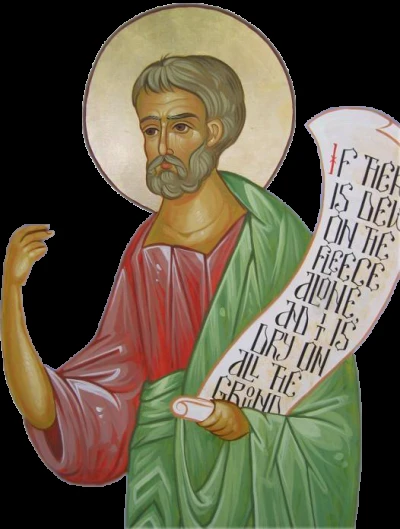
Righteous Judge and Prophet
Righteous Gideon, Judge of Israel
✓ Comprehensive Orthodox source review completed
The hesitant servant called by God to deliver Israel with three hundred men and to reveal divine strength in human weakness.
Core account checked against Holy Bible — Judges 6–8, Orthodox Church in America — The Righteous Gideon, Orthodox Church in America — Hebrews 11. Additional ecclesiastical references appear below.
Life and Witness
Israel under Midian and Gideon's Call
The Righteous Gideon was a son of Joash from the clan of Abiezer in the tribe of Manasseh. His history is told in Judges 6–8. Israel had fallen into idolatry and was oppressed by Midian. While Gideon was threshing wheat in a winepress to hide it from raiders, the angel of the Lord addressed him as a mighty man of valor and called him to deliver Israel.
Gideon protested his weakness and the insignificance of his family. The Biblical emphasis is therefore not on a naturally invincible commander but on God's power working through a hesitant servant. Gideon first destroyed his father's altar to Baal and received the name Jerubbaal because Baal was challenged to contend for himself.
The Signs of the Fleece
Before the campaign Gideon asked for confirmation through a fleece placed on the threshing floor: first dew appeared on the fleece while the ground remained dry, and then the fleece remained dry while the ground was wet. Judges records these as signs granted in Gideon's weakness, not as a universal method for making ordinary decisions.
Orthodox hymnography and patristic tradition also read the fleece typologically. The dew became an image of divine grace and, in Marian interpretation, of the mystery of the Incarnation: the Word descended without destroying the purity of the Theotokos. The typology does not erase the literal Old Testament setting.
The Three Hundred and the Defeat of Midian
Gideon's army was reduced from thousands to three hundred so that Israel could not claim that its own strength had brought deliverance. At night the three companies surrounded the Midianite camp with trumpets, jars and hidden torches. At the signal they broke the jars, raised the lights and sounded the trumpets. Panic spread through the camp, and the enemy turned upon itself before Israel pursued.
The video's phrase '300-man strategy that destroyed an empire' is dramatic shorthand. Midian was a confederation of raiding peoples, not an empire in the later administrative sense. Scripture presents the victory as deliverance from oppression and proof that salvation came from God, not as a celebration of violence detached from repentance and covenant faithfulness.
Judge of Israel—and the Warning of the Ephod
After the victory the Israelites asked Gideon and his descendants to rule over them. Gideon refused a hereditary kingship, declaring that the Lord would rule over Israel. The land then had rest for forty years during his days, and Hebrews 11 names Gideon among those whose faith acted through weakness.
The Biblical record is also candid about his failure. Gideon made an ephod from gold taken after the battle, and Israel went after it; Judges calls it a snare to Gideon and his household. A complete Orthodox presentation must preserve this warning rather than turn him into a flawless military hero. God truly used him, yet his later action shows the continuing danger of idolatry.
Commemoration in the Orthodox Church
The Greek Synaxarion commemorates the Righteous Gideon on September 26, while the Orthodox Church in America calendar lists him on November 26. This is a calendar difference in received local usage, not evidence for two different prophets. The site follows the September 26 placement used by the Greek tradition and by the channel's video schedule.
On September 26 the principal Greek Orthodox commemoration is the Repose of the Holy Apostle and Evangelist John the Theologian. Gideon is therefore shown here as the day's featured secondary commemoration. His enduring spiritual lesson is obedience amid fear, God's strength in human weakness and the necessity of remaining faithful after victory.
Source-Critical Summary
Judges 6–8 is the controlling source for Gideon's call, fleece, three hundred men, victory, refusal of dynastic rule, forty years as judge and the later ephod. Hebrews 11:32 supplies the New Testament witness to his faith. Ecclesiastical lives and hymnography interpret that scriptural history and preserve his feast.
The page does not treat modern motivational retellings as primary evidence. Details not found in Scripture are included only when clearly attributed to Orthodox liturgical or hagiographical tradition. It also retains the morally difficult parts of the Biblical record and distinguishes the Greek September feast from the OCA November observance.
Biographical information on this page is based exclusively on the Orthodox ecclesiastical sources listed below.
Holy Bible — Judges 6–8Orthodox Church in America — The Righteous GideonOrthodox Church in America — Hebrews 11Greek Orthodox Archdiocese Digital Chant Stand — September 26Mystagogy Resource Center — Righteous Gideon, Judge of Israel