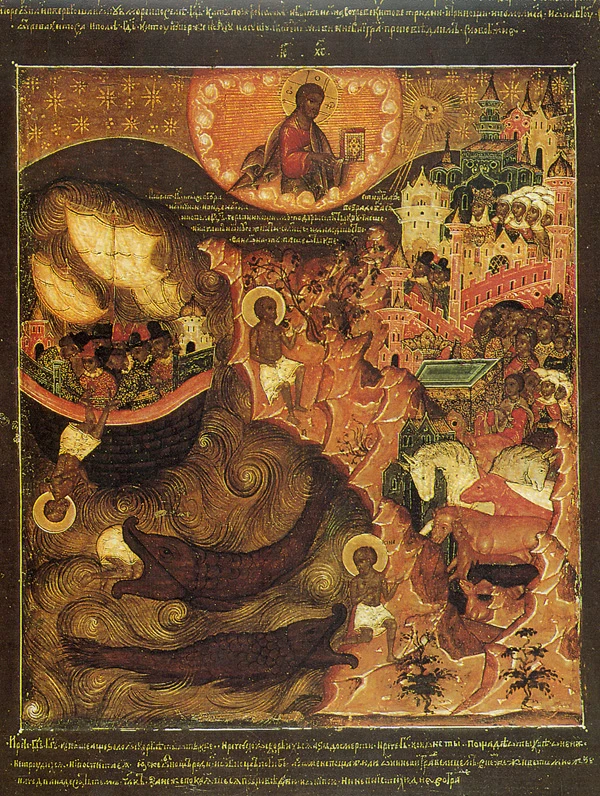
Prophet
Holy Prophet Jonah
✓ Comprehensive Orthodox source review completed
The reluctant prophet preserved for three days in the deep, whose preaching brought Nineveh to repentance and prefigured Christ's Burial and Resurrection.
Core account checked against Orthodox Church in America — Prophet Jonah, Life, Orthodox Church in America — Prophet Jonah, Troparion and Kontakion, Orthodox Church in America — Complete Commemorations for September 22. Additional ecclesiastical references appear below.
Life and Witness
The Prophet and His Mission to Nineveh
The Holy Prophet Jonah lived in the eighth century before Christ. Holy Scripture identifies him as Jonah son of Amittai, from Gath-hepher, and also mentions his prophetic ministry during the reign of Jeroboam II. The Orthodox Church commemorates him on September 22, while the complete canonical account of his mission is preserved in the Book of Jonah.
God commanded Jonah to go to Nineveh, the great Assyrian city, and proclaim judgment because of its wickedness. Jonah instead boarded a ship sailing toward Tarshish. The text does not excuse his flight: it shows a prophet resisting a difficult mission and God patiently leading him from fear and narrowness toward obedience and mercy.
The Storm, the Great Fish and Jonah's Prayer
A violent storm endangered the ship. Jonah acknowledged that he was fleeing from the Lord and asked to be cast into the sea so that the others might be spared. The sailors first tried to reach land, prayed for mercy and only then threw him overboard; the sea became calm, and they feared the Lord.
God appointed a great sea creature to receive Jonah. The biblical and liturgical point is not the modern zoological classification of the creature but divine preservation and repentance. From the depths Jonah prayed in the language of the Psalms, confessed that salvation belongs to the Lord, and after three days and three nights was brought safely onto dry land.
The Repentance of Nineveh
Called a second time, Jonah entered Nineveh and announced that the city would be overthrown in forty days. The Ninevites believed God, proclaimed a fast and turned from violence. Their king laid aside his robe, sat in ashes and ordered both fasting and earnest repentance.
God saw their change of life and did not bring the announced destruction. Orthodox interpretation therefore treats Nineveh as a powerful image of communal repentance: fasting has meaning when joined to prayer, humility, mercy and the abandonment of evil. Christ Himself later said that the Ninevites would stand as witnesses because they repented at Jonah's preaching.
The Plant and God's Compassion
Jonah was distressed when Nineveh was spared. Outside the city, God caused a plant to grow and shelter him, then allowed it to wither. Jonah grieved for the plant, and God used that grief to reveal the contradiction in his heart: he pitied a plant for which he had not labored, yet resisted God's compassion for a great city filled with human beings and animals.
The Book ends with God's question rather than Jonah's answer. The open ending turns the question toward every reader. Prophetic truth and divine judgment are not weapons for hatred; they call sinners to conversion, and God's desire for repentance reaches even those whom His servants may regard as enemies.
The Sign of Jonah and the Resurrection of Christ
In the Gospel, the Lord Jesus Christ names Jonah's three days in the sea creature as the sign of His own saving Burial and Resurrection. The Orthodox Church therefore reads Jonah christologically: the prophet's descent and return prefigure Christ's voluntary descent into death and His rising on the third day.
The comparison does not make Jonah equal to Christ. Christ says that One greater than Jonah is present. Jonah was preserved by grace and sent again to preach; Christ freely gives His life, destroys death and calls all nations to repentance. This Paschal interpretation is the controlling meaning in Orthodox hymnography and iconography.
Feast, Hymnography and Iconography
September 22 is the Orthodox commemoration of the Holy Prophet Jonah. The appointed troparion asks the Lord to save His people through the prophet's prayers, while the kontakion praises Jonah's heart as enlightened by the Holy Spirit and made a dwelling of prophecy.
Orthodox icons portray Jonah with a prophetic scroll and may include the ship, the sea creature or Nineveh. These elements proclaim Scripture and its fulfillment in Christ; they are not intended as a natural-history reconstruction. The Church's veneration is directed to the saint as God's servant, while worship belongs to the Holy Trinity alone.
Source-Critical Summary
The secure scriptural core comprises Jonah son of Amittai, his call and flight, the storm, his three-day preservation, his prayer, renewed mission, Nineveh's repentance, the plant and God's lesson in compassion. Matthew 12 and Luke 11 record Christ's interpretation of Jonah as both a sign of the Resurrection and a witness calling people to repentance.
Some later ecclesiastical traditions identify Jonah with the widow's son raised by the Prophet Elijah or preserve locations connected with his burial. Those details are not stated in the canonical Book of Jonah and are not uniform across the principal Orthodox calendars. They are therefore distinguished from Scripture rather than presented as equally certain biography.
Historical Record and Ecclesiastical Tradition
The canonical Book of Jonah and Christ's words in Matthew 12 and Luke 11 control the article. Later traditions concerning Jonah's childhood and burial are distinguished from Scripture, while the three-day sign is interpreted according to the Lord's own reference to His Burial and Resurrection.
Biographical information on this page is based exclusively on the Orthodox ecclesiastical sources listed below.
Orthodox Church in America — Prophet Jonah, LifeOrthodox Church in America — Prophet Jonah, Troparion and KontakionOrthodox Church in America — Complete Commemorations for September 22Holy Scripture — Book of JonahHoly Scripture — Matthew 12:38-41, the Sign of JonahHoly Scripture — Luke 11:29-32, Jonah and Nineveh