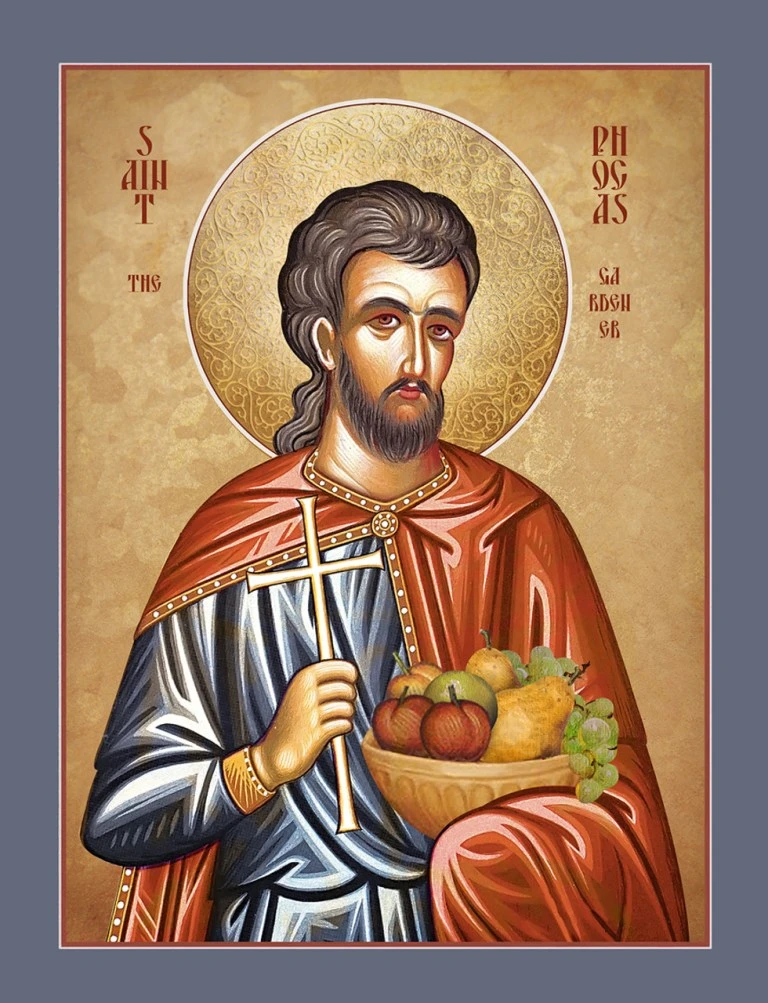
Martyr of Sinope
Holy Martyr Phocas the Gardener
✓ Comprehensive Orthodox source review completed
The humble gardener who welcomed the soldiers sent to kill him, prepared his own grave and became a protector of sailors.
Core account checked against Orthodox Church in America — Martyr Phocas the Gardener of Sinope, Orthodox Church in America — Troparion and Kontakion, Mystagogy Resource Center — Life and Veneration of the Holy Martyr Phocas. Additional ecclesiastical references appear below.
Life and Witness
The Gardener of Sinope
The Holy Martyr Phocas the Gardener lived at Sinope on the Black Sea and is commemorated on September 22. His garden was his only material possession. Through diligent labor and a frugal life, he produced enough to sustain himself, welcome travelers and share with the poor.
Phocas loved Holy Scripture and compared the human soul to a garden requiring constant care. Just as weeds must be removed and good plants cultivated, the heart must be cleansed of passions and made fruitful through prayer, repentance, mercy and the commandments of Christ.
Hospitality to the Men Sent to Kill Him
When the authorities learned that Phocas was a Christian who also brought others to faith, soldiers were sent to arrest and behead him. They arrived at his home without recognizing him. Following the Gospel command of hospitality, Phocas received them, fed them and gave them rest before asking the purpose of their journey.
The soldiers disclosed that they were searching for a Christian named Phocas and asked their host to help locate him. The saint did not expose them to danger or flee secretly. He told them they would find the man the next day and spent the night preparing himself in prayer.
He Prepared His Own Grave
Phocas went into his garden and dug the grave in which he wished to be buried. In the morning he revealed his identity. The soldiers were shaken and ashamed because the man they had been ordered to kill had welcomed them with such generosity. They offered to report that they had been unable to find him.
Phocas refused to preserve his life through a false report and encouraged them to fulfill the order for which they had been sent. He was beheaded and received the crown of martyrdom. His courage does not remove the guilt of persecution; it shows a Christian freely refusing hatred and falsehood even when facing death.
Ancient Witness and the Saint's Shrine
An important early witness to the martyr is the panegyric of Saint Asterius, Bishop of Amasea, who died around 410. The existence of this late-fourth- or early-fifth-century homily gives Phocas's cult and central story an unusually early ecclesiastical witness compared with many expanded medieval lives.
Christians built a church at the place associated with his martyrdom and placed his relics there. The Orthodox life records healings and consolation at his shrine. A portion of his relics is also venerated at the Monastery of Proussos in Evrytania.
Protector of Sailors and the Portion of Saint Phocas
Phocas became especially beloved by sailors. Orthodox tradition records his appearances during storms: warning helmsmen, helping with ropes and sails, and protecting ships from reefs and heavy seas. He is therefore invoked by those who travel by sea.
Sailors developed a charitable custom called the portion of Saint Phocas. A share at their table was symbolically bought in turn by members of the crew; when the voyage ended, the collected money was distributed to the poor. This practice joins gratitude for protection with the hospitality and almsgiving that marked the saint's earthly life.
Identity, Feast and Source-Critical Summary
This page concerns the Martyr Phocas the Gardener of Sinope, not the Hieromartyr Phocas, Bishop of Sinope, who is also commemorated on September 22. Orthodox calendars list them separately, with distinct lives and icons, even though later retellings sometimes blur their identities.
The stable account comprises Phocas's garden, Scripture study, charity, hospitality to the soldiers, voluntary revelation, preparation of his grave, beheading and early veneration. His maritime miracles and relic traditions are received ecclesiastical testimony. Exact civil dates vary, so the article does not force the Gardener into the chronology of the bishop or invent certainty where the sources remain distinct.
Historical Record and Ecclesiastical Tradition
The Gardener is kept distinct from the Bishop of Sinope, although both are commemorated on September 22. His hospitality, self-prepared grave and beheading are supported by the early panegyric of Saint Asterius of Amasea; later maritime miracles are identified as ecclesiastical tradition.
Biographical information on this page is based exclusively on the Orthodox ecclesiastical sources listed below.
Orthodox Church in America — Martyr Phocas the Gardener of SinopeOrthodox Church in America — Troparion and KontakionMystagogy Resource Center — Life and Veneration of the Holy Martyr PhocasOrthodox Church in America — Complete Commemorations for September 22