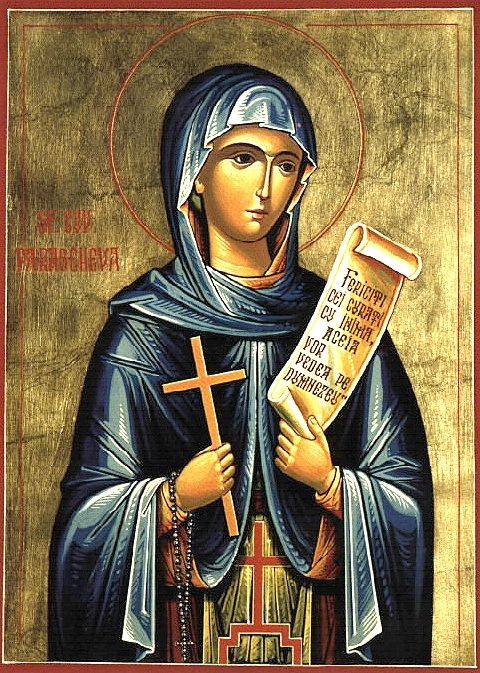
Ascetic & Wonderworker
Venerable Paraskeva the New of Epivates
The humble ascetic whose holy relics crossed the Orthodox world and are venerated in Iași.
Core account checked against Orthodox Church in America — Venerable Paraskevi (Petka), Romanian Patriarchate / Basilica — Patriarch Daniel on Saint Paraskeva and the journey of her relics. Additional ecclesiastical references appear below.
Life and Witness
The Gospel Call in Epivates
Saint Paraskeva the New, also called Paraskevi or Petka, lived in the eleventh century and came from Epivates in Thrace. Her Christian upbringing opened her heart to the Gospel. Hearing Christ’s call to deny oneself and follow Him, she began giving her clothing and possessions to people in need.
Her charity brought difficulties within her household, but it remained part of her desire to serve God. Her later withdrawal into ascetic life grew from this same response to the Gospel: mercy toward her neighbors and renunciation of personal comfort belonged together.
Pilgrimage and Ascetic Life
Orthodox tradition associates her journey with Constantinople, Heraclea and the Holy Land. She embraced monastic and ascetic life and is especially remembered for prayer and solitude in the region of the Jordan.
The received Life describes her remaining in ascetic life until approximately the age of twenty-five. Her story preserves the image of a young woman whose life was dedicated to prayer, poverty and the search for communion with God.
Return to Thrace and Repose
According to her Life, an angel directed her to return toward her homeland. She obeyed and spent her final years quietly in Thrace. The OCA account gives her age at repose as approximately twenty-seven.
Her first burial was simple, near the sea. During her earthly life she had sought little recognition. The subsequent history of her relics would carry her remembrance far beyond the place in which she died.
The Discovery of Her Relics
Orthodox tradition recounts that visions led Christians back to her forgotten grave. When it was opened, her body was found incorrupt. Healings and answered prayers became associated with the relics, and the local community began venerating her.
These events are preserved as part of her received Orthodox Life. They mark the beginning of a devotion that gradually spread through the Balkans and later became especially strong in Moldavia and Romania.
Across the Orthodox World
Over the centuries, her relics passed from Epivates to Tarnovo, later to the Serbian lands and Belgrade, and then to Constantinople. The Romanian Patriarchate’s account also records their passage through Vidin.
Orthodox summaries differ on some medieval transfer dates. The account published by Basilica records the arrival in Tarnovo on October 14, 1235. Her journeys linked communities that shared devotion to the same saint despite political upheaval and changing rulers.
The Relics Arrive in Iași
On June 13, 1641, her relics were brought to Iași and placed in the Church of the Three Hierarchs. Their arrival took place under the Moldavian ruler Vasile Lupu. From this time, the city became a central place of her veneration.
Generations of pilgrims came to seek her intercession. Her remembrance continued to cross national boundaries, uniting Romanian, Bulgarian, Serbian and Greek Orthodox devotion.
The Fire and the Metropolitan Cathedral
A fire in 1888 threatened the chapel where the relics were kept. Orthodox accounts remember their preservation and subsequent placement in the Metropolitan Cathedral of Iași. Basilica dates the cathedral transfer to 1889, while the OCA summary associates the move with the aftermath of the December 1888 fire.
The relics are venerated in the cathedral, and her October 14 feast remains a major occasion of Orthodox pilgrimage. The woman who had embraced an obscure life became a beloved intercessor for communities far beyond her birthplace.
Mercy and Her Feast on October 14
Patriarch Daniel has emphasized her humility and merciful love, explaining that her short life demonstrates that holiness does not depend on reaching old age. Her example joins prayer with generosity toward the poor.
Saint Paraskeva the New of Epivates is distinct from other saints named Paraskevi. This biography and documentary belong to her October 14 commemoration. Venerable Paraskeva, pray to God for us.
Biographical information on this page is based exclusively on the Orthodox ecclesiastical sources listed below.
Orthodox Church in America — Venerable Paraskevi (Petka)Romanian Patriarchate / Basilica — Patriarch Daniel on Saint Paraskeva and the journey of her relics