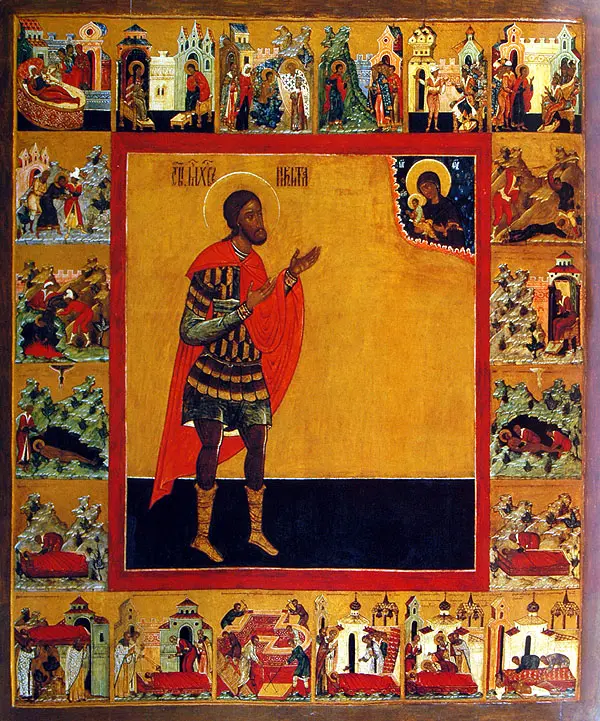
Great Martyr
Holy Great Martyr Nikitas the Goth
✓ Comprehensive Orthodox source review completed
Missionary among the Goths who strengthened Christians under persecution and completed his witness in the flames.
Core account checked against Orthodox Church in America — Great Martyr Nikitas the Goth, The Prologue from Ohrid — September 15, Greek Orthodox Archdiocese of America — Online Chapel, Saints and Feasts. Additional ecclesiastical references appear below.
Life and Witness
A Christian among the Goths
The Holy Great Martyr Nikitas was a Goth who lived during the fourth century in the region north of the lower Danube. The Christian faith had already taken root among the Gothic peoples through missionary preaching and the ministry of Bishop Theophilos, who took part in the First Ecumenical Council at Nicaea in 325.
Nikitas believed in Christ and received Holy Baptism. He did not keep the faith as a private possession: through his example and teaching he brought fellow Goths to Christ and strengthened Christians living amid hostility and political conflict.
Persecution under Athanaric
A struggle arose between Fritigern, associated with the Christian Goths, and the pagan ruler Athanaric. After regaining power, Athanaric launched a fierce persecution, seeking to restore pagan worship and punish those who confessed Christ.
Nikitas openly denounced the ruler’s cruelty and impiety. The saint’s contest was spiritual as well as visible: he resisted idolatry, encouraged the persecuted and called his people to the Gospel without answering violence with hatred.
Martyrdom in the Fire
Athanaric’s men seized Nikitas and subjected him to tortures, attempting to force him to abandon Christ. When he remained steadfast, he was condemned to be burned alive. The Orthodox account relates that he surrendered his soul to God in the flames in the year 372, yet his body was not consumed.
A radiant light revealed the martyr’s relics. A Christian named Marianus recovered the body by night and carried it to Cilicia, where it was buried with honor. The preservation of the relics is remembered as God’s testimony to the martyr’s faith, not as escape from martyrdom, for Nikitas truly completed his witness unto death.
Relics and Orthodox Veneration
The relics of Saint Nikitas were later transferred to Constantinople. A portion was eventually given to the Serbian monastery of Visoki Dečani, where the Great Martyr continues to be honored within the worshipping life of the Orthodox Church.
In iconography he is commonly shown as a warrior-martyr holding the Cross of confession. His weapons and military clothing do not glorify earthly warfare; they express courage, vigilance and the spiritual victory of a Christian who remained faithful under persecution.
Feast Day and Spiritual Meaning
Saint Nikitas shows that the Gospel can take root among every people and that Christian mission is sustained through personal holiness, truthful teaching and patient endurance. His life calls the faithful to reject every form of idolatry and to confess Christ without fear.
September 15 — Holy Great Martyr Nikitas the Goth.
Historical Record and Ecclesiastical Tradition
The fourth-century Gothic mission, persecution under Athanaric and Nikitas's death by fire form the stable account. The unconsumed body and later translations of relics are identified as synaxarial testimony; devotional claims lacking a cited Orthodox authority have been excluded.
Biographical information on this page is based exclusively on the Orthodox ecclesiastical sources listed below.
Orthodox Church in America — Great Martyr Nikitas the GothThe Prologue from Ohrid — September 15Greek Orthodox Archdiocese of America — Online Chapel, Saints and Feasts