Great Feast
Nativity of the Most Holy Theotokos
✓ Comprehensive Orthodox source review completed
The Church celebrates the birth of the Virgin Mary, the holy child of the righteous Joachim and Anna and the beginning of the preparation for the Incarnation.
Core account checked against Orthodox Church in America — Nativity of the Theotokos, Orthodox Church in America — Lives of the Saints and Icons, September 8, Greek Orthodox Archdiocese of America — Holy Monastery of the Nativity of the Theotokos. Additional ecclesiastical references appear below.
Life and Witness
The Righteous Joachim and Anna
The Orthodox Church celebrates the Nativity of the Most Holy Theotokos and Ever-Virgin Mary on September 8. The ecclesiastical tradition names her parents as the righteous Joachim and Anna. They belonged to the faithful remnant of Israel that awaited the fulfillment of God’s promises and the coming of the Messiah. Although they lived uprightly and gave generously, they remained childless into old age. In the social world of their time, barrenness brought not only sorrow but also public reproach.
The details of Mary’s birth are not recorded in the canonical books of the New Testament. They are received through the ancient Christian tradition reflected in the Church’s hymnography and associated with early writings concerning the childhood of the Theotokos. The Orthodox Church does not treat those writings as another Gospel. It receives and proclaims what the feast expresses within worship: Joachim and Anna remained faithful, prayed with perseverance, and were chosen to become the parents of the woman from whom the Son of God would take human flesh.
Prayer, Promise and the Birth of Mary
According to the ecclesiastical narrative, Joachim withdrew in grief to pray, while Anna poured out her sorrow before God and promised to dedicate the child she sought to His service. An angel announced that their prayer had been heard. The elderly couple received the promise with thanksgiving, and Anna conceived the child Mary—not apart from the natural union of marriage, but through God’s providential answer to long and faithful prayer.
The birth of Mary brought joy first to her parents and then, in the Church’s understanding, to the whole creation. The child herself was fully human, born of human parents and sharing the nature of Adam. Yet she was prepared by divine providence and by her own free growth in holiness to become the Theotokos, the one who would freely answer the Archangel Gabriel and give human nature to the eternal Word.
Orthodox teaching does not isolate Mary from the human race. Her holiness is the fruit of God’s grace welcomed in complete freedom and obedience. For this reason, the feast honors both God’s saving purpose and the human response represented by Joachim, Anna and their daughter.
The Beginning of the Preparation for Salvation
The Nativity of the Theotokos is not celebrated as an independent miracle detached from Christ. Its entire meaning points toward the Incarnation. With Mary’s birth, the living person who would become the Mother of the Messiah enters history. The Church therefore calls the feast the beginning of joy for the whole world and the first visible preparation for the coming of the Savior.
The festal troparion proclaims that the birth of the Virgin announced joy to the whole universe because from her Christ, the Sun of Righteousness, would shine forth. The hymn connects Mary’s nativity directly with the saving work of her Son: the curse is overcome, blessing is given, death is destroyed and eternal life is bestowed. All honor offered to the Theotokos in the feast returns finally to Christ, whose true Incarnation she makes manifest.
The kontakion joins several generations within the same mystery. Joachim and Anna are released from the reproach of childlessness; Adam and Eve are released from the corruption of death; and the Church rejoices because the one who will nourish the incarnate Life has been born. The liturgy thus sees a single history of salvation stretching from the fall of humanity to the birth, Passion and Resurrection of Christ.
Biblical Readings and Orthodox Theology
The Old Testament readings appointed at Vespers interpret ancient images in the light of the Theotokos and the Incarnation. Jacob’s ladder, joining earth to heaven, prefigures the union of divine and human nature realized in Christ. The closed eastern gate seen by the Prophet Ezekiel becomes an image of the Ever-Virgin Mother of God. The house built by divine Wisdom in Proverbs is understood as the pure human dwelling prepared for the Word.
At Matins the Church reads the Magnificat from the Gospel of Luke, in which Mary magnifies the Lord and declares that all generations will call her blessed. At the Divine Liturgy, the Epistle speaks of the Son of God taking the form of a servant, while the Gospel declares blessed those who hear the word of God and keep it. The readings therefore prevent veneration of the Theotokos from becoming sentimental or separated from discipleship: her blessedness is inseparable from hearing God’s word, keeping it and offering her whole life in obedience.
The Icon of the Feast
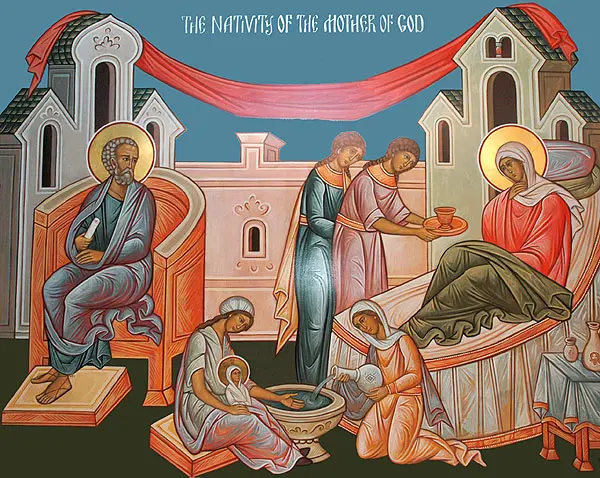
The Orthodox icon normally places Saint Anna reclining after childbirth, attended by women who bring food and prepare the newborn child. The infant Mary appears below or near her mother, while Saint Joachim is included within the household scene. The icon uses the visual language of an ordinary human birth while revealing its place in the extraordinary providence of God.
The domestic details affirm that the Mother of God was truly born into human history. At the same time, the ordered and prayerful composition announces that this birth serves the mystery of the Incarnation. The faithful do not worship the painted material; they honor the persons represented, and through the feast glorify the God who works salvation within real human life.
Miraculous Icons Commemorated on September 8
The feast itself should not be confused with a catalogue of miracles surrounding the birth of Mary. The principal Orthodox sources emphasize its saving and theological meaning. On the same date, however, the Church also commemorates several wonderworking icons of the Mother of God whose individual histories preserve accounts of divine help received through her intercessions.
Among those listed in the Orthodox calendar are the Kursk-Root Icon of the Sign, the Pochaev Icon, and icons associated with Kholm, Glinsk, Domnitsa, Syamsk, Isaakov and Lukianov. The Kathariotissa Icon, depicting the Nativity of the Theotokos, is especially venerated on the Greek island of Ithaca. Each icon has its own history and must be studied from its own ecclesiastical record; their commemoration on September 8 does not mean that every miracle attached to them belongs to the historical narrative of Joachim, Anna and the birth of Mary.
Orthodox veneration always distinguishes between God, who alone is the source of grace, and the Mother of God, whose intercessions are sought. A miracle connected with an icon is understood as an act of divine mercy, not as power belonging independently to wood, paint or any created person.
Churches and Monasteries Around the World
The dedication of churches to the Nativity of the Theotokos shows how widely the feast is loved across Orthodox lands and the diaspora. In Kleisoura of Kastoria, Greece, the Holy Monastery of the Nativity of the Theotokos preserves an important katholikon, ecclesiastical art and the memory of Saint Sophia of Kleisoura, who lived there in asceticism from 1927 until 1974. It remains an active women’s monastery and a place of pilgrimage.
In Saxonburg, Pennsylvania, the Nativity of the Theotokos Monastery is identified by its official history as the first Greek Orthodox women’s monastery in the Americas. It was founded in 1989 by Elder Ephraim of Philotheou with the blessing of the Greek Orthodox Archdiocese of America. The sisterhood follows the cenobitic monastic life and celebrates its principal feast on September 8.
In London, the Cathedral of the Nativity of the Mother of God and the Holy Royal Martyrs serves as the cathedral of the ROCOR Diocese of Great Britain and Western Europe. Its parish history reaches back to 1725, making the community one of the oldest Orthodox parishes in the British Isles. Its present cathedral in Chiswick was built in the Pskov architectural style and consecrated in 2018.
These examples do not form an exhaustive worldwide directory. Countless Orthodox parishes and monasteries in Greece, the Middle East, Eastern Europe, Russia, the Americas, Australia and elsewhere bear the name of the feast. Only communities confirmed through identifiable ecclesiastical or official institutional records are named here.
Liturgical Celebration and Spiritual Meaning
The feast is observed with Great Vespers, Matins and the Divine Liturgy. It stands near the beginning of the ecclesiastical year, which opens on September 1. This position is spiritually fitting: the first Great Feast of the annual cycle celebrates the birth of the woman through whom Christ enters the world, while the cycle moves toward the saving mysteries of His Nativity, Passion and Resurrection.
For the faithful, the Nativity of the Theotokos is a school of patient prayer. Joachim and Anna did not abandon God when their hope seemed humanly impossible. Their long sorrow became the place of faithful endurance, and their answered prayer was offered back to God. The feast also teaches that divine providence does not bypass human freedom. Mary’s birth prepares for salvation, but her later assent—“Let it be to me according to your word”—reveals the free obedience through which she serves the Incarnation.
The Church therefore celebrates neither privilege without responsibility nor glory without humility. It celebrates God’s grace bearing fruit in faithful human lives and calls every Christian to become, by grace, a dwelling place of Christ through prayer, purity, repentance and obedience to the word of God.
Feast Day
September 8 — The Nativity of our Most Holy Lady the Theotokos and Ever-Virgin Mary.
From the Orthodox Synaxarion
The Prologue from Ohrid presents the Nativity of the Theotokos as the answer to the prayer of Joachim and Anna and the beginning of the visible preparation for the Incarnation. The feast is therefore celebrated as joy for the whole inhabited world.
Historical Record and Ecclesiastical Tradition
The feast and its theology are secured by the Church's liturgical reception. The names Joachim and Anna and the narrative of the birth come from early Christian tradition, especially the Protoevangelium of James, not from the canonical Gospels; the page identifies that distinction.
Biographical information on this page is based exclusively on the Orthodox ecclesiastical sources listed below.
Orthodox Church in America — Nativity of the TheotokosOrthodox Church in America — Lives of the Saints and Icons, September 8Greek Orthodox Archdiocese of America — Holy Monastery of the Nativity of the TheotokosNativity of the Theotokos Monastery, Saxonburg — Official HistoryROCOR Diocese of Great Britain and Western Europe — London Cathedral of the Nativity of the Mother of GodHoly Monastery of the Nativity of the Theotokos, Kleisoura — Ecclesiastical and Pilgrimage HistoryThe Prologue from Ohrid — September 8