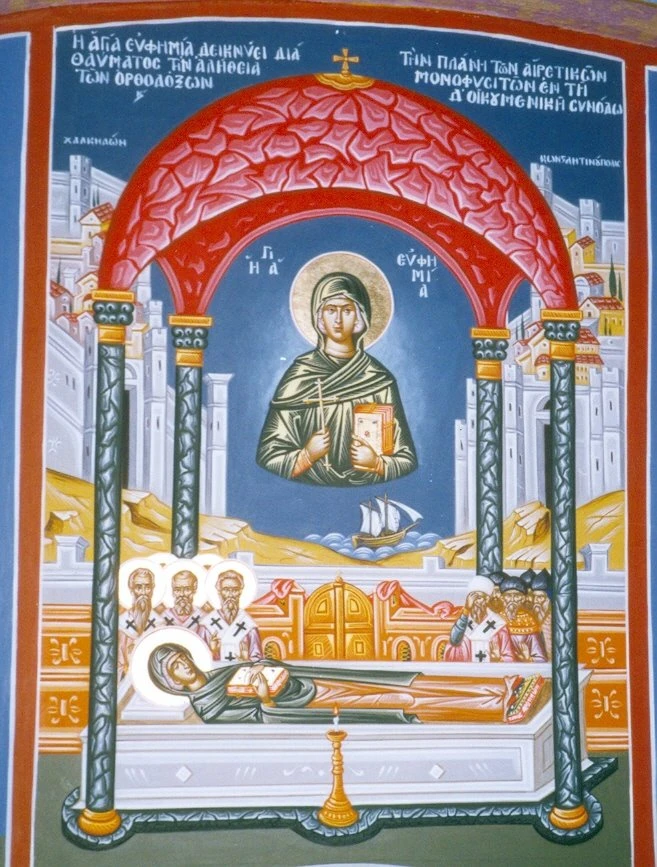
Great Martyr & Defender of Orthodoxy
Miracle of Saint Euphemia
✓ Comprehensive Orthodox source review completed
The Great Martyr whose relics confirmed the Orthodox definition of the Fourth Ecumenical Council.
Core account checked against Orthodox Church in America — The Miracle of Saint Euphemia the All-Praised, Ecumenical Patriarchate — Patriarchal Church of Saint George, The Prologue from Ohrid — July 11. Additional ecclesiastical references appear below.
Life and Witness
The Great Martyr of Chalcedon
Saint Euphemia was a young Christian of Chalcedon who confessed Christ during the persecution of Diocletian. After refusing sacrifice to the pagan gods, she endured torture and completed her witness in the arena. The Church commemorates her martyrdom on September 16.
Her holy relics were kept with honor in Chalcedon, where the Fourth Ecumenical Council assembled in 451 to defend the Orthodox confession that Christ is one Person in two natures, divine and human, without confusion, change, division or separation.
The Miracle of the Orthodox Definition
According to the Church's received account, the bishops placed the Orthodox definition and the opposing confession in the reliquary of Saint Euphemia, sealed it and prayed. When the tomb was opened, the Orthodox confession was found in the saint's right hand, while the other writing lay at her feet.
The miracle is celebrated on July 11. It does not replace the conciliar teaching, Scripture or patristic witness; it is remembered as a sign accompanying the Church's confession of the mystery of the incarnate Christ.
Relics and Veneration
The relics of Saint Euphemia were later transferred to Constantinople and are venerated in the Church of Saint George at the Ecumenical Patriarchate in the Phanar. Orthodox pilgrims continue to honor her as Great Martyr and defender of the faith.
Feast Days
July 11 — Miracle of Saint Euphemia at the Fourth Ecumenical Council. September 16 — Holy Great Martyr Euphemia the All-Praised.
Historical Record and Ecclesiastical Tradition
The Fourth Ecumenical Council at Chalcedon in 451, its definition of Christ as one Person in two natures and its meeting in Saint Euphemia's basilica belong to the historical conciliar record. The placing of rival confessions in her reliquary and their miraculous disposition is the Church's later liturgical-hagiographical account, commemorated on July 11, and is not substituted for the Council's acts or patristic reasoning.
Biographical information on this page is based exclusively on the Orthodox ecclesiastical sources listed below.
Orthodox Church in America — The Miracle of Saint Euphemia the All-PraisedEcumenical Patriarchate — Patriarchal Church of Saint GeorgeThe Prologue from Ohrid — July 11