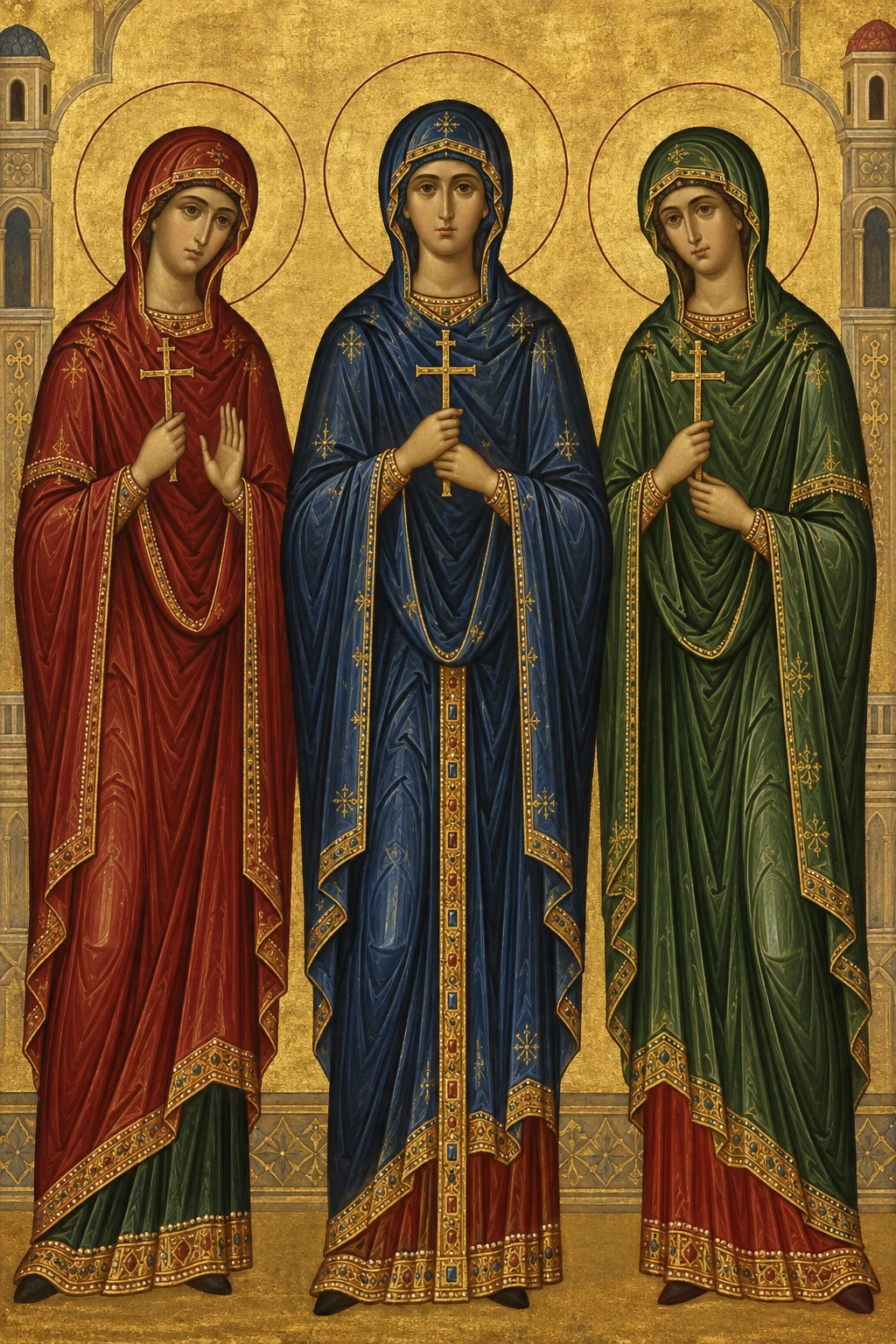
Virgin Martyrs & Wonderworkers
Holy Martyrs Menodora, Metrodora and Nymphodora
✓ Comprehensive Orthodox source review completed
Three sisters of Bithynia whose life of prayer and healing was crowned by an unbroken common confession of Christ.
Core account checked against Orthodox Church in America — Martyrs Menodora, Metrodora and Nymphodora at Nicomedia, Orthodox Metropolitanate of Hong Kong and South East Asia — Saints Menodora, Metrodora and Nymphodora, Orthodox Synaxarion — Saint Martyrs Menodora, Metrodora and Nymphodora. Additional ecclesiastical references appear below.
Life and Witness
Three Sisters from Bithynia
The Holy Virgin Martyrs Menodora, Metrodora and Nymphodora were sisters from Bithynia in Asia Minor. They lived during the great persecutions at the beginning of the fourth century, when Christians under the emperor Galerius Maximian were commanded to sacrifice to the pagan gods. The Church dates their martyrdom between the years 305 and 311.
Raised in the Christian faith, the sisters were united not only by blood but by a common desire to belong wholly to Christ. Orthodox accounts remember them as women of piety, modesty and spiritual wisdom. They freely chose virginity and withdrew from the distractions of public life, seeking a solitary place where they could devote themselves to prayer.
Ascetic Life in the Wilderness
The three sisters settled in a mountainous region near Pythian Warm Springs in Bithynia. Their withdrawal was not contempt for other people. It was a form of hesychia—sacred stillness—in which the heart could be purified through fasting, vigil, labor and continual remembrance of God. They lived together as a small ascetic community, strengthening one another in obedience and love.
Their bodily beauty, praised in the synaxaria, was joined to a deeper spiritual beauty formed through self-denial. The sisters did not seek reputation, followers or earthly honor. Yet a holy life cannot always remain hidden. People in suffering began to find help through their prayers, and knowledge of the three ascetics spread through the surrounding region.
The Gift of Healing
The Orthodox tradition records that God granted the sisters the gift of healing illnesses. The sick came to their place of solitude and received help through their prayers. The Church does not present this grace as a power possessed independently by the saints. Christ is the physician of souls and bodies; the sisters served as His faithful intercessors and gave freely what they had freely received.
Their wonderworking ministry also reveals why their isolation was not selfish. Prayer made them more, not less, responsive to human suffering. The quiet mountain became a place where those burdened by illness encountered mercy, hope and the confession of Christ.
Arrest and the Promises of Fronton
Reports of their healings and Christian faith reached the governor Fronton. He ordered the sisters to be arrested and brought before him. When he saw their youth and dignity, he first attempted persuasion rather than torture. He praised their appearance and promised wealth, honor and marriages to noble men if they would worship the pagan gods.
The sisters answered that they had already chosen Christ as their Bridegroom. Earthly advantage could not replace the Kingdom they sought, and fear could not force them to offer worship to idols. Fronton then separated them, hoping that each would become vulnerable without the presence of the others.
The Martyrdom of Saint Menodora
Menodora, the eldest, was brought first to trial. The governor renewed his promises and then threatened her with severe suffering. She confessed Christ without hesitation. According to the synaxarial account, she was beaten with rods for a prolonged time until her body was broken by the torment. She gave thanks to God and surrendered her soul into His hands.
Fronton ordered her body to be placed before Metrodora and Nymphodora. He intended the sight of their sister’s wounds to terrify them into submission. Instead, their sorrow became a new confession. They honored Menodora as a martyr who had remained faithful and refused to be separated from her victory in Christ.
The Martyrdom of Saints Metrodora and Nymphodora
Metrodora was then tortured. Orthodox accounts describe beatings and burning torches, yet she continued to confess the Savior. She followed her elder sister in martyrdom. Nymphodora, now standing alone before the governor, was shown the bodies of both sisters and offered a final opportunity to save her earthly life through apostasy.
The youngest sister rejected the demand. Her communion with Christ and with her martyred sisters was stronger than the threat of death. She endured torture and completed the shared witness of the three. Their earthly sisterhood was thus crowned as a spiritual sisterhood in the Kingdom of God.
Divine Judgment and Christian Burial
The synaxarial tradition relates that Fronton ordered the bodies of the martyrs to be burned, but a sudden storm arose. Lightning struck and killed the governor and his servant, while rain extinguished the fire. Christians were then able to recover the sacred bodies and bury them reverently at the place known as the Warm Springs of Pythia.
This account is preserved by the Church as part of their martyrdom narrative. Its central meaning is not revenge but the failure of persecution to erase Christian witness. The bodies that the authorities sought to destroy were received by the faithful with honor, and the memory of the three sisters entered the worship of the whole Church.
Miracles and Intercession
The first miracles associated with the sisters occurred during their ascetic life, when those suffering from illness were healed through their prayers. Orthodox sources also speak of healings connected with their sacred relics after martyrdom. Individual modern claims should be accepted only when supported by responsible ecclesiastical testimony; the historical synaxaria do not provide a complete catalogue of names, dates and medical details.
The faithful ask the three martyrs to intercede for bodily and spiritual healing, for steadfastness under pressure and for unity within families. Their life gives particular encouragement to sisters, monastics, young women and all Christians who must preserve faith amid promises, intimidation or social coercion.
Sacred Relics and Places of Veneration
Ecclesiastical accounts record that portions of the relics of the three saints are preserved on Mount Athos. The sacred skull of Saint Menodora is associated with Great Lavra, that of Saint Nymphodora with the Monastery of Saint Paul, and relics of Saint Metrodora with Pantokrator Monastery. A portion of their relics is also reported at the Protection cathedral of the Russian Saint Panteleimon Monastery.
Further Greek traditions identify the skull of Saint Metrodora at the Monastery of the Holy Bodiless Powers, commonly called Petraki Monastery, in Athens. Other portions are associated with the Monastery of Panagia Goumenissa in Kilkis, Agathonos Monastery in Phthiotis and the Monastery of Zerbitsa near Sparta. Because relics may be translated or divided over the centuries, these locations are presented according to the cited Orthodox ecclesiastical records rather than as an assertion that the list is exhaustive.
No single internationally famous church dedicated only to the three sisters appears consistently in the principal sources consulted for this article. Their worldwide veneration is chiefly carried through their feast, icons, hymns and the monasteries that preserve portions of their relics. The site therefore names only places supported by identifiable Orthodox testimony.
Iconography and Spiritual Meaning
In Orthodox iconography the saints are normally shown together as three youthful women wearing modest robes and holding crosses of martyrdom. Their halos proclaim participation in the uncreated grace of God, while the crosses identify the manner of their witness. They are not portrayed as powerless victims but as free confessors who chose fidelity to Christ.
Their shared icon expresses unity without erasing personhood. Each sister endured her own trial, yet none separated herself from the others. Their story teaches that Christian family bonds reach their fulfillment when they lead each person toward Christ, prayer, mercy and courageous truth.
Feast Day
September 10 — Holy Virgin Martyrs and Wonderworkers Menodora, Metrodora and Nymphodora of Bithynia.
Historical Record and Ecclesiastical Tradition
The sisters' ascetic life, healing ministry, trial before Fronton and common martyrdom are shared across the Orthodox witnesses. Lists of present relic locations are later ecclesiastical records and are therefore attributed rather than treated as a complete archaeological inventory.
Biographical information on this page is based exclusively on the Orthodox ecclesiastical sources listed below.
Orthodox Church in America — Martyrs Menodora, Metrodora and Nymphodora at NicomediaOrthodox Metropolitanate of Hong Kong and South East Asia — Saints Menodora, Metrodora and NymphodoraOrthodox Synaxarion — Saint Martyrs Menodora, Metrodora and NymphodoraAncient Faith Ministries — Martyrs Menodora, Metrodora and NymphodoraMystagogy — Holy Virgin Martyrs and the locations of their sacred relics