Martyr
Holy Martyr Mamas
✓ Comprehensive Orthodox source review completed
A young shepherd who confessed Christ with courage and became a beloved witness of the early Church.
Core account checked against Orthodox Church in America — Martyr Mamas of Caesarea in Cappadocia, Orthodox Church in America — Troparion and Kontakion of Saint Mamas, Church of Cyprus — Christian monuments of Cyprus, including the Church of Saint Mamas in Morphou. Additional ecclesiastical references appear below.
Life and Witness
Born in the Darkness of Prison
The Holy Great Martyr Mamas was born in Paphlagonia in Asia Minor during the third century. His parents, Theodotus and Rufina, belonged to respected families and openly confessed the Christian faith. Because they would not obey the pagan authorities, they were arrested and confined in prison at Caesarea in Cappadocia.
Theodotus, conscious of his bodily weakness, prayed that God would receive him before the tortures began, and he died in prison. Rufina then gave birth prematurely to their son. Before her own death, she entrusted the newborn child to God and asked Him to become the infant’s Protector. Thus Mamas entered the world beside parents who had already offered their lives for Christ.
The Christian Widow Ammia
According to the Orthodox account, God answered Rufina’s prayer through a wealthy and devout Christian widow named Ammia. The Prologue from Ohrid says that an angel appeared to her in a dream and instructed her to go to the prison. With the governor’s permission, she buried Theodotus and Rufina reverently and brought the orphan into her home, raising him as her own son.
The tradition explains his unusual name through his childhood. When he began to speak, the first word he uttered was “mama,” and he came to be called Mamas. Ammia educated him carefully in both learning and the Christian faith. He showed unusual intelligence and maturity, but the most important fruit of his upbringing was his refusal to conceal Christ.
A Young Missionary among His Companions
While still a schoolboy, Mamas spoke prudently with other children and confirmed his teaching by his own example. The ecclesiastical life says that many of his companions were led to Christianity through him. His mission was therefore already active before adulthood: a child born to imprisoned confessors became a confessor to his own generation.
The governor Democritus learned of this activity and ordered the fifteen-year-old youth to be arrested. Because Mamas came from a distinguished family, the governor hesitated to torture him personally and sent him to Emperor Aurelian, whose reign lasted from 270 to 275.
Confession before Emperor Aurelian
Aurelian first tried kindness and persuasion, then threats, to make the young Christian renounce the faith. Mamas answered that he would deny neither in his heart nor with his lips his God and King, Jesus Christ. He also exposed the emptiness of worship offered to lifeless idols.
The emperor ordered cruel torments. The Prologue remembers beatings and burning torches, while the fuller Orthodox life records an attempt to drown him. An angel of the Lord delivered Mamas from the water and directed him to a high mountain in the wilderness near Caesarea. There he built a small church and lived in fasting, prayer and strict self-restraint.
The Mountain, the Gospel and the Wild Animals
In the wilderness, the saint’s peace with God was reflected in creation. Wild animals gathered near his dwelling and listened while he read the Holy Gospel. Goats and deer provided milk, and Mamas made cheese from it. His solitude was never selfish: he freely distributed this food to the poor and joined ascetic prayer to practical mercy.
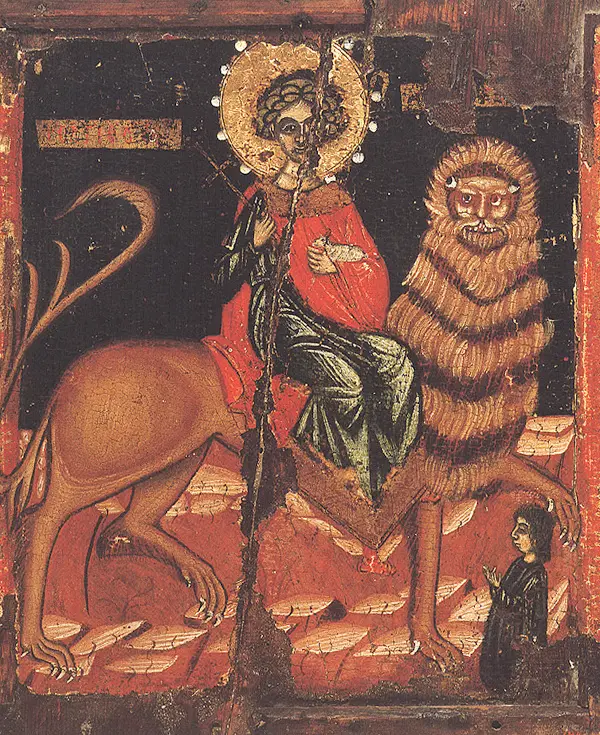
This is why Orthodox iconography often portrays him as a youthful shepherd seated upon or accompanied by a lion, with a lamb or young animal in his arms. The animals are not decorative folklore. They proclaim the Church’s conviction that holiness restores the peace between the human person and creation that was wounded by sin.
The Soldiers and the Lion
When the fame of Mamas spread through Caesarea, soldiers were sent to arrest him. They met him on the mountain but mistook him for an ordinary shepherd. The saint welcomed them, offered them milk and then revealed his identity, knowing that martyrdom awaited him.
He told the soldiers to go ahead and promised to meet them at the city gate. Mamas kept his word and arrived accompanied by a lion. He did not use the animal to attack his captors or save himself. Instead, he surrendered voluntarily, showing that the courage of a martyr rests in faithfulness to Christ rather than in violence.
Torture and Martyrdom
The deputy governor Alexander subjected the young saint to prolonged and severe tortures. A voice from heaven strengthened him with the words, “Be strong and take courage, Mamas.” When he was thrown before wild beasts, they would not harm the one whose sanctity they had already recognized in the wilderness.
Finally, a pagan priest struck him with a trident. Mortally wounded, Mamas walked beyond the city and entered a small stone cave. There God called His martyr into the heavenly Kingdom, and the saint surrendered his soul. Christians buried him at the place of his death. The Church commemorates his parents, Theodotus and Rufina, together with the son whose faith completed their family’s offering.
Ancient Miracles and Intercession
The Orthodox life records the angelic rescue from drowning, the obedience of wild animals, the heavenly voice during torture and the refusal of the beasts in the arena to attack him. It also says that many healings took place through his holy relics after his martyrdom.
Saint Basil the Great bears especially important witness to the already-established local veneration of Mamas in the fourth century. In a sermon recalled by the Orthodox Church in America, he called upon those who had received help, guidance, healing, restoration of children and prolongation of life through the martyr’s intercession to gather and praise him. This early ecclesiastical testimony is stronger than later stories repeated without identifiable sources.
Relics, Shrines and Worldwide Veneration
The martyr was first buried near Caesarea, where his memory and help were known to the faithful. Over the centuries, traditions concerning portions of his relics developed in several regions. Because individual claims require separate historical verification, this page does not present every later attribution as equally certain.
One of the best-known Orthodox sanctuaries bearing his name is the Church of Saint Mamas at Morphou in Cyprus, documented in material published by the Church of Cyprus. The saint holds an exceptionally prominent place in Cypriot devotion, and his image riding the lion is closely associated with the island. His veneration also spread through Cappadocia, Greece, Cyprus and beyond, while churches, chapels and local feasts preserve his memory in many Orthodox communities.
Liturgical and Spiritual Meaning
The troparion calls Mamas a divine offspring of martyrs who followed the steps of his parents. The kontakion presents him as a shepherd who leads the faithful into life-giving pastures and as a fervent intercessor for those in danger. These hymns interpret every episode of his life through Christ: the orphan is protected by divine providence, the child becomes a teacher, the wilderness becomes a church and apparent defeat becomes victory.
Saint Mamas also teaches that Christian courage does not depend on age. He confessed Christ as a schoolboy, used the gifts of creation to feed the poor, welcomed the soldiers sent to seize him and faced death without hatred. His authority over animals is secondary to his mastery over fear and his unwavering love for the Savior.
Feast Day
September 2 — Holy Great Martyr Mamas of Caesarea in Cappadocia, together with his parents, the Martyrs Theodotus and Rufina.
From the Orthodox Synaxarion
The Prologue from Ohrid remembers Saint Mamas as a young confessor formed in the faith from childhood. His pastoral way of life and courage before the authorities became signs of innocence joined to an unshakable confession of Christ.
Historical Record and Ecclesiastical Tradition
His Christian parents, adoption by Ammia, youthful confession, wilderness life and martyrdom form the shared hagiographical account. The animals, angelic deliverance and heavenly voice are identified as Synaxarion testimony; Saint Basil's early sermon provides especially strong evidence for his established fourth-century veneration.
Biographical information on this page is based exclusively on the Orthodox ecclesiastical sources listed below.
Orthodox Church in America — Martyr Mamas of Caesarea in CappadociaOrthodox Church in America — Troparion and Kontakion of Saint MamasChurch of Cyprus — Christian monuments of Cyprus, including the Church of Saint Mamas in MorphouThe Prologue from Ohrid — September 2