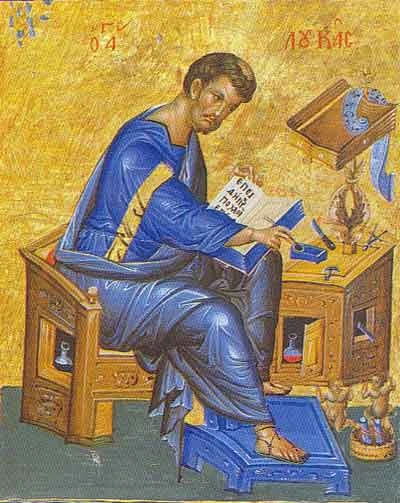
Apostle, Evangelist & Physician
Holy Apostle and Evangelist Luke
The beloved physician, companion of Saint Paul and writer of the Gospel and Acts of the Apostles.
Core account checked against Orthodox Church in America — Apostle and Evangelist Luke, Orthodox Synaxarion — Saint Luke the Evangelist. Additional ecclesiastical references appear below.
Life and Witness
Physician and Witness of the Gospel
The Orthodox Church remembers Saint Luke as an apostle, evangelist, physician and companion of Saint Paul. Tradition places his origin in Antioch of Syria. The New Testament names him among Paul’s fellow workers and identifies him as the beloved physician.
His Christian witness united care for others with the proclamation of salvation. The Church receives him as the author of the Gospel according to Luke and the Acts of the Apostles, two works that carry the reader from the coming of Christ to the spread of the apostolic Church.
The Road to Emmaus
Luke’s Gospel recounts how the risen Lord joined two disciples traveling to Emmaus. Christ opened the Scriptures to them, and they recognized Him in the breaking of bread. The Gospel names Cleopas but leaves the other disciple unnamed.
Orthodox tradition identifies that unnamed companion as Luke. This identification belongs to the Church’s received tradition, while the Gospel text itself preserves the second disciple’s anonymity. The encounter expresses themes central to Luke’s witness: the fulfillment of Scripture, the Resurrection and recognition of Christ.
Companion of Saint Paul
Luke accompanied Saint Paul and shared the labor of the Gospel. References in Colossians, Philemon and Second Timothy preserve his connection with the apostle. The brief statement in Second Timothy that Luke remained with Paul conveys the steadfastness of that companionship.
The Acts of the Apostles also contains passages narrated in the first-person plural, traditionally connected with Luke’s participation in the journeys described. His writing is received within the Church as the testimony of a companion who served the apostolic mission.
The Gospel according to Luke
The opening of Luke’s Gospel describes careful investigation and the writing of an orderly account so that the reader may understand the certainty of the teaching received. The book preserves the Annunciation, the Visitation, the Magnificat and accounts of Christ’s birth and childhood.
Its narrative repeatedly returns to mercy, repentance, prayer, the Holy Spirit and care for the poor. The Good Samaritan and the Prodigal Son give memorable expression to compassion and the recovery of the lost. These passages form part of the Church’s continuing reading of the Gospel.
The Mother of God and the Acts of the Apostles
Luke preserves details concerning the Theotokos that are especially cherished in Orthodox worship. Tradition holds that he received important testimony from the Mother of God herself. The Gospel records both her response to God and her place within the mystery of the Incarnation.
In Acts, Luke narrates the Ascension, Pentecost, the apostolic preaching and the growth of Christian communities. The story moves from Jerusalem toward Rome, showing the proclamation of Christ passing beyond its first setting and gathering people into the life of the Church.
The Tradition of the First Icons
Orthodox tradition also honors Luke as an iconographer and associates him with the earliest icons of the Mother of God. The Hodegetria type, in which the Theotokos directs attention toward Christ, is especially connected with this remembrance.
The attribution belongs to ecclesiastical tradition. It should not be treated as a documentary authentication of every surviving icon later associated with his name. The Church’s remembrance joins his written proclamation of Christ to the visual confession of the Incarnation.
Later Mission, Repose and Relics
After the martyrdoms of Peter and Paul, tradition remembers Luke continuing his preaching in several regions, including Achaia, Libya and Egypt. His earthly life is particularly associated with Thebes. Orthodox accounts commonly remember him as a martyr, while the Greek Synaxarion also records a tradition of peaceful repose in old age.
The same Synaxarion records the transfer of his relics to the Church of the Holy Apostles in Constantinople in 357. The differences concerning his final years are retained rather than combined into an artificially precise account.
The Feast of the Evangelist
The Orthodox Church celebrates the Holy Apostle and Evangelist Luke on October 18. His feast honors the physician, missionary and writer through whose Gospel and Acts generations of Christians have heard the proclamation of Christ.
His example joins careful testimony to faithful companionship. The evangelist who wrote of mercy also shared the practical labor of the apostolic mission. Holy Apostle and Evangelist Luke, pray to God for us.
Biographical information on this page is based exclusively on the Orthodox ecclesiastical sources listed below.
Orthodox Church in America — Apostle and Evangelist LukeOrthodox Synaxarion — Saint Luke the Evangelist