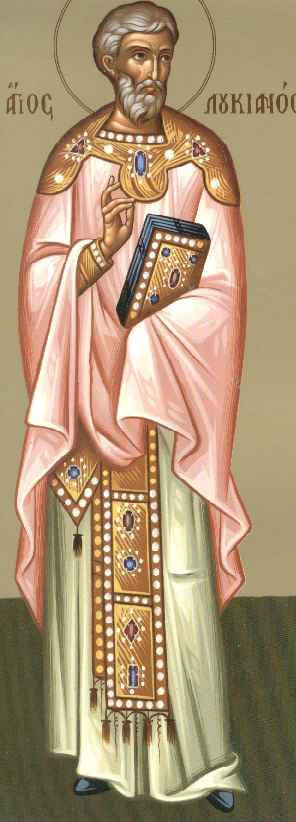
Priest, Biblical Teacher & Martyr
Hieromartyr Lucian, Presbyter of Antioch
The teacher of Scripture who strengthened prisoners and, according to Orthodox tradition, celebrated the Eucharist upon his own chest.
Core account checked against Orthodox Church in America — Martyr Lucian the Presbyter of Antioch, Orthodox Synaxarion — Hieromartyr Lucian of Antioch and liturgical texts. Additional ecclesiastical references appear below.
Life and Witness
A Young Christian of Samosata
Saint Lucian came from Samosata in Syria and belonged to a pious Christian family. According to the Orthodox Life, he lost his parents when he was twelve. He distributed his inheritance to the poor and directed his life toward the study of Scripture and the service of God.
His early renunciation joined charity to the pursuit of spiritual knowledge. The Church remembers him as a priest, teacher, ascetic and martyr whose learning was united with prayer and fidelity to Christ.
Formation at Edessa
Lucian went to Edessa and studied under Macarius the Confessor. There he learned the ascetic life while devoting himself to Holy Scripture. His education was therefore formed within a relationship of spiritual guidance, rather than pursued as scholarship alone.
Prayer, fasting and the disciplined reading of the sacred texts prepared him for the ministry that would later bring students and other Christians to him. His received Life places spiritual formation at the beginning of his work as a teacher.
Priest and Teacher in Antioch
He was ordained a presbyter and became known in Antioch for his preaching and instruction. Orthodox tradition remembers a school in which he taught students to understand Scripture and to live according to the Christian faith.
The Greek Synaxarion emphasizes the fervor of his preaching and his encouragement of Christians facing persecution. The liturgical hymns honor him as one who trained and strengthened martyrs. His responsibility as a priest continued through teaching, counsel and personal example.
Service to the Biblical Text
Lucian is also remembered for careful work on the Greek biblical text, especially the Septuagint. The Greek Synaxarion associates this work with his knowledge of Hebrew and his effort to preserve faithful readings of Scripture.
The documentary presents this textual labor as part of his service to the Church. The received accounts connect scholarship with the reading and proclamation of the Word of God. This biography follows those Orthodox accounts without identifying every surviving manuscript or assigning all later textual traditions to Lucian personally.
The Prison at Nicomedia
During the persecution associated with Diocletian, Lucian was arrested and imprisoned in Nicomedia. The longer Orthodox account describes nine years of imprisonment. Hunger, confinement and severe suffering did not end his priestly care for others.
He encouraged fellow Christian prisoners to remain steadfast in their confession. The same teacher who had helped students read Scripture now helped those around him face the possibility of martyrdom. His imprisonment became another setting for the ministry he had already embraced.
The Eucharist in Chains
Shortly before his death, Lucian desired to receive the Holy Mysteries for Theophany. Christians brought bread and wine, but he was bound in chains and too weak to stand. There was no church altar available.
According to Orthodox tradition, the priest placed the gifts upon his own chest and celebrated the Eucharist while lying in captivity. The Christians present received Holy Communion. The Church’s remembrance of this extraordinary event expresses the endurance of his priestly ministry when freedom and bodily strength had been taken from him.
Final Confession and Reverent Burial
The following day, imperial representatives came to determine whether Lucian was still alive. The received Life preserves his repeated confession that he was a Christian. He then died after prolonged imprisonment, hunger and suffering.
Tradition recounts that his body was thrown into the sea and that, thirty days later, dolphins brought it toward the shore. Christians recovered and reverently buried his remains. This account is presented as part of the Orthodox hagiographical tradition, without adding undocumented later miracle narratives.
Commemoration and Spiritual Witness
The Orthodox Church commemorates Saint Lucian of Antioch on October 15. The OCA also preserves an earlier January 7 commemoration, subsequently transferred when that day became associated with the Synaxis of Saint John the Baptist.
His Life brings together Scripture, charity, ascetic discipline and the Eucharist. His learning served the faithful; his courage strengthened prisoners; and his last days remained dedicated to Christ. The saint commemorated here is Lucian the Presbyter of Antioch, distinct from the later hieromartyr Lucian of the Kiev Caves. Holy Hieromartyr Lucian, pray to God for us.
Biographical information on this page is based exclusively on the Orthodox ecclesiastical sources listed below.
Orthodox Church in America — Martyr Lucian the Presbyter of AntiochOrthodox Synaxarion — Hieromartyr Lucian of Antioch and liturgical texts