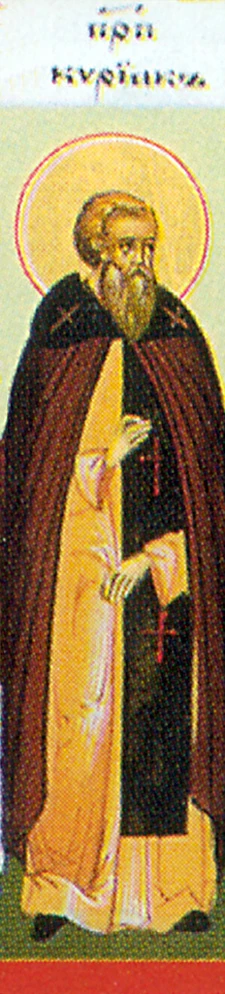
Venerable Father & Wonderworker
Venerable Kyriakos the Anchorite
✓ Comprehensive Orthodox source review completed
The Corinthian reader who became a Palestinian ascetic, defender of Orthodox doctrine and spiritual father for 109 years.
Core account checked against Orthodox Church in America — Venerable Kyriakos the Anchorite, Orthodox Church in America — Troparion and Kontakion, Greek Orthodox Archdiocese — Online Chapel, September 29. Additional ecclesiastical references appear below.
Life and Witness
The Young Reader of Corinth
Saint Kyriakos was born in Corinth to the priest John and his wife Eudokia. A relative, Bishop Peter of Corinth, recognized the child's seriousness and appointed him a reader. Constant attention to Holy Scripture awakened in him a desire to belong wholly to Christ.
Before he was eighteen, the Gospel command to deny oneself, take up the Cross and follow Christ pierced his heart during a church service. He left for Jerusalem, venerated the holy places and began a life of obedience rather than attempting solitary asceticism without guidance.
Disciple of Euthymios and Gerasimos
After a period under Abba Eustorgios near Sion, Kyriakos entered the Lavra of Saint Euthymios the Great. Saint Euthymios tonsured him and placed him under Saint Gerasimos of the Jordan, who trained the young monk in prayer, fasting, obedience and participation in the Holy Mysteries.
Following Saint Gerasimos's repose, Kyriakos returned to the Lavra of Saint Euthymios and embraced years of silence. He was ordained deacon at thirty-seven and later entered the Souka monastery founded by Saint Chariton, accepting once again the lowest obediences as a novice despite his experience.
Priest, Canonarch and Defender of Orthodoxy
Kyriakos was ordained priest and served as canonarch for eighteen years, safeguarding the order of the services. In all, he spent thirty years at Saint Chariton's monastery. His nightly Psalter, little sleep, fasting and freedom from malice made his life a hidden school of repentance.
In old age he also defended the Orthodox faith against Origenist errors. The Life written by Cyril of Scythopolis presents him as a witness who combined strict asceticism with doctrinal vigilance. The reported vision of the Theotokos, Saint John the Baptist and Saint John the Theologian emphasizes that spiritual experience cannot be separated from fidelity to the Church's confession.
The Desert, Healings and the Lion
Seeking solitude, Kyriakos moved through the wildernesses of Natoufa, Rouva and Sousakim. The sick and those troubled by demons nevertheless found him, and the Orthodox Life records healings through prayer, the sign of the Cross and anointing with oil. He repeatedly withdrew, not from contempt for people, but from a desire for undistracted prayer.
Tradition says that in his final desert dwelling a great lion lived peacefully beside him, guarded him from robbers and ate from his hand. When stored water disappeared in the summer heat, the saint prayed and rain filled the rock hollow. These accounts are received as hagiographical testimony, not as ordinary natural-history claims.
A Life of 109 Years
Two years before his repose, Kyriakos returned to Saint Chariton's cave at Souka. Though extremely old, he remained active in prayer and work. He summoned the brethren, blessed them and fell asleep in the Lord after a life traditionally counted as 109 years.
The Church commemorates the Venerable Kyriakos the Anchorite on September 29. His name, derived from the Greek word for Lord, expresses the purpose of his long life: to belong to Christ through Scripture, obedience, Eucharistic communion, ascetic labor and love for those who sought help.
Source-Critical Summary
The principal narrative is preserved by Cyril of Scythopolis, a sixth-century monk familiar with the Palestinian monastic world. The stable account includes Kyriakos's Corinthian origin, journey to Palestine, formation under Euthymios and Gerasimos, service at Souka, desert withdrawals, defense of Orthodox doctrine and repose at an advanced age.
The exact chronology of every move and the stories of healings, miraculous rain, the lion and the vision of the Theotokos are presented as the Church's received Life. They are not exaggerated into guarantees of automatic miracles, and the lion of the hagiography is not confused with a modern zoological report.
Biographical information on this page is based exclusively on the Orthodox ecclesiastical sources listed below.
Orthodox Church in America — Venerable Kyriakos the AnchoriteOrthodox Church in America — Troparion and KontakionGreek Orthodox Archdiocese — Online Chapel, September 29GOARCH Digital Chant Stand — Menaion for September 29