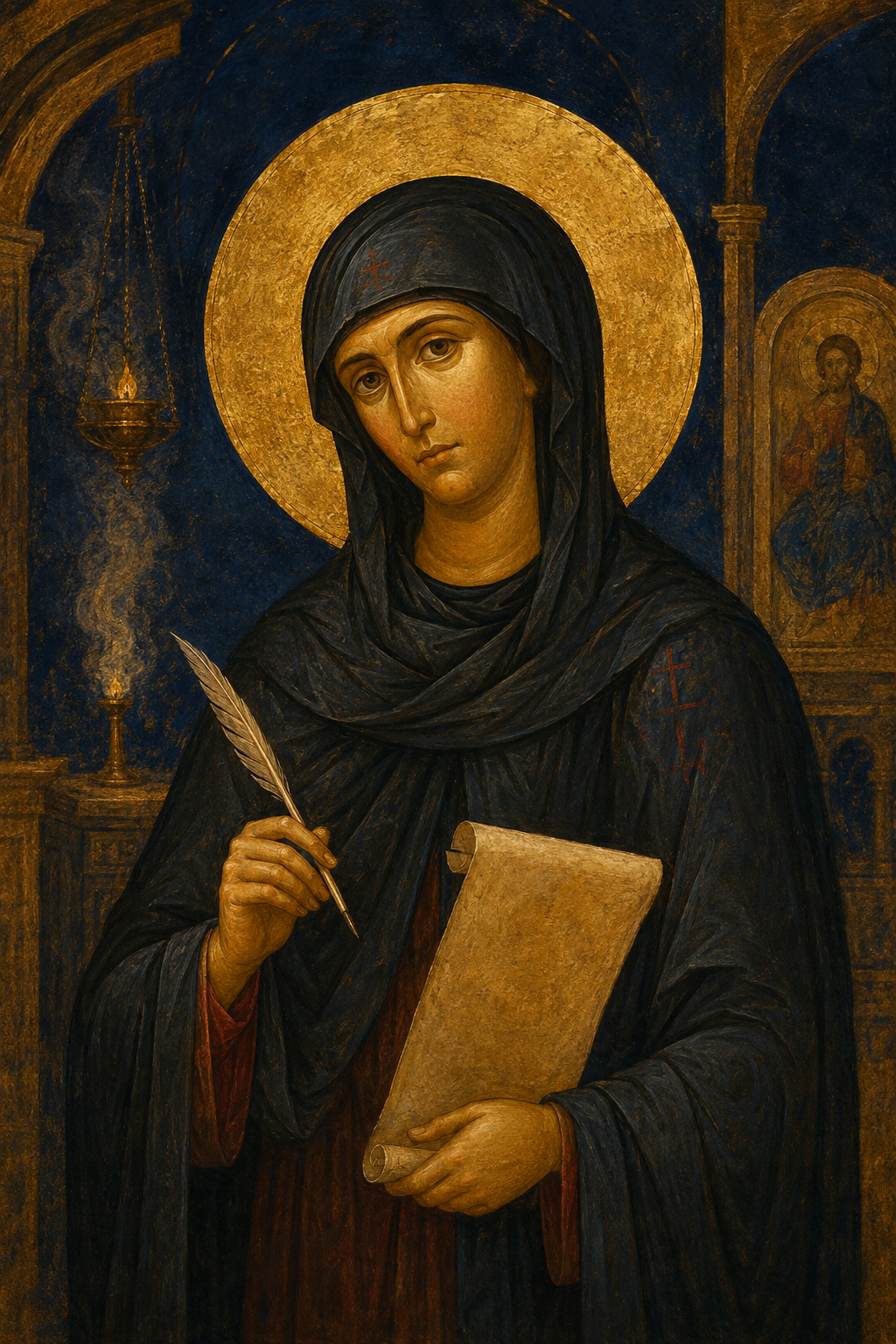
Venerable Nun & Hymnographer
Saint Kassiani
✓ Comprehensive Orthodox source review completed
Poet, composer and monastic whose hymns still give voice to repentance and divine love.
Core account checked against St. Mary Antiochian Orthodox Church — Saint Kassiani, Saint Andrew Greek Orthodox Church — Saint Kassiani the Hymnographer and Poet, Holy Trinity Greek Orthodox Church — Hymn of Kassiani. Additional ecclesiastical references appear below.
Life and Witness
Historical Setting and Early Life
Saint Kassiani, also known as Kassia or Kassiane, lived in Constantinople during the first half of the ninth century, when the Byzantine Empire was still wounded by the second period of Iconoclasm. The imperial authorities opposed the public veneration of the holy icons, while confessors, monastics and faithful laypeople defended the teaching received by the Church and solemnly affirmed at the Seventh Ecumenical Council. Kassiani came from an educated and prosperous family and received an unusually broad education for a woman of her period. The ecclesiastical accounts remember her not merely for learning, but for the discernment and fearless speech with which she placed that learning at the service of the Orthodox faith.
The well-known account of the imperial bride-show places the young Kassiani before Emperor Theophilos. When the emperor made a disparaging remark about woman through the fall of Eve, Kassiani answered by pointing to the supreme good that also came through a woman: the Incarnation of Christ from the Most Holy Theotokos. The exchange is preserved in Orthodox accounts as a sign of her theological intelligence and courage. It should not be turned into a romantic legend: the Church remembers Kassiani primarily as a nun, confessor and hymnographer, not as a disappointed candidate for an earthly throne.
Confession During Iconoclasm
Kassiani openly honored the sacred images of Christ, the Theotokos and the saints at a time when doing so could bring punishment. Orthodox accounts describe her as helping imprisoned icon-venerators and enduring persecution herself. Her confession rested on the Church’s teaching that honor shown to an icon passes to the person depicted, and that the image of Christ proclaims the reality of the Incarnation: the eternal Word truly assumed visible human nature and entered history for our salvation.
Her witness therefore joined doctrine to mercy. Defense of the icons was not an abstract cultural struggle, but fidelity to Christ and solidarity with those who suffered for the Orthodox confession. Peace was restored to the Church in 843 under Empress Theodora, an event commemorated on the Sunday of Orthodoxy. Kassiani belongs to the generation whose endurance helped preserve that confession.
Monastic Life and Her Convent
Saint Kassiani embraced the monastic life and around the year 843 founded a women’s monastery in Constantinople, becoming its first abbess. There she ordered her life around prayer, fasting, obedience, spiritual motherhood and the common worship of the Church. Her monastery also provided the setting in which her theological poetry and music could be composed, tested in prayer and sung by a community rather than treated as private literary work.
As abbess, Kassiani carried responsibility for the spiritual formation of the sisters entrusted to her. The surviving tradition presents no division between her asceticism and her artistry. Her hymns arose from the same life of repentance and contemplation that shaped her monastic vocation. For this reason the Orthodox Church receives her work not simply as Byzantine literature, but as theology expressed in liturgical poetry.
Hymnography and Theological Work
About fifty hymns have been associated with Saint Kassiani, although the attribution of some compositions differs among manuscripts. Orthodox parish sources note that twenty-three of her hymns entered the liturgical books of the Church. She wrote stichera and other hymns for feasts of the Lord, the Mother of God, martyrs and saints. Her language combines biblical imagery, doctrinal precision and a profound awareness of repentance.
Her hymnography repeatedly places the faithful within the saving events being celebrated. Sin is not treated sentimentally, and repentance is never reduced to despair. The sinner stands before the merciful Christ, confesses the depth of the fall and reaches toward the One whose compassion is deeper still. This union of compunction and hope is one reason her work has remained alive in Orthodox worship for more than a thousand years.
The Hymn of Kassiani in Holy Week
Her best-known composition is the doxastikon commonly called the Hymn of Kassiani. It is appointed at the Aposticha of the Bridegroom Matins for Great and Holy Wednesday, normally celebrated in parish practice on Holy Tuesday evening. The hymn gives voice to the woman who anointed the Lord with precious myrrh before His Passion. It does not identify her with Saint Mary Magdalene; rather, it prayerfully develops the Gospel image of the repentant woman approaching Christ.
The woman recognizes both her sin and the divinity of the One before her. Her tears become a spiritual counterpart to the waters of the sea, and her act of anointing anticipates the burial of the Savior. The hymn moves from shame to confession, from fear to bold supplication, and finally to trust in the immeasurable mercy of Christ. Sung near the beginning of the Lord’s Passion, it calls every worshipper to enter Holy Week through repentance.
A later ecclesiastical story relates that Emperor Theophilos once entered Kassiani’s monastery while she was composing the hymn and added a line concerning Eve hearing the footsteps of God in Paradise. Kassiani is then said to have retained the line and completed the hymn. This account is part of the received devotional tradition surrounding the composition; the hymn’s liturgical authority, however, rests in its reception and continual use by the Orthodox Church.
Miracles and Spiritual Legacy
The Orthodox sources consulted for this page do not provide a securely documented series of posthumous miracles comparable to those preserved for certain wonderworking saints. It would therefore be misleading to invent healings, apparitions or interventions and attribute them to Saint Kassiani. Her sanctity is witnessed above all through her Orthodox confession, monastic life and the hymns that the Church continues to sing.
Her enduring liturgical ministry is itself an extraordinary spiritual legacy. Each Holy Week, in Orthodox churches across the world, her words lead clergy, chanters and faithful into contrition before the Passion of Christ. Through them, generations who lived centuries after her have learned to pray, repent and hope in divine mercy. The faithful may seek her intercessions as they do those of every saint, while distinguishing prayerful veneration from unverified miracle stories.
Monastery, Tomb Tradition and Worldwide Veneration
The monastery founded by Saint Kassiani stood in Constantinople, traditionally located in the western part of the city near the Constantinian walls. The original community and buildings have not survived in an identifiable form that can function today as an international pilgrimage center. Nevertheless, its true inheritance remains present wherever Kassiani’s hymns are used in the worship of the Church.
A local tradition on the Greek island of Kasos holds that Kassiani travelled there near the end of her life and reposed on the island. A marble tomb and a chapel associated with her memory are shown to pilgrims. Because details of her final journeys vary in later accounts, this should be presented as the ecclesiastical tradition of Kasos rather than as an event documented with the same certainty as her Constantinopolitan monastic foundation and hymnographic work.
Her widest shrine is liturgical rather than geographical. The Hymn of Kassiani is chanted in Greek, Arabic, Church Slavonic, English and many other languages in Orthodox cathedrals, monasteries and parishes throughout the world. Her commemoration on September 7 and her annual presence in Holy Week have made her one of the best-known women hymnographers in the entire Orthodox tradition.
Feast Day
September 7 — Venerable Kassiani the Hymnographer.
From the Orthodox Synaxarion
The ecclesiastical account emphasizes that Saint Kassiani united monastic obedience with the defense of the holy icons. Her hymnography was received into the worship of the Church, where it continues to call the faithful to repentance and love for Christ.
Historical Record and Ecclesiastical Tradition
The saint's authorship of major hymns and her defense of the holy icons belong to the stable ecclesiastical witness. The famous exchange with Emperor Theophilos is preserved hagiographically, while individual attributions within the hymnographic corpus require textual caution.
Biographical information on this page is based exclusively on the Orthodox ecclesiastical sources listed below.
St. Mary Antiochian Orthodox Church — Saint KassianiSaint Andrew Greek Orthodox Church — Saint Kassiani the Hymnographer and PoetHoly Trinity Greek Orthodox Church — Hymn of KassianiMystagogy — The Tomb of Saint Kassiani in Kasos (local ecclesiastical tradition)