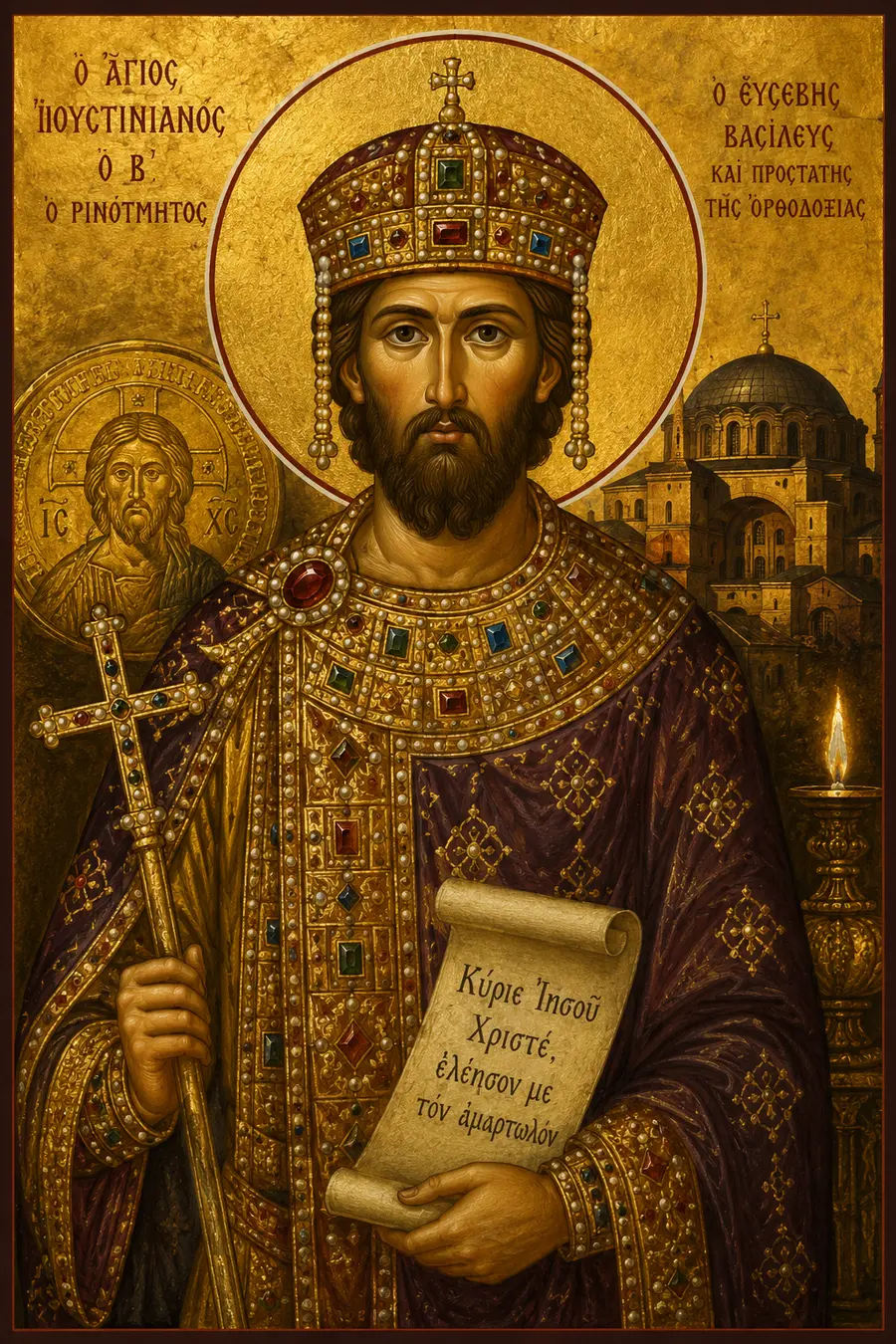
Right-believing Emperor
Saint Justinian II, Emperor
✓ Comprehensive Orthodox source review completed
The Byzantine emperor remembered in Church tradition for repentance and defense of the Orthodox faith.
Core account checked against Orthodox Church in America — Lives of the Saints, August 2, Orthodox Church in America — Lives of the Saints, August 2, Ecumenical Patriarchate — Conciliar and ecclesiastical history. Additional ecclesiastical references appear below.
Life and Witness
A Difficult Imperial Life
Justinian II ruled the Byzantine Empire in two separate periods marked by political violence, exile and restoration. He was deposed and mutilated, later returned to the throne and was finally killed in 711.
Sources about his personal sanctity and liturgical status are not uniform across Orthodox calendars. This page therefore distinguishes established imperial history from local or limited ecclesiastical commemoration.
Church Councils and Religious Policy
His reign included the Quinisext Council in Trullo, whose canons addressed liturgical and disciplinary life. The reception and authority of these canons belong to the wider conciliar tradition, not to the emperor acting alone.
Justinian also promoted Christian imagery, including the image of Christ on coinage. These acts must be considered alongside the severity and instability of his rule.
Historical Caution
The Church does not canonize political success, revenge or imperial power. Where Justinian II appears in a local calendar, his memory must be approached through the judgment of that ecclesiastical tradition.
August 2 — Commemoration attributed to the right-believing Emperor Justinian II in certain local sources.
From the Orthodox Synaxarion
The ecclesiastical commemoration must be read with sobriety: Justinian II’s turbulent reign included exile and restoration, while the Church’s calendar emphasizes repentance and concern for Orthodox order rather than presenting political power itself as holiness.
Historical Record and Ecclesiastical Tradition
Justinian II is a well-documented Byzantine emperor whose two reigns, the Council in Trullo, mutilation, restoration and violent death belong to political and ecclesiastical history. His listing as a saint on August 2 is not uniform in the principal Orthodox calendars, so the page does not claim universal canonization and explicitly treats the title and commemoration as limited or local unless a competent Church authority supplies stronger evidence.
Biographical information on this page is based exclusively on the Orthodox ecclesiastical sources listed below.
Orthodox Church in America — Lives of the Saints, August 2Orthodox Church in America — Lives of the Saints, August 2Ecumenical Patriarchate — Conciliar and ecclesiastical history