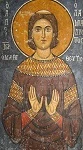
Venerable Ascetic & Wonderworker
Venerable John Lampadistis of Cyprus
✓ Comprehensive Orthodox source review completed
The young Cypriot ascetic who answered blindness with forgiveness and became a beloved intercessor of the Marathasa valley.
Core account checked against Orthodox Metropolitanate of Hong Kong and South East Asia — Saint John Lampadistis, Mystagogy Resource Center — Saint John the Lampadistes, Cyprus Department of Antiquities — Monastery of Agios Ioannis Lampadistis. Additional ecclesiastical references appear below.
Life and Witness
A Child of Lampadou in Cyprus
Saint John Lampadistis was born in the tenth century in the village of Lampadou, near the modern communities of Galata and Mitsero in Cyprus. His parents, the priest Kyriakos and Anna, were devout Christians who gave their only child a careful education in Holy Scripture and the life of the Church.
The Cypriot ecclesiastical tradition remembers him as pure in heart, gentle in conduct and drawn from youth toward complete dedication to God. The surname Lampadistis refers to his native place; he must not be confused with Saint John Lampados or with other saints named John.
Blindness, Forgiveness and Renunciation
The received Life says that John's parents arranged a marriage for him, while he desired a life of chastity and prayer. Some accounts call the young woman his wife and others his betrothed. Her father, angered by John's decision, employed a practitioner of magic who placed poison in fish served to John, and the poison left him blind.
John endured the loss of his sight without hatred. He forgave those responsible, comforted his parents and refused to let suffering become a reason for vengeance. The Church therefore remembers the episode chiefly as a witness to forgiveness and patient trust in Christ, not as an invitation to fascination with magic or poison.
Ascetic Life in Marathasa
With a faithful guide, also named John, the young ascetic left Lampadou and went to the Marathasa valley. He settled at the monastery associated with Saint Herakleidios, who was also remembered as coming from Lampadou, and devoted himself to unceasing prayer, fasting, vigil, spiritual instruction and works of mercy.
Later Cypriot testimony, including the chronicle of Leontios Machairas, calls him the great John Lampadistis of Marathasa and remembers him as a deacon. His hidden life of prayer drew people seeking help, and local Orthodox tradition attributes healings and deliverance from demonic affliction to his intercession.
Repose at Twenty-Two
Saint John lived only a short earthly life. Three days before his repose, the hagiographical account says that his sight returned and that he saw three radiant birds circling above him, a sign interpreted as a summons from the Holy Trinity. He prayed and peacefully surrendered his soul to God at the age of twenty-two.
His parents and the monastic brotherhood buried him reverently. His feast is celebrated on October 4. The exact year of his repose is not securely established, but the Church of Cyprus places his life in the tenth century.
Monastery, Relics and Living Veneration
The Monastery of Saint John Lampadistis at Kalopanagiotis preserves the center of his veneration in the Marathasa valley. The church complex, built around the older church of Saint Herakleidios and the chapel of Saint John, preserves important Byzantine and post-Byzantine wall paintings and belongs to the painted churches of the Troodos region.
Ecclesiastical sources record his holy skull at Kykkos Monastery and another portion of his relics at Stavrovouni, while churches dedicated to him stand at Pelendri and elsewhere in Cyprus. Claims of healing belong to the living devotional tradition of the local Church and are presented as testimony, not as laboratory or medical documentation.
Source-Critical Summary
The stable Cypriot Orthodox tradition preserves John's origin at Lampadou, his priestly parents, youthful chastity, blindness, forgiveness, ascetic life in Marathasa, early repose and October 4 commemoration. The monastery and enduring local cult provide material evidence for the long history of his veneration.
The arranged marriage or betrothal, the precise means of poisoning, the vision before death and individual miracles are hagiographical details preserved in later ecclesiastical sources. The page keeps those details explicitly within their genre and does not present them as a contemporary civil biography.
Biographical information on this page is based exclusively on the Orthodox ecclesiastical sources listed below.
Orthodox Metropolitanate of Hong Kong and South East Asia — Saint John LampadistisMystagogy Resource Center — Saint John the LampadistesCyprus Department of Antiquities — Monastery of Agios Ioannis Lampadistis