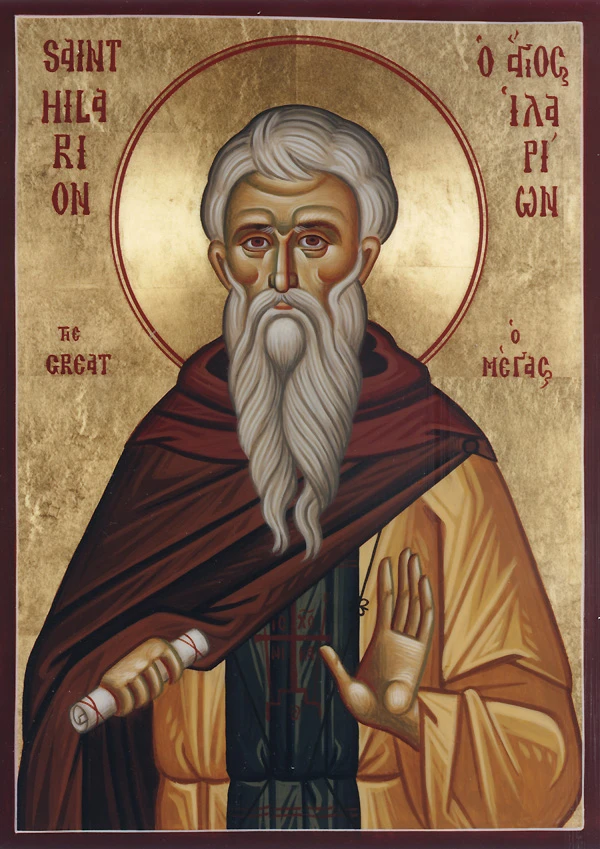
Desert Father & Wonderworker
Venerable Hilarion the Great
The disciple of Saint Anthony whose prayer, perseverance and spiritual guidance helped shape Palestinian monasticism.
Core account checked against Orthodox Church in America — Venerable Hilarion the Great, Orthodox Synaxarion — Saint Hilarion the Great and liturgical texts. Additional ecclesiastical references appear below.
Life and Witness
From Gaza to the Christian Faith
Saint Hilarion the Great is remembered as one of the great fathers of Palestinian monasticism. He came from Thabatha near Gaza, where he was raised by pagan parents. His family sent him to Alexandria for his education.
In Alexandria he encountered Christianity and received Baptism. The discovery of the faith changed the direction of his life. Learning about Saint Anthony the Great, he sought the Egyptian ascetic so that he might learn the life of prayer and the service of God.
Learning from Saint Anthony
Hilarion’s encounter with Anthony connected his vocation with the flourishing monastic life of Egypt. He desired to imitate the elder’s dedication to God, rather than merely hear reports about it.
When he returned to his homeland, his parents had died. He distributed his inheritance to the poor and withdrew into the wilderness near Maiuma. His renunciation joined generosity to a deliberate choice of prayer, fasting, labor and ascetic discipline.
The Struggle in the Wilderness
The received Life describes severe temptations and frightening experiences during his solitude. He heard cries and the roaring of wild beasts at night. Orthodox tradition understands these terrors as part of the spiritual struggle through which the ascetic was tempted to abandon the desert.
Hilarion answered fear with prayer and perseverance. His Life presents the wilderness as a place where the passions had to be confronted and where trust in God was learned through sustained effort. The saint’s endurance is remembered alongside his later gifts of healing and discernment.
The Encounter with Thieves
One episode preserved in the Greek Synaxarion describes thieves questioning Hilarion about what he would do if robbers came upon him. His poverty left him without possessions to defend, and his hope in the life to come freed him from the fear they expected.
He met their threats without violence. The account says that his words moved the robbers to repentance. His encounter with them is therefore remembered as an act of spiritual instruction, expressing the freedom that came from renunciation.
Healing and Spiritual Discernment
According to Orthodox tradition, Hilarion prayed for the sick and helped people afflicted by unclean spirits. These gifts drew many visitors, and his reputation spread throughout Palestine. The Church attributes the healings to the grace of God working through his prayer.
Those seeking spiritual guidance also came to him. His discernment was remembered together with ascetic discipline and compassion. The gift of helping others did not become a reason to abandon his own struggle for humility and prayer.
A Father of Palestinian Monasticism
Disciples gathered around Hilarion, and monastic communities grew under his influence. His life became an example for others who sought to dedicate themselves to God through obedience, labor and ascetic practice.
Yet his growing reputation created a tension that remained throughout his later years. The more widely he became known, the more he sought solitude. He continued to withdraw from attention while the monastic life he had helped establish spread beyond his own place of retreat.
Cyprus, Repose and the Holy Relics
After journeys through several regions, Hilarion eventually settled in Cyprus. The Greek Synaxarion associates his final years with the area of Paphos. He completed his earthly life in prayer and solitude.
The OCA dates his repose to approximately 371–372; the Greek entry gives a different chronology. The accounts agree on the main course of his vocation and his final association with Cyprus. The Greek Synaxarion records that his disciple Hesychius later conveyed his relics to Palestine, where they were received with honor at Maiuma. It also lists portions of his relics at Proussos and Kykkos monasteries.
Commemoration on October 21
The Orthodox Church celebrates Saint Hilarion the Great on October 21. His liturgical remembrance praises ascetic perseverance and the grace of healing. He is distinguished from the later saints named Hilarion who followed in the monastic tradition.
His Life joins solitude to service: the man who sought the wilderness also became a guide for disciples and a source of help for those who suffered. Venerable Father Hilarion, pray to God for us.
Biographical information on this page is based exclusively on the Orthodox ecclesiastical sources listed below.
Orthodox Church in America — Venerable Hilarion the GreatOrthodox Synaxarion — Saint Hilarion the Great and liturgical texts