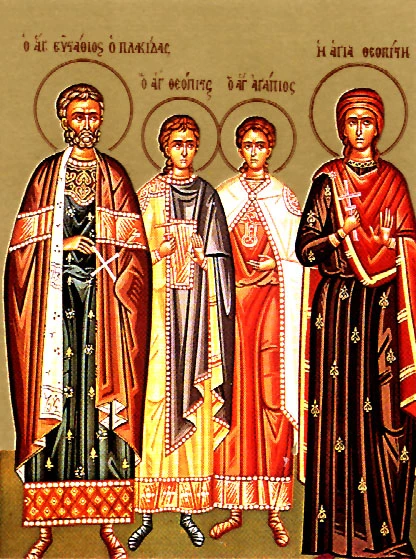
Great Martyr and Family of Martyrs
Great Martyr Eustathius Placidas and His Family
✓ Comprehensive Orthodox source review completed
The Roman commander called through the vision of the Cross, tested like Job, reunited with his family and crowned with them in martyrdom.
Core account checked against Orthodox Church in America — Greatmartyr Eustathius Placidas and His Family, Orthodox Church in America — September 20 Troparion and Kontakion, Ancient Faith Ministries — Great Martyr Eustathius Placidas with His Family. Additional ecclesiastical references appear below.
Life and Witness
Plakidas, the Merciful Roman Commander
The Orthodox Church commemorates the Holy Great Martyr Eustathius Placidas together with his wife Theopiste and their sons Agapius and Theopistus on September 20. Before Baptism he was called Plakidas, and the received ecclesiastical life describes him as a distinguished Roman commander during the reigns of Titus and Trajan. Even before knowing Christ, he was noted for mercy toward the poor and afflicted.
The life is transmitted as sacred hagiography rather than as a surviving Roman military record. Its purpose is to reveal how divine grace calls a person who already responds to the natural law through compassion, while making clear that virtue reaches its fulfillment in faith, Baptism and communion with Christ.
The Vision of the Cross between the Stag’s Antlers
While hunting, Plakidas pursued a stag and saw a radiant Cross between its antlers. From the Cross he heard the voice of Christ calling him by name and revealing that the mercy he had shown unknowingly honored the Lord. Plakidas confessed Christ and was instructed to seek Baptism.
His wife Tatiana had also received a dream calling the family to the true God. A Christian bishop baptized them: Plakidas received the name Eustathius, Tatiana became Theopiste, and their sons were named Agapius and Theopistus. The stag and Cross became the best-known iconographic sign of the saint’s conversion, but the Church venerates Eustathius for his whole confession and martyrdom, not merely for the vision.
Trials after Baptism: The Patience of Job
Returning to the place of his conversion, Eustathius was warned that severe trials would follow, like those of righteous Job. Disease took his servants, his livestock perished and the family lost its wealth. They departed in poverty without renouncing the faith they had received.
During a sea journey the shipmaster separated Theopiste from her husband and children. Later, while Eustathius was carrying his sons across a river one at a time, a lion seized one child and a wolf the other. Believing his family lost, he grieved deeply yet refused despair. Unknown to him, the boys were rescued and Theopiste was preserved unharmed. The account presents endurance as trust in God amid genuine sorrow, not as the denial of grief.
Hidden Labor, Return to Command and Reunion
Eustathius lived in obscurity and worked for five years in the village called Badessos in the Synaxarion. When Rome again needed its former commander, his friends Antiochus and Acacius found him by recognizing a scar. He returned to his military rank and led the imperial forces.
Two capable young soldiers serving under him were, without anyone knowing it, his sons. Their conversation revealed their shared childhood, and Theopiste, living nearby, recognized them and then her husband. Thus the family was reunited. The precise geography and military campaign cannot be independently reconstructed; the stable ecclesiastical meaning is the restoration granted after faithful endurance.
Refusal of Sacrifice and the Martyrdom of the Family
After the victory, Hadrian ordered a pagan sacrifice. Eustathius refused, declaring that he was a Christian and owed thanksgiving to Christ alone. The emperor stripped him of rank and attempted to make the whole family renounce the faith, but Eustathius, Theopiste, Agapius and Theopistus remained steadfast.
They were condemned to wild beasts, which did not harm them. The four were then enclosed in a heated bronze bull and completed their martyrdom. The Orthodox life relates that their bodies were found unburned three days later and were reverently buried by Christians. These details belong to the Church’s received martyrological witness; the article does not add later sensational embellishments.
Hymnography, Iconography and Orthodox Meaning
The troparion praises Eustathius together with his wife and sons as martyrs crowned through suffering. The kontakion interprets his life as an imitation of Christ’s Passion and a faithful drinking of the Lord’s cup. The liturgical texts therefore place the entire narrative under the Cross and Resurrection, not under admiration for military power.
Orthodox icons may show the family holding crosses, the stag with the Cross between its antlers, or the final contest. Eustathius is sometimes invoked by Christians facing family separation, danger in travel or sudden loss. Such devotion is prayer for the saints’ intercession before God and is never a replacement for Christ, the one source of salvation.
Source-Critical Summary
The common Orthodox core comprises Plakidas’s merciful life and conversion through the vision of the stag and Cross; the Baptism of his family; severe losses and separation; patient fidelity; restoration to command and reunion; refusal of idolatrous sacrifice; preservation from beasts; and martyrdom together on September 20.
Names, spellings and some narrative details vary: Eustathius is also rendered Eustace or Eustathios; Theopiste as Theopista; and the sons as Agapius/Agapios and Theopistus/Theopistos. The story’s exact chronology, geography and military setting are not established by independent contemporary documentation. They are presented here as the Orthodox Church receives them, without confusing hagiographical testimony with a modern archival biography.
Historical Record and Ecclesiastical Tradition
The Church receives the life of Eustathius and his family as sacred hagiographical testimony. The principal narrative, names and liturgical commemoration are preserved, while the exact geography, campaign and chronology are not presented as independently verified Roman archival history.
Biographical information on this page is based exclusively on the Orthodox ecclesiastical sources listed below.
Orthodox Church in America — Greatmartyr Eustathius Placidas and His FamilyOrthodox Church in America — September 20 Troparion and KontakionAncient Faith Ministries — Great Martyr Eustathius Placidas with His FamilyOrthodox Christian Recorded Books — The Life and Passion of the Holy Great Martyr Eustathius Placidas