Venerable Mother
Venerable Euphrosyne of Alexandria
✓ Comprehensive Orthodox source review completed
The Alexandrian ascetic who lived for thirty-eight years as the monk Smaragdos and unknowingly consoled her grieving father.
Core account checked against Orthodox Church in America — Venerable Euphrosyne of Alexandria, Orthodox Church in America — Troparion and Kontakion, Orthodox Church in America — Complete Commemorations for September 25. Additional ecclesiastical references appear below.
Life and Witness
Childhood in Christian Alexandria
Venerable Euphrosyne was born in Alexandria at the beginning of the fifth century, the only child of wealthy and devout Christian parents. Her mother died when Euphrosyne was twelve, and her father Paphnutios raised her with deep affection while regularly seeking guidance from the abbot of a nearby monastery.
When Euphrosyne reached eighteen, her father planned an honorable marriage for her. The Church's life does not portray marriage as inferior; rather, it records that this particular young woman had received a personal calling to virginity, prayer and the monastic life.
Renunciation and the Name Smaragdos
Euphrosyne distributed her possessions to the poor and left her home. Fearing that her father would quickly find her in a women's monastery, she entered the men's monastery known to her family while dressed as a man and gave the name Smaragdos. The monks received the unknown ascetic without recognizing her identity.
This episode belongs to the received hagiographical life and should be read in its ascetical setting. Her disguise was not a rejection of the body or a general rule for Christian vocation; it was an exceptional means by which the saint sought hiddenness, freedom from an arranged marriage and uninterrupted dedication to God.
Thirty-Eight Years of Hidden Asceticism
In a solitary cell Euphrosyne spent thirty-eight years in fasting, prayer, obedience and service. The monks admired the spiritual maturity of Smaragdos, while the saint carefully avoided praise and guarded the secret of her identity. Her hidden life expresses a central monastic conviction: holiness seeks God rather than public recognition.
The video title speaks of a monk who counseled her own father. In the Church's account, Paphnutios repeatedly visited the monastery in grief over his missing daughter. The abbot sent him to Smaragdos, whose words brought him consolation, although he did not know that the ascetic before him was Euphrosyne herself.
Recognition before Her Repose
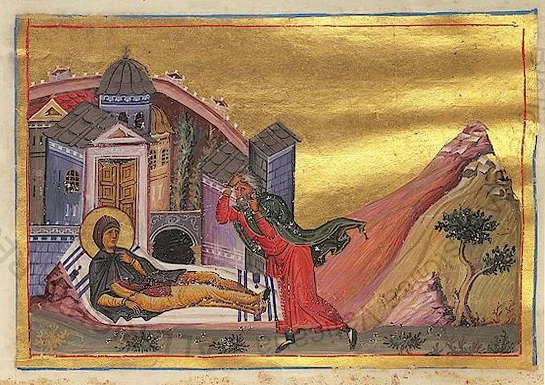
As her earthly life approached its end, Euphrosyne asked Paphnutios to remain with her for three days. She then revealed that she was his lost daughter and asked that he alone prepare her body for burial. The revelation transformed decades of grief into wonder, thanksgiving and a final act of parental love.
After burying Euphrosyne, Paphnutios gave his wealth to the poor and to the monastery, received monastic tonsure and lived for ten years in his daughter's cell. The Church commemorates father and daughter together on September 25 and also on February 15 in the OCA calendar.
Spiritual Meaning and Liturgical Memory
The Orthodox life connects Euphrosyne's witness with Titus 2:12: Christians are called to renounce worldly passions and live soberly, righteously and devoutly. Her story joins radical detachment to compassion, spiritual counsel and reconciliation between parent and child.
Her commemoration does not celebrate secrecy for its own sake. It honors freedom of vocation, perseverance in prayer and the hidden work of grace. The saint's true identity was finally disclosed not to gain fame but to heal her father's sorrow and entrust her burial to him.
Source-Critical Summary
The stable Orthodox core is that Euphrosyne was an Alexandrian Christian, the daughter of Paphnutios; she desired monastic life, entered a men's monastery under the name Smaragdos, lived there in asceticism for thirty-eight years, unknowingly counseled her grieving father and revealed herself shortly before her repose. Paphnutios then became a monk and completed his life in her cell.
Exact dialogue, secondary chronology and expanded miracle narratives differ among later retellings. This article follows the official OCA life and the Church's liturgical commemoration, presenting the disguise and recognition as received hagiographical testimony rather than claiming a surviving contemporary civil biography.
Historical Record and Ecclesiastical Tradition
The official Orthodox life supplies the stable account of Euphrosyne's Alexandrian origin, the name Smaragdos, thirty-eight years of hidden asceticism, counsel to her father and final recognition. Expanded dialogues and secondary chronology are treated as hagiographical tradition rather than a contemporaneous civil record.
Biographical information on this page is based exclusively on the Orthodox ecclesiastical sources listed below.
Orthodox Church in America — Venerable Euphrosyne of AlexandriaOrthodox Church in America — Troparion and KontakionOrthodox Church in America — Complete Commemorations for September 25Greek Orthodox Archdiocese Digital Chant Stand — September 25