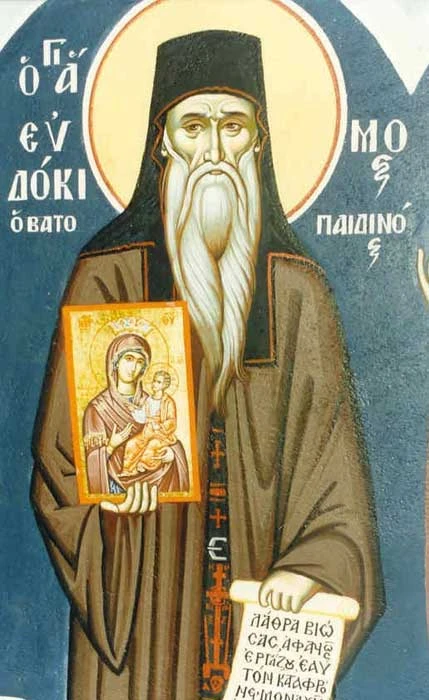
Venerable Athonite Father & Wonderworker
Venerable Eudokimos the Newly-Revealed of Vatopedi
✓ Comprehensive Orthodox source review completed
The unknown monk whose fragrant relics were discovered kneeling with an icon of the Theotokos in Vatopedi's burial vault in 1840.
Core account checked against Holy Great Monastery of Vatopedi — Saint Eudokimos, a model of humility and testimony of sanctification, Orthodox Church in America — Venerable Eudokimos of Vatopedi Monastery on Mount Athos, Orthodox Church in America — Troparion and Kontakion of Venerable Eudokimos. Additional ecclesiastical references appear below.
Life and Witness
The Unknown Monk of Vatopedi
The earthly name and biography of the Venerable Eudokimos newly revealed at Vatopedi are not known. The Church therefore does not construct a detailed life for him from conjecture. His sanctity became known through the discovery of his fragrant relics in the brotherhood's burial vault at the Holy Great Monastery of Vatopedi on Mount Athos.
His monastic clothing suggests that he reposed centuries before the discovery, probably in the first half of the seventeenth century according to the Orthodox Church in America account. What remains certain is not his former rank or public achievements, but the hidden life with God disclosed after his repose.
The Discovery of the Fragrant Relics
On October 5, 1840, while the monks were renovating the burial vault, part of its roof collapsed and covered a remote corner with rubble. As the brethren cleared the debris, a wondrous fragrance filled the place. They found the skeleton of an unknown monk clothed in a simple chiton, kneeling with his hands folded upon his breast and holding an icon of the Most Holy Theotokos.
Archbishop Chrysanthos of Smyrna, then living in retirement at Vatopedi, understood the incorrupt fragrance as testimony that the grace of the Holy Spirit had rested upon this hidden servant of God. The relics were transferred reverently to the monastery's katholikon on the evening of October 4.
The Name Eudokimos
Because the monk's original name was unknown, the brotherhood, with the blessing of the Ecumenical Patriarchate, gave him the symbolic name Eudokimos—a name associated with divine good pleasure. The monks trusted that, if the saint wished another name to be used, God would make it known.
The name expresses the heart of his veneration: an anonymous monk, hidden from human fame, had lived in a manner pleasing to God. His feast on October 5 is linked to the day on which his relics were revealed and brought into the public worship of the Church.
Healings and the Silver Reliquary
Orthodox accounts report that healings began soon after the translation of the relics. One monk suffering from consumption and near death prayed to the newly revealed saint and recovered. Another monk, Gabriel, likewise received healing through his intercession and, in gratitude, offered a precious silver reliquary for the saint's venerable head.
These events are presented as the testimony received by the monastery and the Orthodox hagiographical tradition. They are not medical case records, and veneration of the saint is never a substitute for responsible medical care. The Church gives thanks to Christ, from whom every grace and healing comes.
Was His Name Savva?
A later monastic account says that a Vatopedi monk saw the saint in a vision and heard that his true name was Savva. This led some to identify Eudokimos with Saint Savva of Vatopedi, a fourteenth-century monk.
The identification has been questioned, and no definitive judgment of the Church has established it. It must therefore remain an explicitly unproven tradition. The site preserves the name under which the saint is liturgically honored—Eudokimos—without turning the possible Savva identification into historical certainty.
A Witness to Hidden Holiness
Saint Eudokimos reveals the Orthodox understanding that holiness does not depend upon earthly recognition. No speeches, offices or public works are securely preserved from his life. His prayerful posture, the icon of the Theotokos and the fragrance of his relics became the signs by which the monastery recognized a brother who had pleased God in secret.
The Holy Great Monastery of Vatopedi continues to celebrate his memory as a model of humility and a testimony of sanctification. His relics remain connected with the monastery's worship, and his icon commonly shows him holding the image of the Mother of God found with him.
Source-Critical Summary
The discovery at Vatopedi, the unknown identity of the monk, the kneeling relics with an icon of the Theotokos, the fragrance, the translation to the katholikon, the healings and the October 5 commemoration form the received Orthodox account. One source notes a variant date of September 1841 for renovation work; this page follows the liturgically established October 5, 1840 tradition while acknowledging that archival retellings differ.
Nothing certain is known about the saint's life before his repose. The proposed identification with Savva and the explanation of how he entered the vault are preserved as possibilities or monastic traditions, not as proven biography.
Biographical information on this page is based exclusively on the Orthodox ecclesiastical sources listed below.
Holy Great Monastery of Vatopedi — Saint Eudokimos, a model of humility and testimony of sanctificationOrthodox Church in America — Venerable Eudokimos of Vatopedi Monastery on Mount AthosOrthodox Church in America — Troparion and Kontakion of Venerable EudokimosChurch of Saint George, Sylikou — Orthodox icon and October 5 commemoration