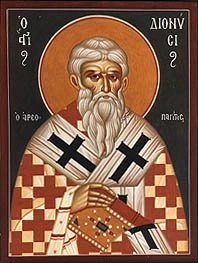
Bishop, Disciple of Saint Paul & Martyr
Hieromartyr Dionysius the Areopagite
✓ Comprehensive Orthodox source review completed
The Athenian judge named in Acts who received Saint Paul's preaching and became a shepherd of the Church of Athens.
Core account checked against Acts of the Apostles 17:16–34, Orthodox Church in America — Hieromartyr Dionysius the Areopagite, Bishop of Athens, Orthodox Church in America — Troparion and Kontakion. Additional ecclesiastical references appear below.
Life and Witness
The Athenian Who Heard Saint Paul
The secure scriptural foundation for Saint Dionysius is Acts 17:16–34. When the Apostle Paul proclaimed the unknown God and the Resurrection at the Areopagus in Athens, some mocked and others delayed judgment, but Dionysius the Areopagite believed. Scripture names him among the small company that joined Paul, together with a woman named Damaris and others.
His title indicates membership in or association with the Areopagus, Athens' ancient council and court. His conversion was not the victory of one philosophical school over another; it was the free response of an educated Athenian who received the apostolic proclamation of the crucified and risen Christ.
Disciple and Bishop of Athens
Orthodox tradition says that Dionysius became a disciple and fellow worker of Saint Paul. After formation in the apostolic faith, he was consecrated Bishop of Athens, succeeding Saint Hierotheos. In that ministry he preached Christ and shepherded the Church arising in the city of philosophers.
The Synaxarion also connects him with the Dormition of the Mother of God and preserves an account of his reverent encounter with her. These details belong to ecclesiastical tradition; Acts itself attests his conversion but does not narrate his episcopate or later travels.
Mission and Martyrdom
The received Life relates that Dionysius continued the apostolic mission after Saint Paul's martyrdom. Accompanied by the presbyter Rusticus and the deacon Eleutherius, he preached in the West and was arrested during persecution. The three confessed Christ and were beheaded.
Traditions differ about the place of his martyrdom. A widespread account connects it with Gaul and later tells that Dionysius carried his severed head; Saint Dimitri of Rostov instead places his martyrdom at Athens. Modern scholarship generally distinguishes Dionysius the Areopagite from Saint Denys of Paris. The page therefore does not collapse the two saints into one biography.
The Areopagitic Writings
The works transmitted under the name Dionysius include The Divine Names, Mystical Theology, The Celestial Hierarchy, The Ecclesiastical Hierarchy and ten letters. They profoundly shaped Orthodox language about divine transcendence, purification, illumination, perfection, angelic orders and the sacramental life of the Church.
The Orthodox tradition receives these writings as a major theological inheritance and venerates their author under the name Dionysius. At the same time, most contemporary scholars date the surviving corpus to the late fifth or early sixth century and call its author Pseudo-Dionysius. This historical authorship question must be stated honestly without diminishing the texts' importance in Orthodox theology.
Prayer, Knowledge and Theosis
The Dionysian tradition insists that God is beyond every created name and concept, yet freely gives Himself to creation. True theology is therefore not intellectual possession. It is inseparable from purification, prayer, participation in the holy Mysteries and transformation by divine grace.
The celestial and ecclesiastical hierarchies are not systems of worldly privilege. Their purpose is the communication of divine light and the ascent of creation toward communion with God. The highest serve the lower, and every ministry finds its meaning in Christ.
Feast and Source-Critical Summary
The Orthodox Church commemorates the Hieromartyr Dionysius the Areopagite on October 3 together with Saints Rusticus and Eleutherius. Orthodox icons portray him as a bishop and martyr, often holding the Gospel or the cross of confession.
Acts 17 securely attests an Athenian convert named Dionysius. His episcopate, missionary journeys, presence at the Dormition and martyrdom are received hagiographical traditions with variant forms. The attribution of the Areopagitic corpus is an ancient ecclesiastical tradition disputed by modern textual scholarship. Each layer is identified rather than silently merged.
Biographical information on this page is based exclusively on the Orthodox ecclesiastical sources listed below.
Acts of the Apostles 17:16–34Orthodox Church in America — Hieromartyr Dionysius the Areopagite, Bishop of AthensOrthodox Church in America — Troparion and KontakionGreek Orthodox Archdiocese Digital Chant Stand — October 3Orthodox Metropolitanate of Hong Kong and South East Asia — Hieromartyr Dionysius