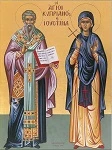
Hieromartyr & Virgin Martyr
Hieromartyr Cyprian and Virgin Martyr Justina
✓ Comprehensive Orthodox source review completed
The former pagan magician transformed by repentance and the consecrated virgin whose prayer and the sign of the Cross overcame every assault.
Core account checked against Orthodox Church in America — Hieromartyr Cyprian, Virgin Martyr Justina and Martyr Theoktistos, Orthodox Church in America — Troparion and Kontakion, Greek Orthodox Archdiocese Digital Chant Stand — October 2. Additional ecclesiastical references appear below.
Life and Witness
Justina's Conversion and Consecrated Life
The Holy Virgin Martyr Justina lived at Antioch. According to the received Orthodox Life, she heard the preaching of the deacon Praïlios, came to faith in Christ and led her parents, Aedesius and Cledonia, away from pagan worship. After Baptism she dedicated herself to Christ in prayer, fasting and virginity.
A young man named Aglaidas desired to marry her. When she refused, he sought the help of Cyprian, a celebrated pagan philosopher, priest and practitioner of magic. The narrative never treats Aglaidas's obsession or Cyprian's attempted coercion as love. Justina's freedom, bodily dignity and steadfast confession remain central.
Cyprian's Former Life and the Failure of Sorcery
The ecclesiastical account describes Cyprian as a native of Antioch who had been trained from childhood in pagan religion, philosophy and ritual magic. He used this knowledge destructively and attempted through demonic powers to turn Justina's will toward Aglaidas.
Justina resisted through prayer, fasting and the sign of the Cross. Every assault failed. The Life's theological claim is not that Christians should become fascinated with occult techniques, but that evil has no independent equality with God and that a person who clings to Christ cannot be reduced to an object of another's desire.
Repentance, Baptism and Episcopal Ministry
When Cyprian saw the powers he served recoil before the name and Cross of Christ, he renounced them. He made the sign of the Cross, escaped their violence and went in repentance to Bishop Anthimos. He burned his books of magic, confessed his sins and received Baptism.
The Synaxarion relates his rapid progress through the ministries of reader, subdeacon, deacon and priest, and finally his consecration as bishop. Justina entered the monastic life and became a superior. Their story is therefore about repentance and transformation, not about acquiring 'Christian magic' or using the saints as automatic protection formulas.
Common Martyrdom at Nicomedia
During the persecution under Emperor Diocletian, Cyprian and Justina were arrested and taken to Nicomedia. They endured torture without abandoning Christ. Justina was beheaded first, followed by Cyprian.
A soldier named Theoktistos, moved by their confession, declared himself a Christian and was beheaded with them. The Orthodox Church commemorates the Hieromartyr Cyprian, the Virgin Martyr Justina and the Martyr Theoktistos on October 2, traditionally dating their martyrdom to the year 304.
Relics, Intercession and Responsible Devotion
Orthodox ecclesiastical sources record portions of their relics at Iviron Monastery on Mount Athos, Meniko in Cyprus, the monastery dedicated to them at Phylē in Attica, Panachrantou Monastery on Andros and the Zlătari church in Bucharest. Because relics can be divided and translated, these claims do not imply that one location possesses an intact body.
The saints are widely invoked by people suffering fear, temptation or perceived demonic oppression. Orthodox prayer is directed to God, asking the saints' intercession; it is not a magical counter-spell. Serious mental or physical symptoms also require appropriate professional care, and devotion must never be used to exploit frightened people.
Identity and Source-Critical Summary
This Saint Cyprian is the hieromartyr associated with Antioch, Justina and Nicomedia. He must not be confused with Saint Cyprian of Carthage, the third-century North African bishop, theologian and martyr commemorated on another date. Combining the two produces a false biography.
The feast, names, conversion, monastic and episcopal service, and martyrdom form the received Orthodox tradition. The elaborate accounts of childhood initiations, journeys to centers of magic, demonic dialogues and exact ordination intervals belong to an extended hagiographical narrative rather than a surviving contemporary court record. This page preserves that distinction while presenting the Church's Life faithfully.
Biographical information on this page is based exclusively on the Orthodox ecclesiastical sources listed below.
Orthodox Church in America — Hieromartyr Cyprian, Virgin Martyr Justina and Martyr TheoktistosOrthodox Church in America — Troparion and KontakionGreek Orthodox Archdiocese Digital Chant Stand — October 2Romanian Patriarchate Basilica — Orthodox Calendar for October 2