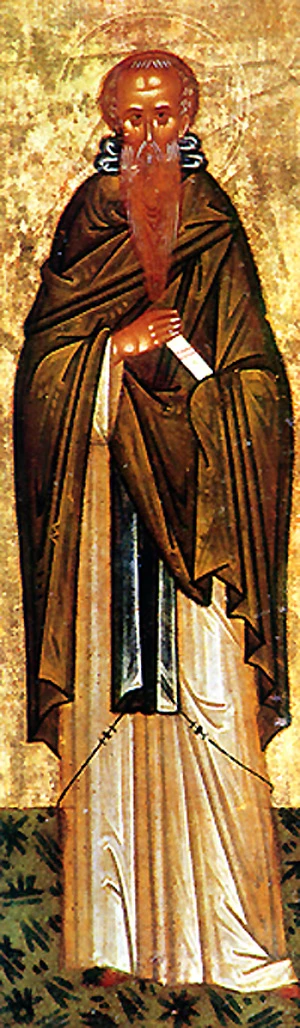
Confessor & Abbot
Venerable Chariton the Confessor
✓ Comprehensive Orthodox source review completed
The survivor of persecution and captivity who transformed a robbers' cave into one of Palestine's great monastic centers.
Core account checked against Orthodox Church in America — Venerable Chariton the Confessor, Orthodox Church in America — Troparion and Kontakion, Greek Orthodox Archdiocese — September 2026 Calendar. Additional ecclesiastical references appear below.
Life and Witness
Confessor from Iconium
Saint Chariton was born at Iconium in Lycaonia and confessed Christ during the persecution of Emperor Aurelian in the third century. The witness of Saint Thecla, also associated with Iconium, strengthened his devotion and courage.
He denounced idolatry, endured severe tortures and survived by God's providence. After Aurelian's death brought the persecution to an end, Chariton was released. Although he had not received death as a martyr, the Church honored him as a confessor who had suffered for the name of Christ.
The Robbers' Cave and the Poisoned Wine
On pilgrimage to Jerusalem, Chariton was seized by robbers, bound and left in their cave while they went out in search of more victims. Expecting death, he entrusted himself to God's will rather than demanding deliverance.
The Orthodox Life relates that a snake drank from the robbers' wine and left its venom in the vessel. The robbers returned, drank and died. Chariton gave thanks to God, then distributed their stolen wealth to the poor, churches and monasteries. The story is received as hagiographical testimony and must not be distorted into approval of revenge or violence.
Founder of the Pharan Lavra
Chariton remained at the place of his deliverance, transformed the cave into a place of prayer and built a church. Disciples gathered around him, and the community became the celebrated Pharan Lavra, one of the formative monasteries of the Judean desert.
He guided the brethren with paternal care and gave them a demanding rule of prayer, fasting, work and obedience. The movement from a robbers' hideout to a monastery is the spiritual center of the Life: a place marked by violence and stolen wealth became a school of repentance and holiness.
Jericho, Souka and the Love of Solitude
Because human praise disturbed his desire for stillness, Chariton repeatedly withdrew farther into the desert. Yet he did not refuse those who came seeking direction. He founded two further communities, one near Jericho and the Souka, later called the Old Lavra.
His withdrawal was therefore not isolation from the Church. Each attempt at solitude became a source of ordered communal life. The monasteries associated with him helped shape Palestinian monasticism and later sheltered generations of ascetics, including Saint Kyriakos commemorated on the following day.
Repose, Relics and Liturgical Memory
Near the end of his life, Chariton lived in a cave above the Souka while continuing to guide the three communities. He reposed peacefully at an advanced age, traditionally in the year 350, and was buried at Pharan according to his wish.
The Orthodox Church commemorates him on September 28. Tradition also associates him with a monastic rule and the office of tonsure. His relics were venerated at the church built on the site of the robbers' cave, joining the memory of his miraculous deliverance to his lifelong work of repentance.
Source-Critical Summary
The convergent Orthodox account includes Chariton's confession under Aurelian, survival and release, pilgrimage to Palestine, capture by robbers, miraculous deliverance, distribution of the stolen treasure, foundation of Pharan, Jericho and Souka, and peaceful repose around 350.
The serpent and poisoned wine, the precise form of his monastic rule and the attribution of the tonsure office belong to received ecclesiastical tradition. The available sources do not justify the video's wording as if the saint intentionally poisoned his captors; the Life says the serpent poisoned the wine while Chariton was bound and praying.
Biographical information on this page is based exclusively on the Orthodox ecclesiastical sources listed below.
Orthodox Church in America — Venerable Chariton the ConfessorOrthodox Church in America — Troparion and KontakionGreek Orthodox Archdiocese — September 2026 CalendarOrthodox Church in America — Lives for September 28