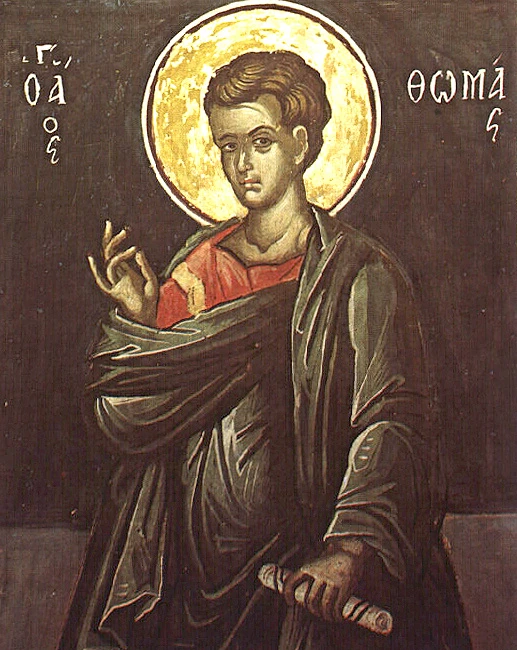
Apostle & Martyr
Holy and Glorious Apostle Thomas
The disciple who brought his uncertainty to the risen Christ, confessed Him as ‘My Lord and my God,’ and carried the Gospel to India.
Core account checked against Gospel according to Saint John — Thomas and the risen Christ, Orthodox Church in America — Holy, Glorious Apostle Thomas, Greek Orthodox Archdiocese of America — Feast of the Holy Apostle Thomas. Additional ecclesiastical references appear below.
Life and Witness
Called to Follow Christ
The Holy and Glorious Apostle Thomas, whose name is rendered Didymus or ‘Twin,’ was one of the Twelve chosen by the Lord Jesus Christ. The Gospel reveals not an indifferent skeptic but a devoted disciple capable of courageous loyalty. When Christ set out for Judea after the death of Lazarus, Thomas told the others, ‘Let us also go, that we may die with Him’ (John 11:16).
At the Mystical Supper, Thomas asked how the disciples could know the way. His honest question drew from the Lord one of the Gospel’s clearest revelations: ‘I am the way, the truth, and the life’ (John 14:6). The Church therefore remembers Thomas as a disciple whose questions were brought directly to Christ and answered by Him.
My Lord and My God
Thomas was absent when the risen Christ first appeared to the assembled disciples. Hearing their testimony, he said that he needed to see the marks of the nails and the wound in the Lord’s side. Eight days later, Christ came again although the doors were shut and invited Thomas to examine His wounds.
Confronted by the living Christ, Thomas answered with the highest confession recorded on the lips of a disciple in Saint John’s Gospel: ‘My Lord and my God!’ Christ did not reject him, but led him from uncertainty to faith and blessed those who would believe without seeing. Orthodox worship calls this not the triumph of doubt, but the ‘good unbelief’ through which the reality of the Resurrection was confirmed for the Church.
The Apostle of India
According to the ancient ecclesiastical tradition received by the Orthodox Church, Thomas carried the Gospel eastward through Parthia and Persia and as far as India. Christians of India have preserved a living memory of his apostolic preaching from the earliest centuries and continue to honor him as their father in the faith.
The Acts of Thomas contains later narrative material and cannot be read as a modern biography, yet it witnesses to the very early and widespread association of the Apostle with India. The stable core of Church tradition is that Thomas preached Christ there, founded Christian communities and sealed his ministry with martyrdom.
Martyrdom and Holy Relics
The received Life relates that Thomas converted many to Christ, including members of a royal household, and was arrested after his preaching provoked opposition. He was pierced with spears and gave his life for the Lord whom he had confessed as God.
Tradition places his martyrdom at Mylapore, near modern Chennai. His relics were later translated to Edessa, while ancient Christian communities and shrines in India continued to preserve his memory. These locations belong to a long ecclesiastical tradition; precise details of his journeys and chronology vary among the surviving accounts.
Feast and Source-Critical Summary
The Orthodox Church commemorates the Holy and Glorious Apostle Thomas on October 6 and honors him with all the Twelve Apostles on June 30. The Sunday after Pascha is also called Thomas Sunday because its Gospel recounts his encounter with the risen Lord.
The New Testament securely attests Thomas as one of the Twelve, his words before the raising of Lazarus, his question at the Mystical Supper and his confession before the risen Christ. His mission to India and martyrdom there belong to ancient and enduring Church tradition. Later accounts supply additional names, speeches and court episodes that should be understood within the hagiographical tradition rather than treated as independently verified civil history.
Biographical information on this page is based exclusively on the Orthodox ecclesiastical sources listed below.
Gospel according to Saint John — Thomas and the risen ChristOrthodox Church in America — Holy, Glorious Apostle ThomasGreek Orthodox Archdiocese of America — Feast of the Holy Apostle ThomasGreek Orthodox Archdiocese Digital Chant Stand — October 6