Bishop & Martyr
Hieromartyr Anthimus
✓ Comprehensive Orthodox source review completed
Bishop of Nicomedia who shepherded the faithful through persecution and sealed his witness with martyrdom.
Core account checked against Orthodox Church in America — Hieromartyr Anthimus, Bishop of Nicomedia, and those with him, VEMA / Saint Andrew's Orthodox Press — Hieromartyr Anthimus, Bishop of Nicomedia, The Prologue from Ohrid — The Hieromartyr Anthimus. Additional ecclesiastical references appear below.
Life and Witness
A Shepherd in the Imperial City
Saint Anthimus was born and raised as a Christian in Nicomedia, the great city of Bithynia that served as an imperial residence. The Orthodox tradition remembers him as a man of disciplined body, humble spirit, peace toward all and fervent zeal for the glory of God. These virtues prepared him for the episcopate, and he was entrusted with the Church of Nicomedia during one of the most violent persecutions of the ancient Christian world.
Under the emperors Diocletian and Maximian, Christians were ordered to sacrifice to the pagan gods and surrender the Scriptures. The persecution became especially fierce after a fire in the imperial palace at Nicomedia was blamed upon the Christians. The Church’s synaxarial account remembers mass executions by the sword, fire, burial alive and drowning. Anthimus therefore shepherded a community in which confession of Christ could lead immediately to imprisonment and death.
The Martyrs of Nicomedia
The commemoration of Saint Anthimus is inseparable from the multitude who suffered in Nicomedia. Orthodox sources remember twenty thousand Christians burned inside a church on the feast of the Nativity of Christ. Saints Dorotheus, Mardonius, Migdonius, Peter, Indes, Gorgonius, Zeno, Domna and Euthymius are also named among those who completed their witness during this persecution.
The number and the individual accounts belong to the Church’s received martyrological tradition. They show the pastoral burden carried by Anthimus: he was not seeking safety for himself while abandoning others, but strengthening a flock surrounded by arrest, torture and death.
Letters from the Village of Semana
At the request of the faithful, the bishop withdrew to the nearby village of Semana. The Prologue explains that he did so not from cowardice, but so that he could continue guiding those who remained. From this place he sent letters to imprisoned Christians, urging them to cling firmly to the holy Faith and not to deny Christ through fear of suffering.
One letter was carried by the deacon Theophilus. Imperial officials intercepted it and brought it to Maximian. The deacon was interrogated and tortured, yet refused to disclose the bishop’s location. Theophilus died without betraying his shepherd, joining the same witness of fidelity that Anthimus had proclaimed in his letters.
The Soldiers Who Came to Arrest Him
When the authorities finally learned where Anthimus was staying, soldiers were sent to seize him. The bishop met them before they recognized him, received them hospitably and served them food. Only after caring for them as guests did he reveal that he himself was the man they sought.
The soldiers were astonished by his kindness. They offered to let him escape and to tell the emperor that they had failed to find him. Anthimus would not preserve his life by asking them to lie. He chose to accompany them willingly, placing truthfulness and obedience to his confession above his own safety.
On the journey, the bishop instructed the soldiers in Christ, and they came to believe. The Orthodox account says that he baptized them and then told them to fulfill the order they had received. Their conversion is one of the central wonders of his life: men sent as captors were transformed into disciples through hospitality, truth and pastoral teaching.
Confession before Maximian
Brought before the emperor, Anthimus saw the instruments prepared for his torture. The ecclesiastical account preserves his fearless answer: such things could not terrify one who desired to die for Christ; execution is fearful only to the person for whom this passing life is the greatest good.
The emperor ordered the bishop to be cruelly tortured. Anthimus did not renounce the Savior whom he had preached to his flock and to his captors. He was finally beheaded by the sword, traditionally dated to the opening years of the fourth century, commonly around 303 or 304. He glorified God to his last breath and received the martyr’s crown.
Pastoral Ministry and Signs of Grace
The principal miracle emphasized by the Orthodox sources is spiritual conversion: the soldiers who came to arrest Anthimus accepted the faith and Holy Baptism. His welcome of enemies, refusal of falsehood and voluntary surrender reveal the Gospel not as an abstract teaching but as a life capable of changing those who encountered it.
The September 3 synaxarion also connects Anthimus with the young Martyr Basilissa of Nicomedia. After she survived severe tortures by the grace of God, the governor Alexander came to faith; the account says that Bishop Anthimus later baptized him. This testimony presents the bishop continuing his sacramental ministry even amid persecution.
The consulted ecclesiastical sources do not provide a securely documented modern catalogue of posthumous miracles specifically attributed to Anthimus. For that reason, this article does not add later healing stories or spectacular details that cannot be traced to the cited Orthodox texts.
Relics, Churches and Veneration
Nicomedia is the modern city of İzmit in Turkey. Its ancient Christian community suffered repeated persecution, earthquakes and later historical upheaval. The Orthodox sources used for this life do not identify a universally recognized intact tomb or a principal international shrine currently preserving the complete relics of Saint Anthimus.
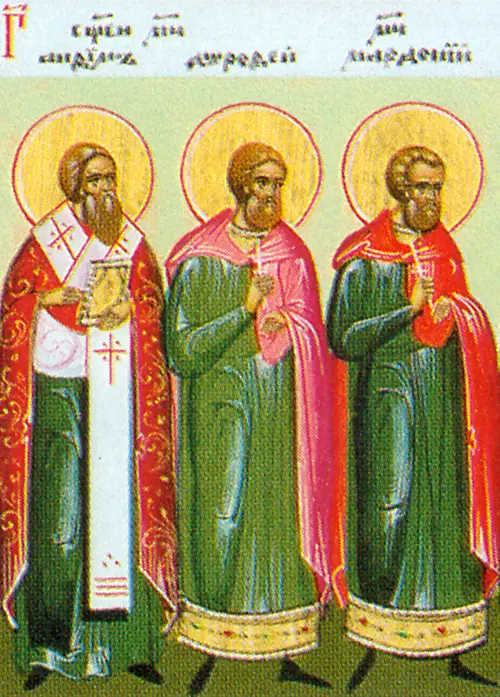
His worldwide veneration is nevertheless preserved in the calendar, services, synaxaria and holy icons of the Orthodox Church. He is depicted as an elderly bishop vested for the Divine Liturgy, often holding the Gospel and raising his hand in blessing; the cross of martyrdom may also accompany his image. Churches and chapels dedicated to him bear witness to local devotion, but no unverified list of buildings is presented here as historical fact.
The Spiritual Meaning of His Life
Saint Anthimus shows that episcopal courage is pastoral rather than theatrical. He remained apart when his flock needed continuing guidance, and he surrendered when truth required it. He strengthened prisoners by letter, honored the sacrifice of his deacon, fed the men who came to bind him and led them to Baptism.
His refusal to permit a convenient lie is particularly striking. The saint did not seek martyrdom recklessly, but neither would he make falsehood the price of survival. In Orthodox memory, his final victory began at the table where he treated his captors as neighbors and was completed before the emperor when he confessed Christ without fear.
Feast Day
September 3 — Hieromartyr Anthimus, Bishop of Nicomedia, and those who suffered with him.
From the Orthodox Synaxarion
The Prologue from Ohrid also preserves the memory of Saint Anthimus as a shepherd who strengthened the Christians of Nicomedia during persecution. His voluntary surrender and refusal to save himself through falsehood reveal the pastoral integrity with which he approached martyrdom.
Historical Record and Ecclesiastical Tradition
The persecution at Nicomedia and Anthimus's episcopal martyrdom belong to the early-fourth-century ecclesiastical setting. His hospitality to the soldiers and their conversion are received hagiographical testimony. The often-repeated figure of twenty thousand martyrs is reported as Church tradition, not a modern demographic calculation.
Biographical information on this page is based exclusively on the Orthodox ecclesiastical sources listed below.
Orthodox Church in America — Hieromartyr Anthimus, Bishop of Nicomedia, and those with himVEMA / Saint Andrew's Orthodox Press — Hieromartyr Anthimus, Bishop of NicomediaThe Prologue from Ohrid — The Hieromartyr AnthimusThe Prologue from Ohrid — September 3