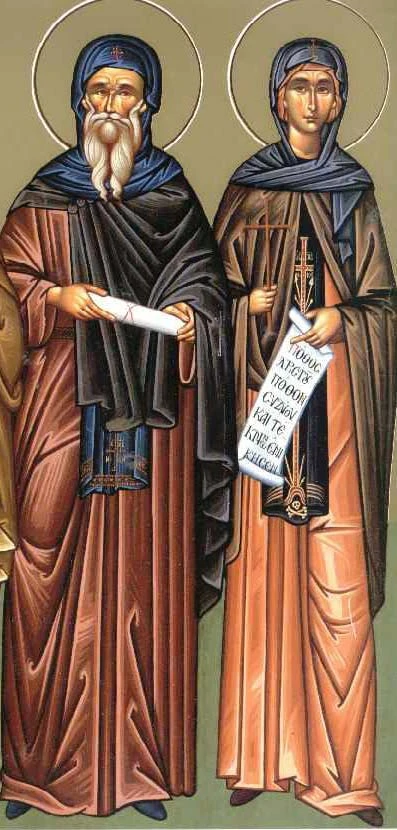
Married Saints & Egyptian Ascetics
Venerable Andronicus and Athanasia of Egypt
A husband and wife whose journey through bereavement, monastic life and hidden companionship ended in an extraordinary revelation.
Core account checked against Orthodox Church in America — Venerable Andronicus and his wife Athanasia of Egypt, Orthodox Synaxarion — Saints Andronicus and Athanasia; relics and liturgical texts, Greek Orthodox Archdiocese of America — Andronicus and his wife Athanasia of Egypt. Additional ecclesiastical references appear below.
Life and Witness
A Christian Household in Antioch
Saints Andronicus and Athanasia were a married couple from Antioch in Syria, remembered for their devotion to God and their generosity. They had a son and a daughter. Before withdrawing into monastic life, they served Christ within the responsibilities of their household and through care for the poor.
The Orthodox Church in America describes Andronicus as a craftsman who divided his income between the Church, the needy and his family. The Greek Synaxarion calls him a money-changer. Both accounts emphasize that prosperity was joined to charity rather than kept for personal comfort.
Bereavement and the Search for Consolation
The death of both children brought profound grief to their home. The received Life does not preserve the circumstances of the deaths. The parents sought consolation in God and dedicated themselves more fully to prayer and service.
Their decision to embrace the monastic life arose through shared consent. The Greek account also remembers a pilgrimage to the Holy Land before their journey to Egypt. Their story preserves both the pain of loss and the possibility of continuing to love and serve after bereavement.
Separate Monastic Communities in Egypt
Andronicus entered an Egyptian monastic community; the Greek Synaxarion connects it with Abba Daniel. Athanasia entered the women’s community of the Tabennisiotes. The two spouses began a new life in separate monasteries, each accepting prayer, fasting, work and obedience.
Twelve years passed in ascetic life before the pilgrimage described in the longer account. The discipline of those years changed their appearance. Their former relationship remained hidden when they later encountered one another as pilgrims.
The Pilgrimage to Jerusalem
According to the fuller Life preserved by the Orthodox Church in America, Andronicus set out for Jerusalem to venerate the holy places. On the road he encountered another ascetic who was traveling in the same direction. This pilgrim was Athanasia, dressed in men’s clothing because of the difficulties of the journey.
The account says that they did not recognize one another after their long ascetic separation. They continued together as fellow pilgrims. The woman who had shared Andronicus’s earlier life now accompanied him without her identity being known.
Years of Ascetic Silence
After returning from Jerusalem, the received account describes them living together in an ascetic cell for many years. Their companionship was shaped by prayer, fasting, labor and silence. Andronicus remained unaware that his fellow ascetic was his wife.
The life remembered by the Church joins their earlier charity to their later renunciation. Their service of God continued in a different form: the shared responsibilities of a household gave way to the discipline of ascetic companionship.
Athanasia’s Note and Their Repose
Athanasia left a written note to be opened after her death. It disclosed her identity and revealed that the ascetic beside Andronicus had been the woman who had once shared his home and his grief. Saint Andronicus reposed soon afterward.
The Greek Synaxarion gives a shorter account in which the couple entered separate monasteries and completed their lives peacefully. The longer narrative of the pilgrimage, their shared cell and Athanasia’s note is attributed here to the OCA Life. The accounts also differ in chronology: the OCA places them in the fifth century, while the Greek entry associates them with approximately 540.
Relics, Veneration and the Feast
The Orthodox Church commemorates Saints Andronicus and Athanasia on October 9. The Greek Synaxarion records portions of the relics of both saints at the Holy Monastery of Kykkos in Cyprus. It also preserves liturgical hymns honoring their ascetic life and silence.
The hymns praise Andronicus as a wonderworker through prayer, fasting and vigil. The consulted biographical accounts do not supply a detailed catalogue of individual healing events, so no separate miracle narratives are added here. Their remembrance rests in the Church’s worship, their received Life and the veneration of their holy relics.
Biographical information on this page is based exclusively on the Orthodox ecclesiastical sources listed below.
Orthodox Church in America — Venerable Andronicus and his wife Athanasia of EgyptOrthodox Synaxarion — Saints Andronicus and Athanasia; relics and liturgical textsGreek Orthodox Archdiocese of America — Andronicus and his wife Athanasia of Egypt